
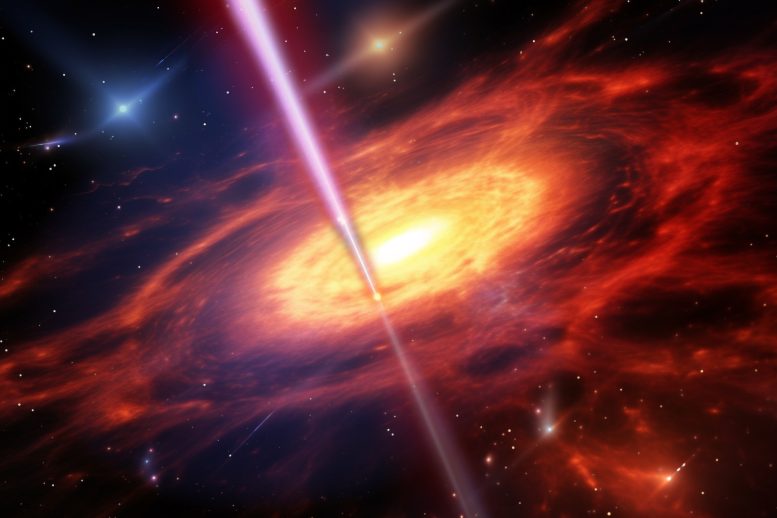
A long gamma-ray burst near the center of an ancient galaxy suggests neutron star mergers can occur independently of lifelong binary systems.
For the first time, an international team of astronomers has observed a long gamma-ray burst near the center of an ancient galaxy. This is special because these kinds of gamma-ray bursts typically occur when massive stars collapse or when neutron stars circle each other for a long time, and there are no such stars at the center of ancient galaxies. The team, led by Andrew Levan (Radboud University), published their findings in Nature Astronomy.
The general consensus used to be that long gamma-ray bursts of at least a few seconds can only occur when a very heavy star collapses into a supernova at the end of its life. In 2022, a second potential trigger of long gamma-ray bursts was uncovered when two large stars, which had been orbiting each other all their lives, turned into neutron stars at the end and collided into a kilonova. Now in 2023, it seems that long gamma-ray bursts can occur in a third way.
“Our data indicate that this is a case of two separate neutron stars merging. So not neutron stars that have been together all their lives,” says lead researcher Andrew Levan (Radboud University). “We suspect that the neutron stars were pushed together by the gravity of the many surrounding stars at the center of the galaxy.”
The team of researchers studied the aftermath of a gamma-ray burst observed by the Neil Gehrels Swift Observatory on October 19, 2019. They did so using the Gemini South telescope in Chile, the Nordic Optical Telescope on the Canary Island of La Palma, and the Hubble Space Telescope.
Key Evidence for Neutron Star Mergers
Their observations show that the burst was caused near the center of an ancient galaxy. This immediately provides two arguments pointing to the merging of two sources.
The first argument is that there are almost no heavy stars in ancient galaxies that could collapse into supernovae, because heavy stars typically occur in young galaxies. In addition, supernovae emit bright optical light, which was not observed in this case.
A second argument is that the center of galaxies are busy places. There are hundreds of thousands of normal stars, white dwarfs, neutron stars, black holes, and dust clouds all orbiting a supermassive black hole. Altogether, this represents over 10 million stars and objects crammed into a space of a few light-years across. “That is an area comparable to the distance between our sun and the next star,” Levan explains. “So the probability of a collision in the center of a galaxy is much higher than, say, at the outskirts, where we are.”
The researchers are still leaving room for alternative explanations. The prolonged gamma-ray burst could also result from the collision of compact objects other than neutron stars, for example, black holes or white dwarfs. In the future, the researchers hope to be able to observe long gamma-ray bursts at the same time as gravitational waves. This would help them to make more definitive statements about the origin of the radiation.
For more on this discovery:
Reference: “A long-duration gamma-ray burst of dynamical origin from the nucleus of an ancient galaxy” by Andrew J. Levan, Daniele B. Malesani, Benjamin P. Gompertz, Anya E. Nugent, Matt Nicholl, Samantha R. Oates, Daniel A. Perley, Jillian Rastinejad, Brian D. Metzger, Steve Schulze, Elizabeth R. Stanway, Anne Inkenhaag, Tayyaba Zafar, J. Feliciano Agüí Fernández, Ashley A. Chrimes, Kornpob Bhirombhakdi, Antonio de Ugarte Postigo, Wen-fai Fong, Andrew S. Fruchter, Giacomo Fragione, Johan P. U. Fynbo, Nicola Gaspari, Kasper E. Heintz, Jens Hjorth, Pall Jakobsson, Peter G. Jonker, Gavin P. Lamb, Ilya Mandel, Soheb Mandhai, Maria E. Ravasio, Jesper Sollerman and Nial R. Tanvir, 22 June 2023, Nature Astronomy.
DOI: 10.1038/s41550-023-01998-8
Never miss a breakthrough: Join the SciTechDaily newsletter.
Follow us on Google and Google News.