
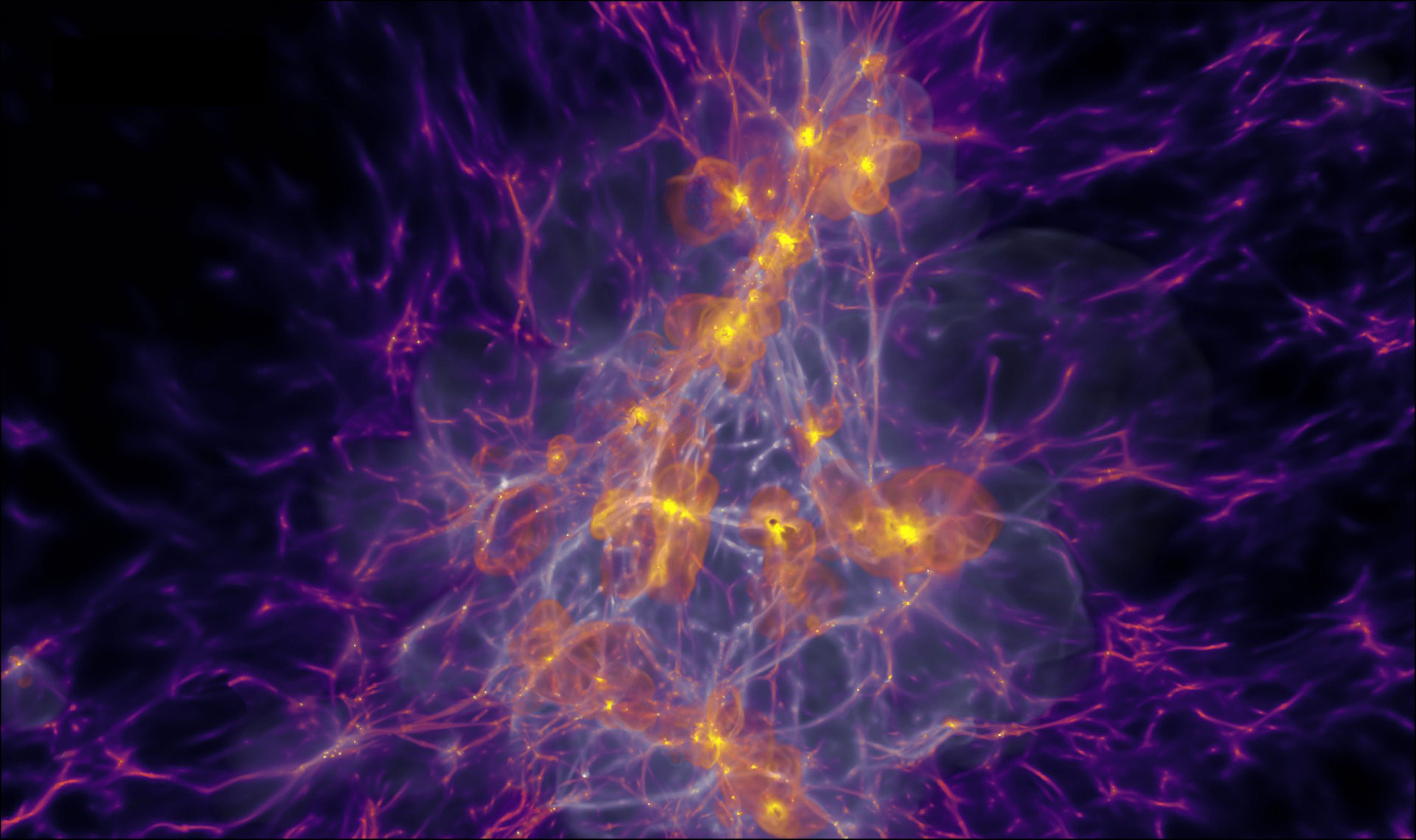
A new generation of simulations is uncovering how starlight, gas, and chemistry interacted in the infant Universe.
The first stars transformed a Universe made mostly of hydrogen and helium. Their light altered surrounding gas, while their explosions scattered newly forged elements that later became part of stars, planets, and eventually life.
Researchers are now recreating that transition with some of the most detailed simulations of the early Universe yet produced. The MEGATRON project links galaxies observed by the James Webb Space Telescope (JWST) with chemical signatures preserved in ancient stars in and around the Milky Way.
Connecting Two Views of the Early Universe
JWST can observe galaxies from the Universe’s youth, while ancient nearby stars preserve chemical traces of earlier generations. Together, these records can help astronomers reconstruct how the first stars formed and spread new elements through space.
The MEGATRON studies suggest that accurately modeling the interaction between starlight, gas, and chemical enrichment is crucial. Simpler simulations may underestimate how strongly stellar radiation and chemistry reshape the gas around young galaxies.
Dr Martin Rey from the University of Bath said: “The James Webb Space Telescope gives us a direct glimpse of the infant cosmos, while stellar archaeology allows us to study the relics of those earliest times in our own Galactic neighborhood. MEGATRON provides a physical bridge between the two.”
Recreating the First Stars
The simulations begin with pristine gas containing no heavy elements, similar to conditions shortly after the Big Bang. They then follow the birth of the first stars, the radiation they emit, their supernova explosions, and the spread of newly created elements into later generations of stars and galaxies.
“The elements that make our world and life possible – carbon, oxygen, iron and many others – were forged by stars. To understand where those elements came from, we need to understand how the first stars formed and enriched their surroundings. MEGATRON allows us to test these ideas directly by comparing detailed simulations with observations from JWST and the chemical fingerprints preserved in ancient stars,” Dr Rey said.
Following a Galaxy Through Cosmic Time
The simulations track a young galaxy that is expected to grow to roughly the mass of the Milky Way. They model gas motion, starlight, and changing chemical composition over billions of years.
Their high resolution reveals gas structures that simpler models can miss, which could affect predictions of how radiation and enriched material behave around early galaxies.
Four MEGATRON studies were published in the Open Journal of Astrophysics.
More Powerful Simulations Ahead
The team plans to compare future simulations more directly with JWST observations and surveys of ancient stars. Researchers at Bath have received 40 million processor hours on the UK’s national supercomputers to run models at higher resolution with more complete physics.
“MEGATRON provides a common physical framework for interpreting two of astronomy’s most exciting new datasets: JWST’s view of the earliest galaxies and the stellar fossil record,” said Dr Rey. “Together, these complementary observations allow us to test competing models of the first stars in ways that weren’t previously possible.”
Reference: “MEGATRON: how the first stars can create an iron metallicity plateau in the smallest dwarf galaxies” by Martin Rey, Harley Katz, Corentin Cadiou, Mahsa Sanati, Oscar Agertz, Jeremy Blaizot, Alex J. Cameron, Nicholas Choustikov, Julien Devriendt, Uliana Hauk, Alexander P. Ji, Gareth C. Jones, Taysun Kimm, Isaac Laseter, Sergio Martin-Alvarez, Kosei Matsumoto, Autumn Pearce, Yves Revaz, Francisco Rodriguez Montero, Joki Rosdahl, Aayush Saxena, Adrianne Slyz, Richard Stiskalek, Anatole Storck, Oscar Veenema and Wonjae Yee, 30 September 2026, The Open Journal of Astrophysics.
DOI: 10.33232/001c.169605
Never miss a breakthrough: Join the SciTechDaily newsletter.
Follow us on Google and Google News.