
UCSB
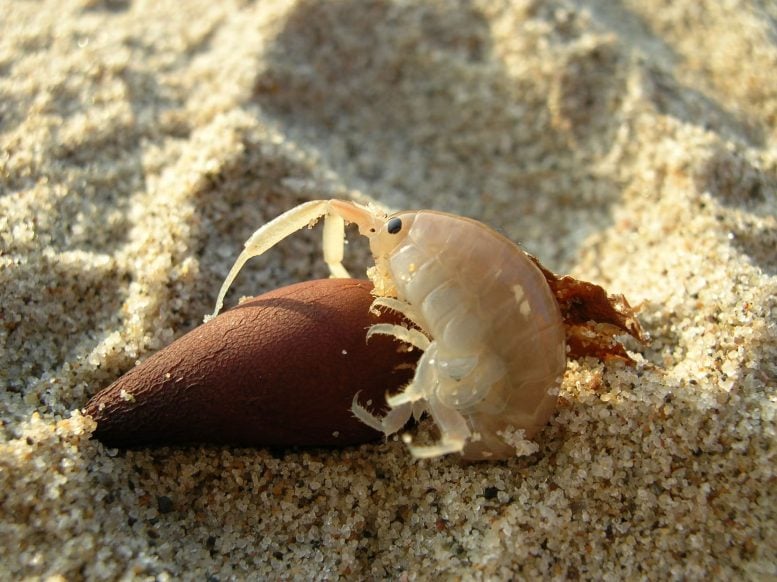
A California beach can be reshaped overnight by creatures barely the size of a fingernail, with sand hoppers digging up to 110 pounds of sand per meter of shoreline each day.
Researchers at UC Santa Barbara found that sand hoppers, tiny crustaceans that eat washed-up kelp, excavate extraordinary quantities of beach sand. Their study, published in the Journal of Geophysical Research: Earth Surface, reveals how these animals contribute to the physical processes shaping California’s coast.
The shrimp-like amphipods (Megalorchestia spp.) moved up to 50 kg (110 lbs) of sand per meter (3.3 feet) of shoreline per day. When the researchers extended their estimates across a longer stretch of coast, the quantities rivaled sediment loads carried by some major Southern California rivers and sand moved by coastal currents.
“They have one of the highest rates of bioturbation of anything on the planet,” said UCSB marine scientist David Hubbard. Bioturbation describes how living organisms move and mix sediment.
The Hidden Work Beneath the Beach
A beach is a temporary resting place for sand on a much longer journey. Waves, currents, and wind continually redistribute sediment, connecting the shoreline to rivers, coastal bluffs, dunes, and nearby waters.
These connected sources and pathways form a system called a “littoral cell.” Rivers and streams deliver sediment from coastal watersheds; cliffs and dunes supply additional material, and onshore processes move sand from shallow coastal waters onto the beach.
Scientists have studied these physical forces extensively. The influence of animals living within the shifting sand has received less attention, despite their potential to alter how sediment moves.
That overlooked contribution drew the interest of physical geographer Tim Baxter. After moving from the United Kingdom to UCSB for postdoctoral work with geography professor Ian Walker, he teamed up with Hubbard and marine scientists Kyle Emery and Jenny Dugan to investigate sand hoppers.
Fresh Burrows Every Day
Sand hoppers shelter beneath stranded seaweed or burrow 10 to 30 cm (4-12 inches) into the beach. They emerge after dark to feed on kelp wrack, the seaweed left behind by the tide.
“We combined our interests and started thinking about the abundance of sand hoppers around UCSB but also across California,” said Baxter, now a research fellow at the University of Oxford. “That got us asking, how much are they digging? What are they contributing to the sediment system and sediment transport on these beaches?”
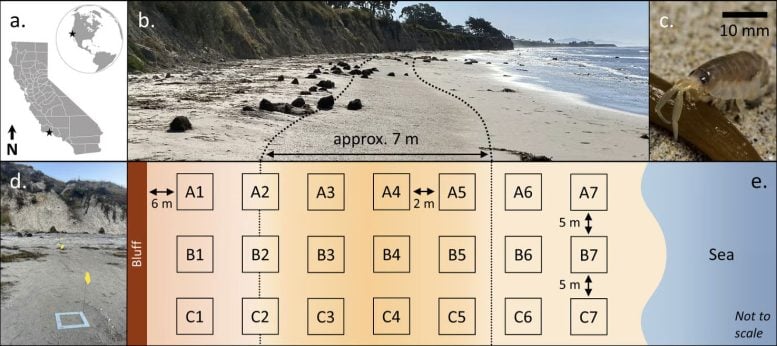
Their digging follows a narrow window of suitable moisture. Sand that is too wet cannot support a burrow, while the dry sand higher on the beach is also unsuitable.
“They don’t like saturated sand that’s like liquid—their burrows collapse immediately,” Hubbard explained. “They don’t like the powdery dry sand above the high tide line. They like the Goldilocks sweet spot in between where the burrow will stay intact because the moisture in the sand is just right.”
An Overnight Experiment Reveals the Scale
Unlike animals that maintain and reuse one burrow, sand hoppers excavate fresh shelters daily as they seek the right moisture conditions. This repeatedly turns over sand recently rearranged by waves or wind.
To measure that activity, the team set up an experiment at Isla Vista Beach, below the coastal bluffs beside UCSB. On a summer night, they waited until high tide had smoothed the sand and the water began to recede, then marked sampling plots with metal frames in the animals’ preferred burrowing zone.
The researchers returned the next morning to collect and weigh the excavated sand. Some plots were already difficult to find.
“When we came back in the morning, we couldn’t even see some of the frames,” Hubbard recalled. “They were completely buried, and we were so glad we had put flags next to them just in case.”
Tiny Animals Move Remarkable Amounts Of Sand
Even after years of studying sand hoppers, Hubbard was struck by what they had accomplished overnight. The measurements placed these roughly centimeter-long (0.4-inch-long) crustaceans among the most active sediment movers in the animal world.
“It was quite impressive, and we weren’t really expecting that,” Baxter said. “I think for me that was the biggest shock.”
Extrapolating the results across 25 kilometers (15.5 miles) of Southern California coastline produced estimates comparable to the daily sediment loads of some major regional rivers. The quantities also rivaled those moved by longshore drift along the intertidal beach.
Burrowing Feeds Life Below The Surface
Sand hoppers already play an essential role in coastal food webs. They consume stranded kelp and, in turn, become prey for shorebirds and fish. Their burrowing extends that influence into deeper layers of the beach.
“There’s a huge churn,” Hubbard explained. “If food like kelp or carrion gets deposited on the beach, it’s going to get buried by them, which makes it available to a different group of organisms.”
Their tunnels also allow oxygen into the sand, supporting microbial processes that require it. Excavation, therefore, changes both the distribution of food and the conditions in which buried organisms live.
The loosened sand can also be picked up more readily by wind or water, Baxter said. “It potentially increases the roughness of the surface of beaches, which has implications for the formation of landforms such as coastal sand dunes.”
A Small Creature With A Larger Coastal Role
That possible connection to dune formation matters because coastal dunes are increasingly used as a nature-based defense against flooding and sea level rise. These landforms can build and repair themselves while absorbing the force of waves and storms.
“I think part of that is the influence of animals on these processes is seen as quite temporary, quite localized, and small,” Baxter said. “What we are trying to show in this study is that actually these activities and interactions are operating on a lot larger scale and that their impacts are really worth highlighting.”
Reference: “Mega Mounders: Burrowing Talitrids (Megalorchestia spp.) Excavate Large Quantities of Sand on California Beaches” by T. I. Baxter, D. M. Hubbard, K. A. Emery, J. D. Dugan, W. Adams, S. Alvarez and I. J. Walker, 16 September 2026, Journal of Geophysical Research: Earth Surface.
DOI: 10.1029/2026JF009312
The work was supported by the National Science Foundation, the UC Office of the President Climate Action Fund, and the California Ocean Protection Council.
Never miss a breakthrough: Join the SciTechDaily newsletter.
Follow us on Google and Google News.