
Close Menu
    Facebook X (Twitter) Instagram
    SciTechDaily
    • Biology
    • Chemistry
    • Earth
    • Health
    • Physics
    • Science
    • Space
    • Technology
    Facebook X (Twitter) Pinterest YouTube RSS
    SciTechDaily
    Home»Biology»The Last Mass Extinction Event Occurred 66 Million Years Ago – Here’s How Ocean Ecosystems Recovered
    Biology

    The Last Mass Extinction Event Occurred 66 Million Years Ago – Here’s How Ocean Ecosystems Recovered

    By University of BristolOctober 20, 20191 Comment3 Mins Read
    Facebook Twitter Pinterest Telegram LinkedIn WhatsApp Email Reddit
    Share
    Facebook Twitter LinkedIn Pinterest Telegram Email Reddit
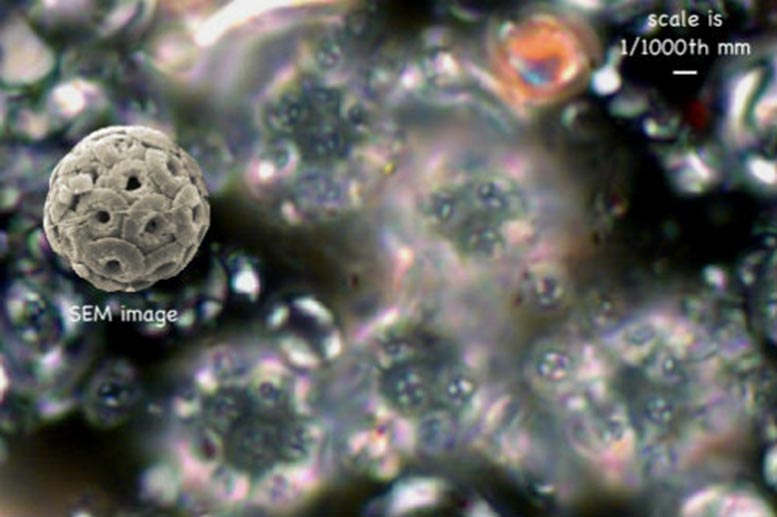
    Plankton Community in the Mass Extinction Recovery Phase
    A light microscope image of a plankton community in the mass extinction recovery phase, dominated by small cells of one species. Superimposed on this, is a high-resolution scanning electron microscope (SEM) image of the same species. These cells are around seven microns in diameter (7/1000ths of a millimeter). Credit: P. Bown

    An international team of scientists, led by the University of Bristol, have produced an unprecedented record of the biotic recovery of ocean ecosystems that followed after the last mass extinction, 66 million years ago.

    In an article published in the journal Nature, the team, which includes researchers from Southampton, University College London, Frankfurt, and California, present a 13 million-year record of fossil plankton dynamics in the aftermath of near annihilation, providing a remarkable glimpse into how the marine ecosystem ‘reboots’.

    The Cretaceous/Paleogene (K/Pg) mass extinction occurred when an asteroid impact caused global environmental devastation and is well known for the extinction of dinosaurs, ammonites, and many other groups.

    However, in addition to the loss of these larger animals, there were equally devastating extinctions in the ocean plankton, which eliminated food production at the base of the marine ecosystem and crippled important ocean functions, such as carbon delivery to the deep sea, which is a critical control on atmospheric carbon dioxide.

    Lead author, Sarah Alvarez, who carried out the research at Bristol’s School of Geographical Sciences and is now based at the University of Gibraltar, said: “We wanted to find out how long the ocean ecosystems took to recover and how this happened.

    “We looked at the best fossil record of ocean plankton we could find – calcareous nannofossils (they are still around today) – and collected 13 million years of information from a sample every 13,000 years.

    “We measured abundance, diversity, and cell size from over 700,000 fossils, probably the largest fossil dataset ever produced from one site.”

    The team found that these plant-like (photosynthetic) plankton bounced back almost immediately after the mass extinction but that the early communities were highly unstable and cell sizes were unusually small.

    Major ecosystem disruption persisted for two million years after the mass extinction, but the gradual appearance of new species and larger cells helped re-establish a stable and resilient ecosystem.

    At the same time, carbon delivery to the sea floor returned to pre-extinction levels, marking the restoration of this critical ocean function. This occurred long before species and ecological diversity fully recovered, as key forms filled essential functional roles. It took eight million more years for species numbers to fully recover to previous levels.

    The marine ecosystem is dependent on the plankton at its base, just as much today as in the past.

    This study, say the authors, highlights the risks posed by diversity loss which may result in highly unstable communities, loss of important ecosystem functions, and long timescales of recovery.

    Co-author, Dr. Samantha Gibbs, from the University of Southampton, added: “Losing species today runs the risk of eliminating key players in the ecosystems.

    “What we’ve demonstrated from the fossil record is that function is achieved if you have the right players fulfilling key roles.

    “Today, by reducing biodiversity, we are running the risk of losing our critical ecosystem players, many of whose importance we don’t yet fully appreciate.”

    Reference: ‘Diversity decoupled from ecosystem function and resilience during mass extinction recovery’ by Sarah A. Alvarez, Samantha J. Gibbs, Paul R. Bown, Hojung Kim, Rosie M. Sheward and Andy Ridgwell, 25 September 2019, Nature.
    DOI: 10.1038/s41586-019-1590-8

    Never miss a breakthrough: Join the SciTechDaily newsletter.
    Follow us on Google and Google News.

    Ecosystems Evolution Marine Biology Plankton University of Bristol
    Share. Facebook Twitter Pinterest LinkedIn Email Reddit

    Related Articles

    Baltic Herring Turn Predators: A Stunning Evolutionary Shift

    Ocean Ecosystem Collapse? Alarming Study Reveals Plankton Can’t Keep Up With Global Warming

    New Research Unravels the Evolutionary Secrets of Ancient Seas’ Forgotten Rulers

    Skull Bones Restricted the Evolution of Earth’s Earliest Land Animals

    Large Bodies Helped Ancient Sea Monsters With Extremely Long Necks Swim

    Corals Emit Chemical Alarm to Summon Friendly Fish When Attacked

    First Direct Observation of an Under-Ice Algal Bloom in the Arctic

    Relationships of Male Dolphins from Shark Bay Determined by Slow Swimming

    Marine Bacteria Use Bioluminescence to Lure Zooplankton and Fish

    1 Comment

    1. Hmmmm …. on November 19, 2024 8:20 pm

      Interesting, but this does not explain how seaturtles, crocodiles, and sharks survived.

      Reply
    Leave A Reply Cancel Reply

    • Facebook
    • Twitter
    • Pinterest
    • YouTube

    Don't Miss a Discovery

    Subscribe for the Latest in Science & Tech!

    Trending News

    Scientists Say This Hellish “Day-Night” Planet May Support Life

    Historians Got It Wrong: New Findings Rewrite the Story of the Battle of Hastings

    Scientists Just Broke the Solar Power Limit Everyone Thought Was Absolute

    Scientists Discover Protein That Turns Brown Fat Into a Calorie-Burning Machine

    Scientists Call for a Complete Rethink of Alzheimer’s Treatment

    Scientists Identify Molecular Switch That Lets Exercise Reverse Muscle Aging

    Why Your Most Vivid Dreams Might Be the Key to Deep, Restful Sleep

    A Bright Star Hid a Massive Secret for 50 Years: Mystery of Gamma Cassiopeiae Finally Solved

    Follow SciTechDaily
    • Facebook
    • Twitter
    • YouTube
    • Pinterest
    • Newsletter
    • RSS
    SciTech News
    • Biology News
    • Chemistry News
    • Earth News
    • Health News
    • Physics News
    • Science News
    • Space News
    • Technology News
    Recent Posts
    • New Carbon Nanotube Coating Could Supercharge 6G Technology
    • Scientists Smash Superconductivity Record at Normal Pressure
    • 100x Less Power: The Breakthrough That Could Solve AI’s Massive Energy Crisis
    • Simple Brain Training Cuts Dementia Risk Decades Later, Study Finds
    • A Simple Injection Could Help the Heart Heal Itself After a Heart Attack
    Copyright © 1998 - 2026 SciTechDaily. All Rights Reserved.
    • Science News
    • About
    • Contact
    • Editorial Board
    • Privacy Policy
    • Terms of Use

    Type above and press Enter to search. Press Esc to cancel.