
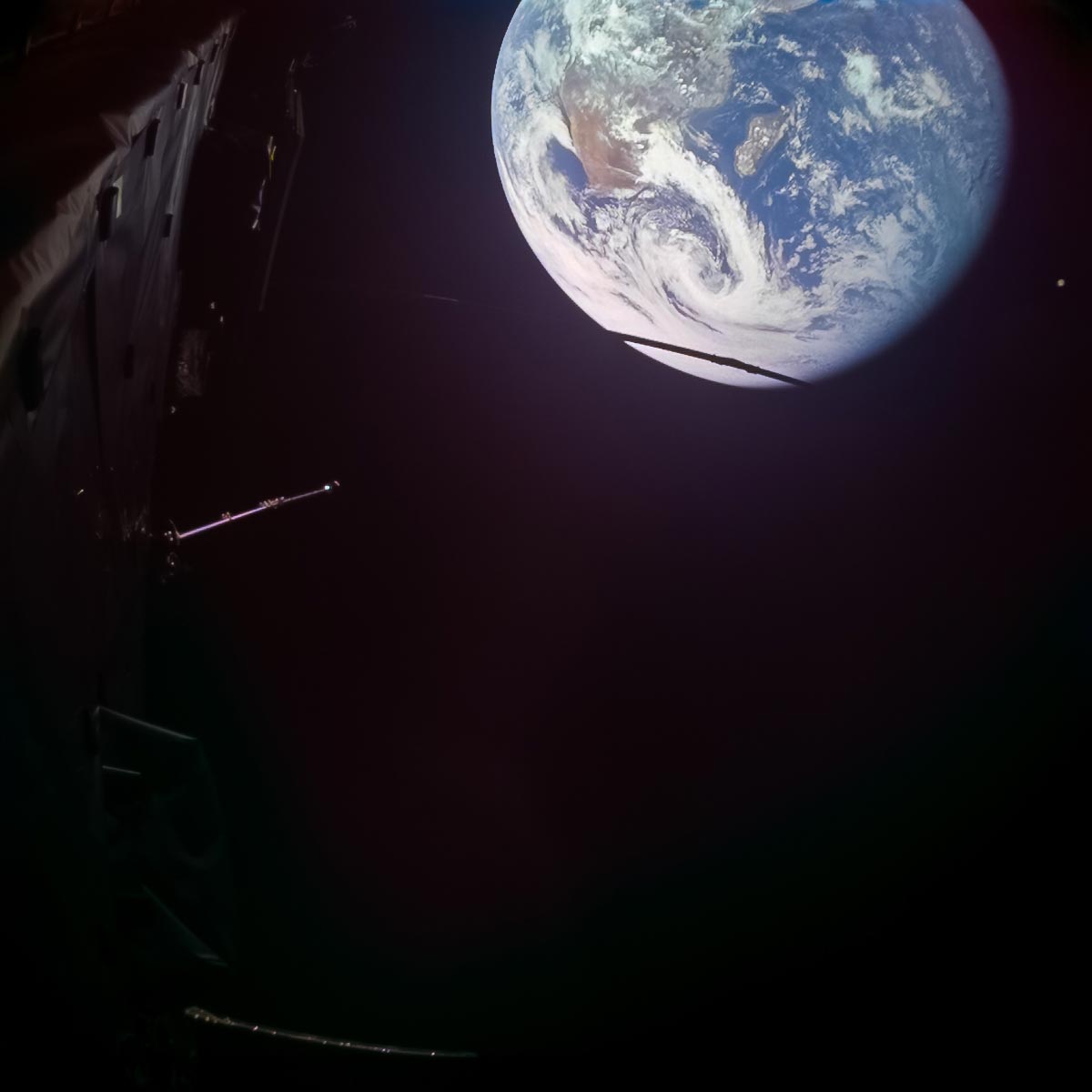
The European Space Agency’s Jupiter Icy Moons Explorer (Juice) made a close pass by Earth on September 28, skimming the outermost reaches of the atmosphere and using the planet’s gravity to reshape its journey toward Jupiter while conserving fuel.
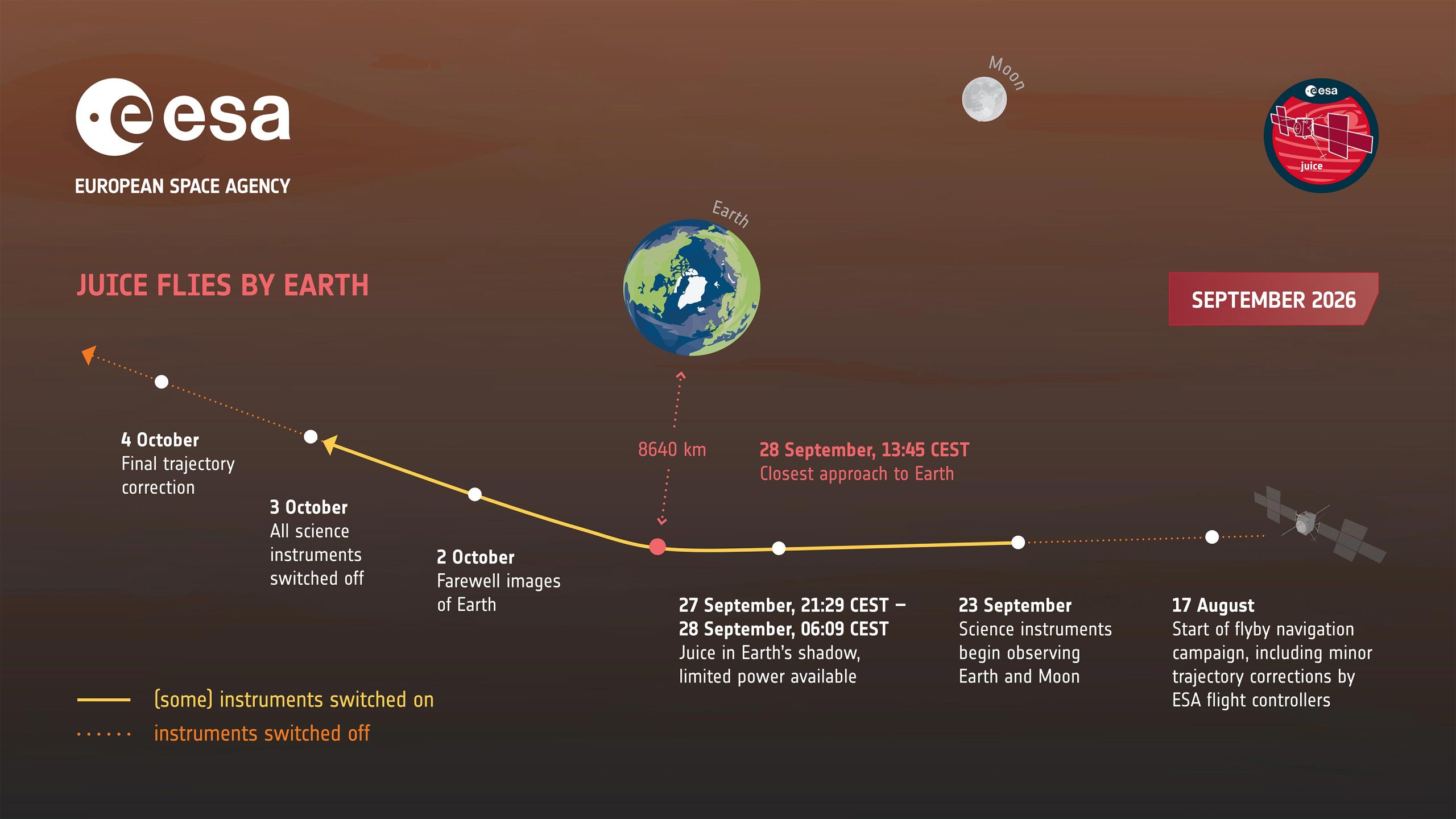
The maneuver changed Juice’s direction by 20° compared with its earlier trajectory and boosted its speed by 3.5 km/s. During the four weeks leading up to the encounter, mission controllers needed to make only one small course correction (out of six opportunities set aside) to guide the spacecraft onto the precise approach needed to take full advantage of Earth’s gravity. Teams began closely tracking Juice on August 17 and will continue that enhanced monitoring through October 10.
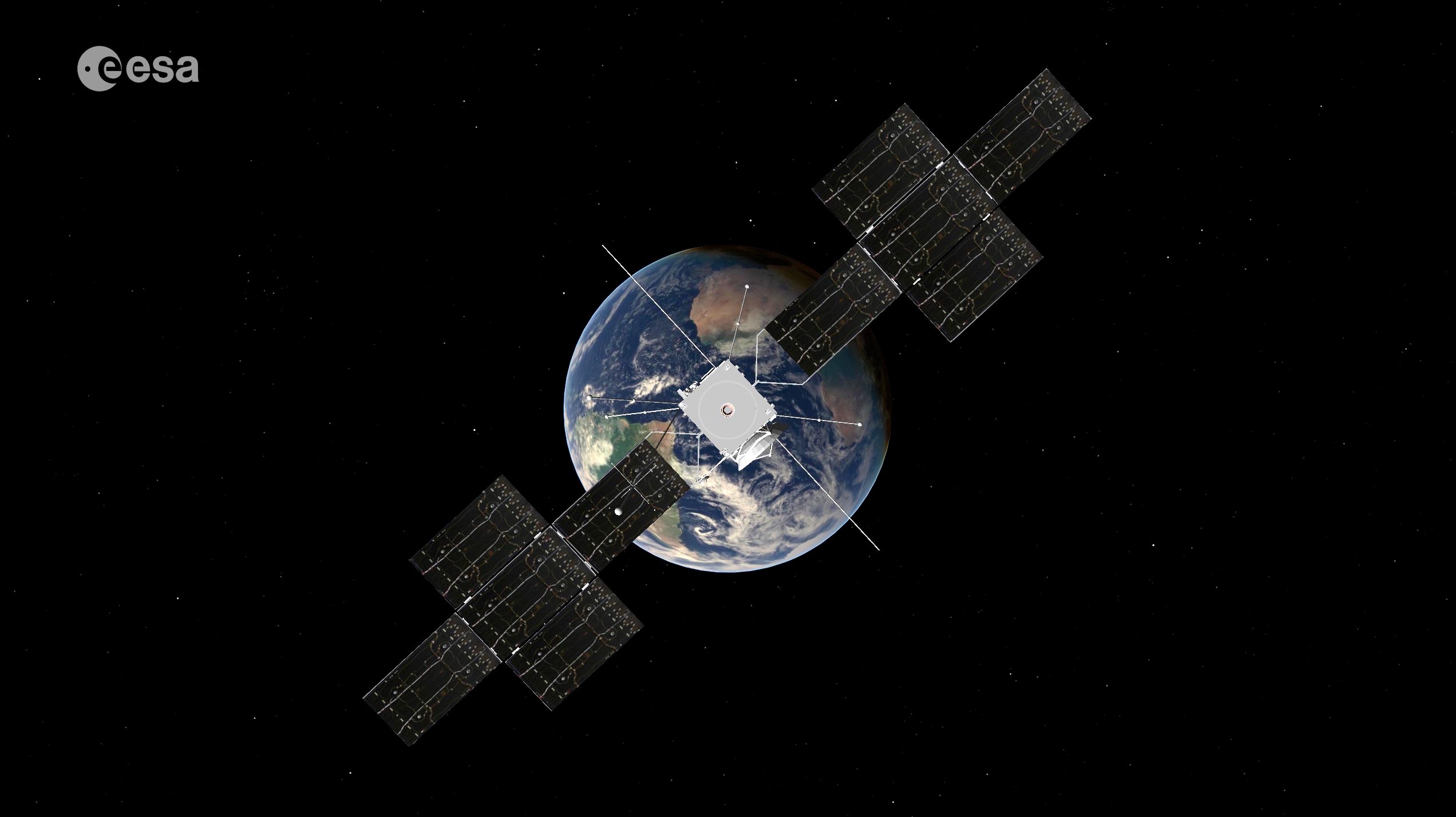
Juice Makes a Close Pass Over Earth
Juice reached its closest point to Earth at 13:45 CEST (11:45 UTC) on September 28. At that moment, the spacecraft passed just 8640 km above the Indian Ocean and captured a sequence of images using its onboard monitoring cameras.
“The flyby required ultra-precise navigation in real time. Thanks to our very careful planning, we used only a small amount of the propellant reserved for this flyby,” says Angela Dietz, Juice’s Spacecraft Operations Manager. “This gives us more to use at Jupiter to carry out observations of the planet’s icy moons.”
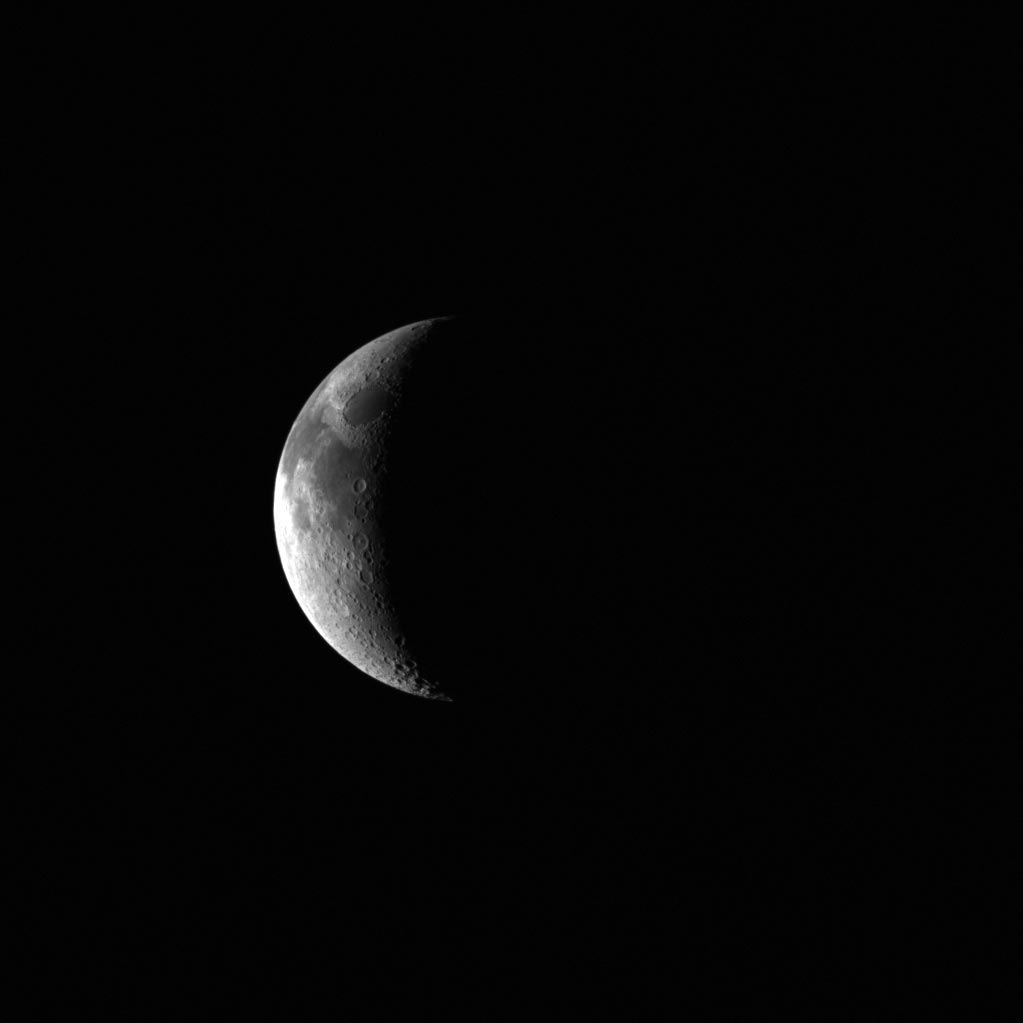
Credit: ESA/Juice/NavCam
Earth Becomes a Test Site for Juice
Changing the spacecraft’s path was the primary purpose of the encounter, but Earth also gave scientists another valuable opportunity to test Juice’s science instruments against a real planetary surface in space.
This was the third such opportunity during the mission. The first came during Juice’s 2024 lunar-Earth gravity assist, followed by the spacecraft’s 2025 observations of Comet 3I/ATLAS.
Teams from ESA’s spacecraft operations, science operations, and technical centers worked for months alongside the outside groups responsible for Juice’s 10 scientific instruments. They carefully planned which instruments should operate at different points in the flyby, allowing researchers to make the most of limited spacecraft resources and available observation time.
“Juice’s journey to Jupiter provides only a few opportunities to calibrate and validate the instruments under well-understood environmental conditions,” explains Juice project scientist Claire Vallat, who led the effort.
“Given the limited time available and operational constraints, instrument activities sometimes have to be prioritized, for example, when Juice was in Earth’s shadow this morning and relying on battery power alone. During this flyby, calibration activities were prioritized based on their relevance to preparing the instruments for their work at Jupiter, while also considering whether an opportunity is unique or can be scheduled later in the journey.”

Credit: ESA/Juice/NavCam
Preparing for Jupiter’s Icy Moons
Although the Earth encounter required extensive preparation, it is relatively simple compared with what awaits Juice at Jupiter. The spacecraft is scheduled to carry out 35 flybys of Jupiter’s giant moons Ganymede, Europa and Callisto.
Planning for some of those encounters has already been underway for years. In the case of the Europa flybys, discussions about instrument operations began 10 years ago and will continue until Juice finally passes the moon in the early 2030s.
The Earth flyby gave mission teams a useful chance to calibrate the spacecraft’s instruments, learn how they behave in the space environment (where they always work a little differently to on Earth!), and improve the tools scientists will use to analyze the incoming data.
Those preparations are especially important because the encounters with Jupiter’s icy moons will be Juice’s main scientific events. The mission team wants the spacecraft and its instruments fully prepared to gather the highest quality observations possible.
Juice Explores Earth’s Magnetotail
Juice also spent several days traveling through the magnetotail, the elongated region of Earth’s magnetic field that extends away from the Sun.
That passage allowed the spacecraft to measure magnetic fields and charged particles far from Earth. At the same time, the European-Chinese Smile mission was observing the northern lights while also measuring magnetic fields and particles much closer to the planet.
Combining observations from Juice and Smile gives researchers an unusual opportunity to examine how activity deep in Earth’s distant magnetotail connects with events occurring near the planet’s poles.
Scientists expect to release images and spectra gathered by several Juice instruments in the coming weeks, once the data have reached Earth and the instrument teams have had time to evaluate them. Among the expected results are high-resolution images of Earth and the Moon captured by Juice’s scientific camera, JANUS.
One Final Earth Flyby Before Jupiter
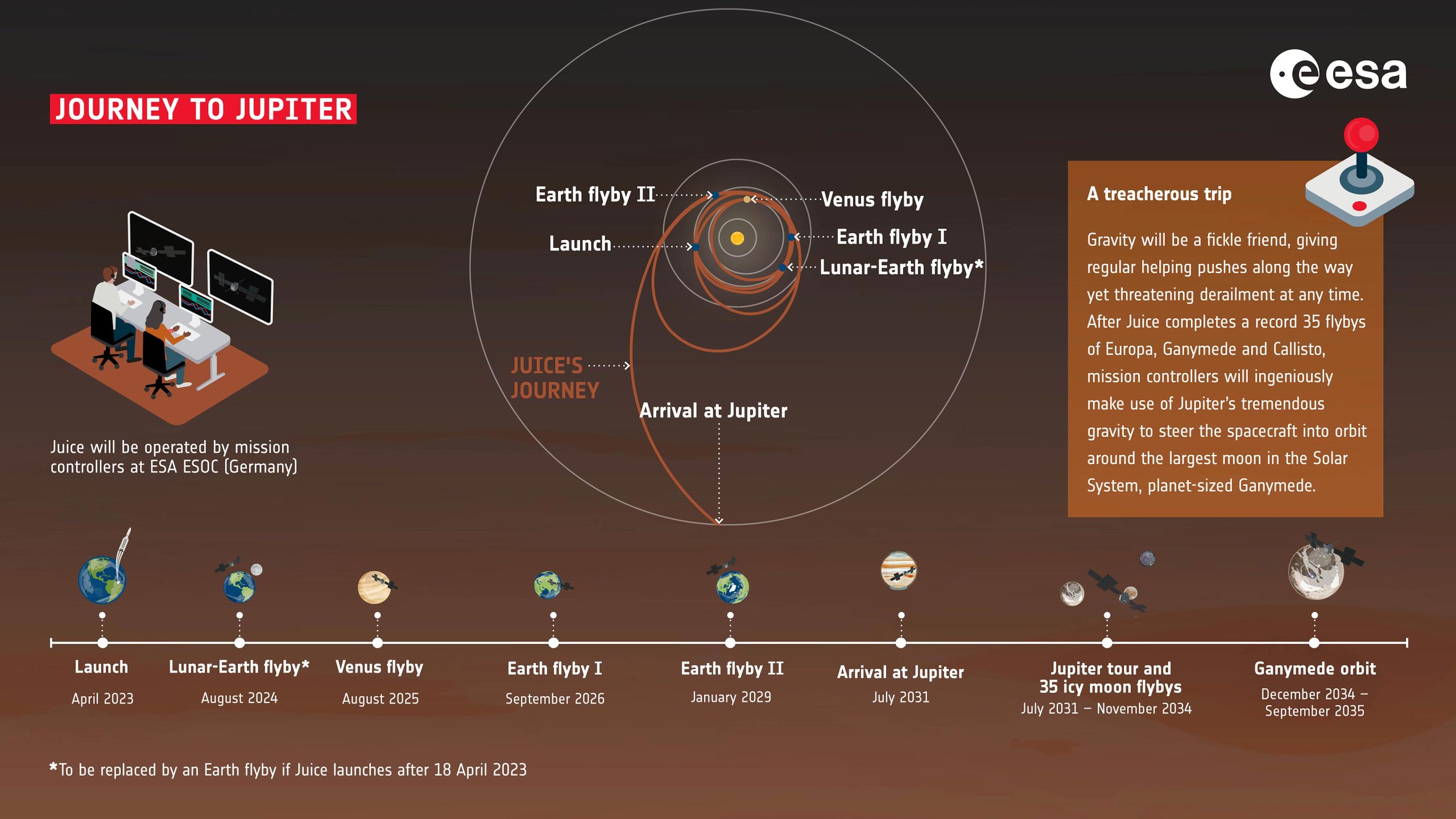
Juice is scheduled to return to Earth again in January 2029. That encounter will be the spacecraft’s third and final flyby of our planet and will place it on the last stage of its route toward Jupiter, where it is expected to arrive in 2031.
About Juice
ESA’s Jupiter Icy Moons Explorer, ‘Juice’, is a major mission to the outer Solar System designed to study Jupiter and three of its large ocean-bearing moons: Ganymede, Callisto, and Europa.
Using a powerful collection of remote sensing, geophysical and in situ instruments, Juice will closely investigate these worlds and explore their potential as environments that could have supported past or present life.
The spacecraft will also examine Jupiter’s complex magnetic, radiation and plasma environment and investigate how those conditions interact with the moons. By doing so, scientists will use the Jupiter system as an example for understanding gas giant systems elsewhere in the Universe.
Juice launched aboard an Ariane 5 from Europe’s Spaceport in Kourou in April 2023. Its eight-year journey includes flybys of Earth and Venus that use planetary gravity to help propel the spacecraft toward Jupiter.
Once there, Juice is expected to complete 35 flybys of the three large moons while orbiting Jupiter. It will eventually shift into orbit around Ganymede.
Juice is led by ESA with contributions from NASA, JAXA and the Israel Space Agency. It is the first large-class mission in ESA’s Cosmic Vision program.
Never miss a breakthrough: Join the SciTechDaily newsletter.
Follow us on Google and Google News.