
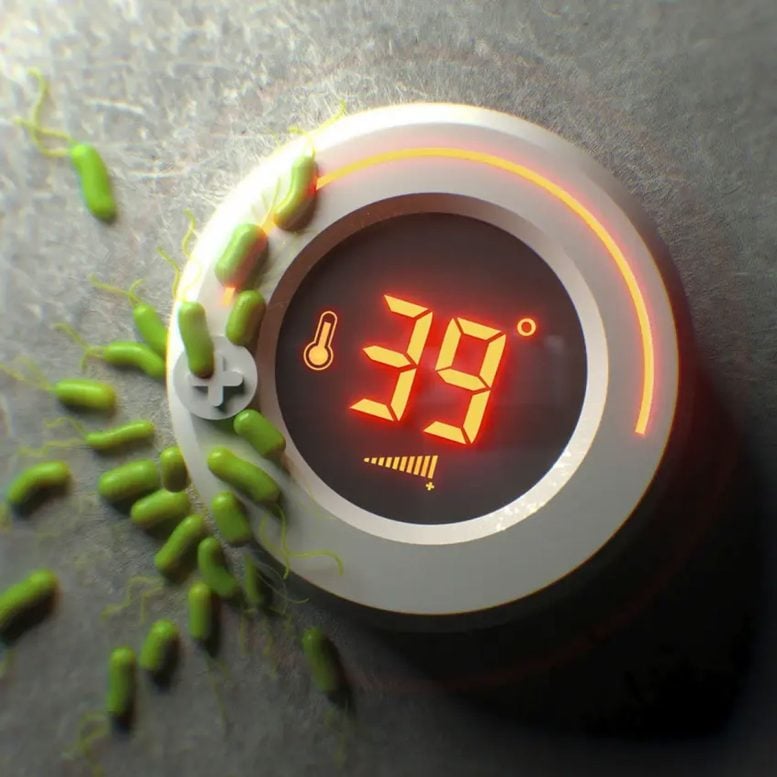
The microbes in your gut may help explain why you develop a fever after a vaccine while someone else feels fine.
Two people can receive the same vaccine and have very different experiences. One develops a fever and feels miserable for a day, while the other barely notices anything. Scientists have long sought to understand why these reactions vary so widely, and new research suggests that part of the answer may lie in the trillions of microbes living in our intestines.
An international research team found that people who developed stronger fevers after vaccination already showed signs of heightened inflammation and distinctive gut microbial activity before receiving their shots. When researchers transferred their gut microbes into mice, the animals also developed stronger inflammatory responses to vaccination. The findings point to a bacterial protein called flagellin as a possible contributor and raise intriguing questions about whether diet could influence how the body responds to vaccines.
Before The Shot, Different Starting Points
Vaccination prevents infectious diseases and protects public health, but concerns about fever and flu-like symptoms can discourage people from getting vaccinated. Understanding why these reactions vary could help researchers find ways to reduce them and address a source of vaccine hesitancy.
The gut microbiome is a plausible place to look because its trillions of microorganisms continually communicate with the immune system, helping shape its baseline activity. Because microbial communities differ between people, the same vaccine may encounter very different immune starting points.
To investigate, researchers led by Ruth Ley at the Max Planck Institute for Biology Tübingen established the µHEAT (Microbial-Human Ecology and Temperature) study. With support from Meral Esen at the Institute of Tropical Medicine in Tübingen, they recruited healthy young adults receiving a SARS-CoV-2 vaccine in 2021 and 2022.
Participants provided fecal samples for microbial analysis and blood samples for immune measurements. They also regularly recorded their temperature during the week before and the week after vaccination.
A Bacterial Signal Linked to Fever
Organizing the study during the pandemic required the team to recruit participants before they had already received their vaccines, while keeping visits and measurements manageable.
“It was a challenging time to set up a new human study, with the pandemic ongoing,” says lead author Kelsey Huus, who led µHEAT during her postdoctoral research and is now an assistant professor at the University of Ottawa in Canada. “We didn’t want to burden participants with too many measurements or visits, and it was a bit of a race against time to get the study organized before everyone was already vaccinated. But it was absolutely worth it, because the project yielded some very exciting results.”
Some participants developed substantial fevers. Before vaccination, their gut microbes showed greater activity in genes involved in bacterial movement, particularly those used to make whip-like swimming structures called flagella.
Flagella are built from proteins called flagellins. Because pathogens such as Salmonella also produce flagellins, the immune system recognizes these proteins as potential danger signals and responds with inflammation. Blood and fecal measurements suggested that participants who developed stronger fevers already had higher levels of inflammation before vaccination.
Testing the Microbiome in Mice
The human observations revealed an association, but the researchers needed an experiment to test whether the microbes themselves could influence vaccine responses. They transferred participants’ fecal microbiomes into mice that lacked intestinal microbes of their own, then vaccinated the animals.
Mice receiving microbes from participants with stronger fever responses developed more severe inflammation than those receiving microbes from people with milder responses. The effect depended partly on the animals’ ability to sense flagellin, providing evidence that the bacterial protein contributed to the response.
“Vaccination provides a controlled way to understand why people can respond so differently to the same immune challenge,” says Ley, director of the Department of Microbiome Science. “Our findings show that microbial flagellin is one contributor to this baseline immune state, providing a potential link between differences in the gut microbiome and differences in immune responses.”
Could Diet Influence The Response?
The team next explored what might encourage gut microbes to produce more flagellin. Participants eating plant-based diets tended to have weaker fever responses, making diet a candidate for further investigation.
“We could see that certain food additives increased flagellin production by gut microbes in vitro,” explains Benoit Chassaing, Inserm research director at Institut Pasteur. “Interestingly, these findings show that components of an industrialized diet may promote the growth of flagellated gut bacteria and increase overall flagellin production.”
Animal experiments offered further evidence. “We found that a high-fat Western-style diet enhanced inflammatory vaccine responses in mice,” says co-author Hirohito Abo of Georgia State University in Atlanta.
“While we could not show that diet determines vaccine responses in humans, our study findings suggest that diet is one factor capable of modifying a pro-inflammatory microbiome,” Huus says. “Interventional studies in people will be needed to determine whether dietary changes can alter microbial flagellin production in humans and, in turn, vaccine responses like fever.”
Beyond Vaccine Side Effects
Future trials could investigate whether interventions targeting the microbiome can reduce strong fevers after vaccination. More broadly, the study suggests that gut microbes help establish an immune state that may influence responses to challenges beyond vaccines.
“Ultimately, this work adds to growing evidence that the gut microbiome plays a central role in human immune health,” Huus adds. “Understanding these interactions could now open new opportunities to improve how we predict, prevent, and manage individual differences in immune responses.”
Reference: “The human gut microbiome primes fever after vaccination” by Kelsey E. Huus, µHEAT Study Group‡, Hirohito Abo, Yi Han Tan, Ezgi Atay, Héloïse Rytter, Ronald Keller, Silke Dauser, Dai Long Vu, Meghan B. Azad, Rob Knight, Alfred Ke, Larisa Lotoski, Marc-André Langlois, Rong Liu, Alexander V. Tyakht, Nicholas Youngblut, Sang-Moo Kang, Julie Parsonnet, Lisa Maier, Benoit Chassaing, Peter G. Kremsner, Andrew T. Gewirtz, Meral Esen and Ruth E. Ley, 8 October 2026, µHEAT Study Group.
DOI: 10.1126/science.aea7733
Never miss a breakthrough: Join the SciTechDaily newsletter.
Follow us on Google and Google News.