
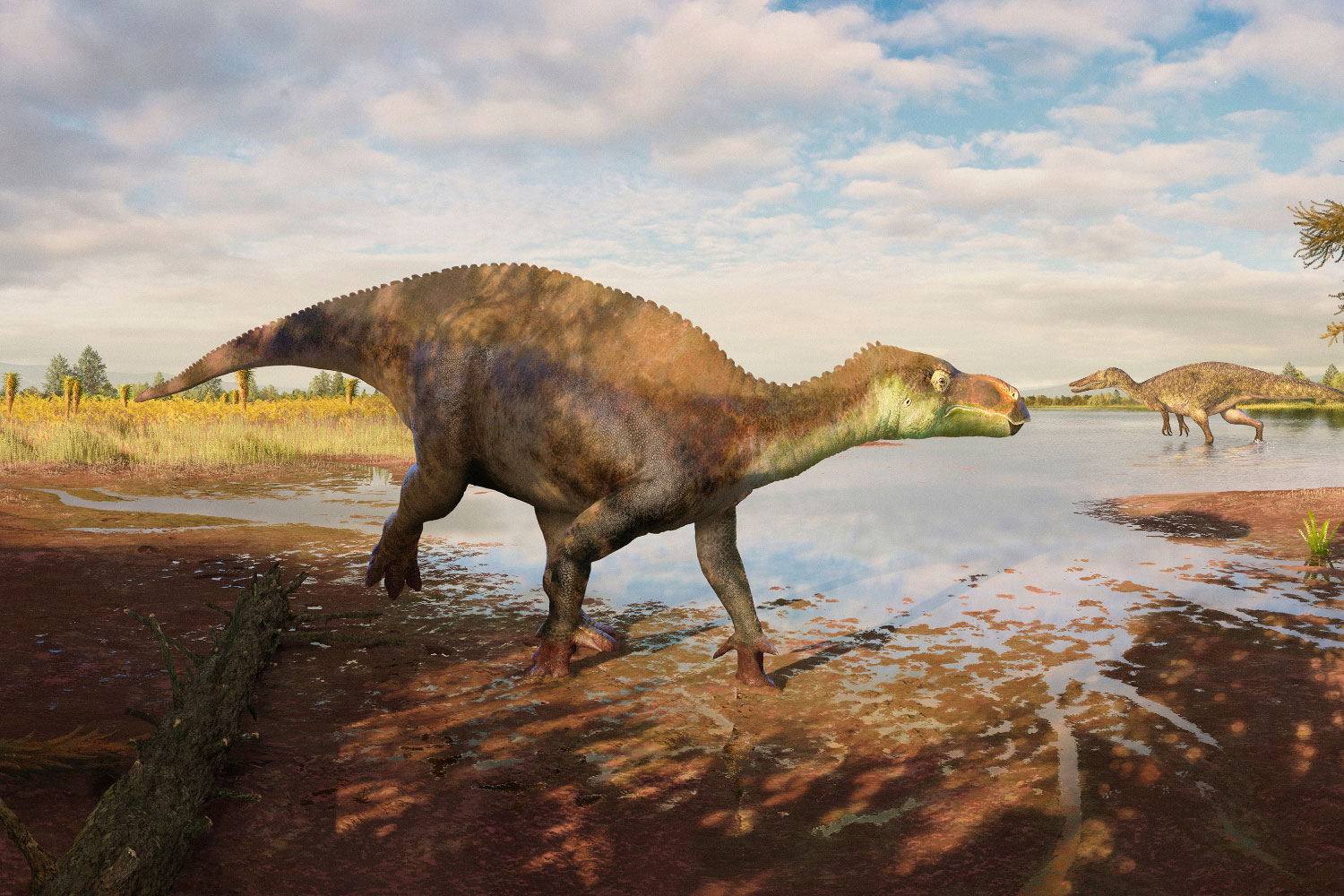
A dinosaur fossil unearthed in England more than two decades ago has now been identified as an entirely new genus and species.
A dinosaur discovered in an English clay quarry 25 years ago has finally been recognized as an entirely new genus and species. Named Paludohadros proudlovii, the plant-eating dinosaur lived about 125 million years ago, when muddy wetlands covered much of southern England. Its identification is also prompting scientists to reconsider other fossils that have spent decades in museum collections.
The four-legged herbivore measured approximately 5 meters (16 feet) long and weighed an estimated 1.5 to 2 metric tons (3,300 to 4,400 pounds), making it comparable in size to a rhinoceros. However, its bones were not fully developed, suggesting that the individual was still young when it died. A mature Paludohadros might have grown to twice its size.
A Prehistoric Predator May Have Hunted This Dinosaur
Paludohadros shared its Early Cretaceous environment with Baryonyx walkeri, a large, two-legged carnivore discovered at the same Surrey quarry in 1983. Although Baryonyx is particularly well known for eating fish, evidence of a young iguanodontian in its last meal suggests that other dinosaurs were also part of its diet.
Professor Susannah Maidment, a senior author of the research from the Natural History Museum, London, and the University of Birmingham, explains: “Paludohadros was found just 100 meters (about 330 feet) away from Baryonyx, whose fossils we also look after at the Natural History Museum. While Baryonyx is best known for eating fish, this dinosaur’s last meal also included a baby iguanodontian.”
“We can’t tell for certain which species this came from, so it’s possible that Baryonyx could have been scavenging on the remains of young Paludohadros or even hunting them when it had the opportunity.”
Why Scientists Are Discovering New Dinosaurs in Old Fossils
Paludohadros belonged to the iguanodontians, a widespread group of plant-eating dinosaurs distinguished in part by their characteristic thumb spikes. For many years, iguanodontian fossils from southern England were generally assigned to one of two genera: Iguanodon or its smaller relative, Mantellisaurus.
A detailed scientific reassessment of Mantellisaurus, published by Natural History Museum researchers in 2023, clarified anatomical differences that had previously been overlooked. These distinctions have helped paleontologists recognize several separate iguanodontian dinosaurs, including Brighstoneus, Comptonatus, the sail-backed Istiorachis, and now Paludohadros.
The latest identification has also led researchers back to older museum specimens. Several fossils collected as early as the 1950s have now been recognized as belonging to Paludohadros, suggesting that additional examples of the dinosaur were preserved long before scientists understood that it represented a separate genus.
A Dinosaur Named in Memory of a Quarry Manager
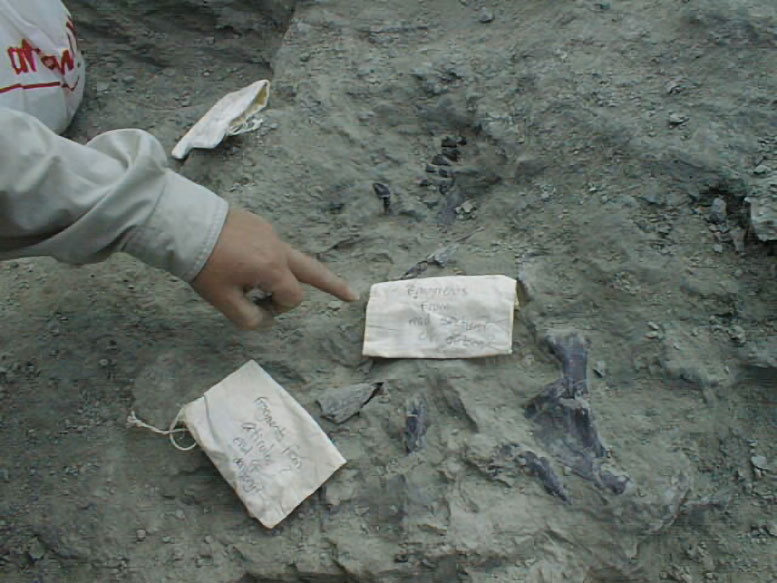
The original Paludohadros fossil was unearthed in 2001 at wienerberger’s Ewhurst brick and roof tile works (Ewhurst Works) in Surrey and subsequently donated to the Natural History Museum. Its genus name reflects the wetland environment it inhabited, drawing on the Latin word palus, meaning “swamp.”
The species name, proudlovii, honors Will Proudlove, a former employee who worked his way up to become the quarry’s manager. Proudlove had a strong interest in the fossils exposed by quarrying operations but died at age 35, shortly before the dinosaur was discovered. He was survived by his wife, Rachael, and their young children, Ellie and Matt.
Rachael Proudlove says, “Will always had an interest in dinosaur fossils and was fascinated about what, if anything, would be uncovered each time a layer of clay was removed from the quarry. Sadly, this dinosaur was only discovered the year after he died, but its story has become a part of our lives since then.”
“We were invited to go and look at it being excavated back in 2001, so it’s amazing to hear all this time later that it’s not just a new species of dinosaur, but a new genus too. We’re absolutely overjoyed and honored that Will’s name and legacy will live on in this dinosaur.”
More Unknown Dinosaurs May Be Hiding in Museum Collections
The research was led by Ricardo Sacamoto, a PhD student at the Natural History Museum, London, and the University of São Paulo. He plans to continue examining the museum’s extensive collection of iguanodontian fossils, looking for anatomical differences that could identify additional unrecognized species.
“Paludohadros is the first species I’ve ever named and I’m honored to have been able to work on it. I still remember the incredible moment when I realized that this was a new species that no one had ever identified before,” Sacamoto says.
“I’m now going to go through the Natural History Museum’s iguanodontian collections to identify what’s there as part of my PhD. This could lead to the discovery of more new dinosaur species that haven’t yet been recognized.”
Reference: “A new iguanodontian dinosaur from the Weald Clay Formation (Lower Cretaceous) of Smokejacks Brickworks, southern England” by Ricardo J. Sacamoto, Jeremy A. F. Lockwood, Max C. Langer, Brett Clark, Paul M. Barrett, Alice Turner and Susannah C. R. Maidment, 26 October 2026, Journal of Systematic Palaeontology.
DOI: 10.1080/14772019.2026.2726221
Never miss a breakthrough: Join the SciTechDaily newsletter.
Follow us on Google and Google News.