
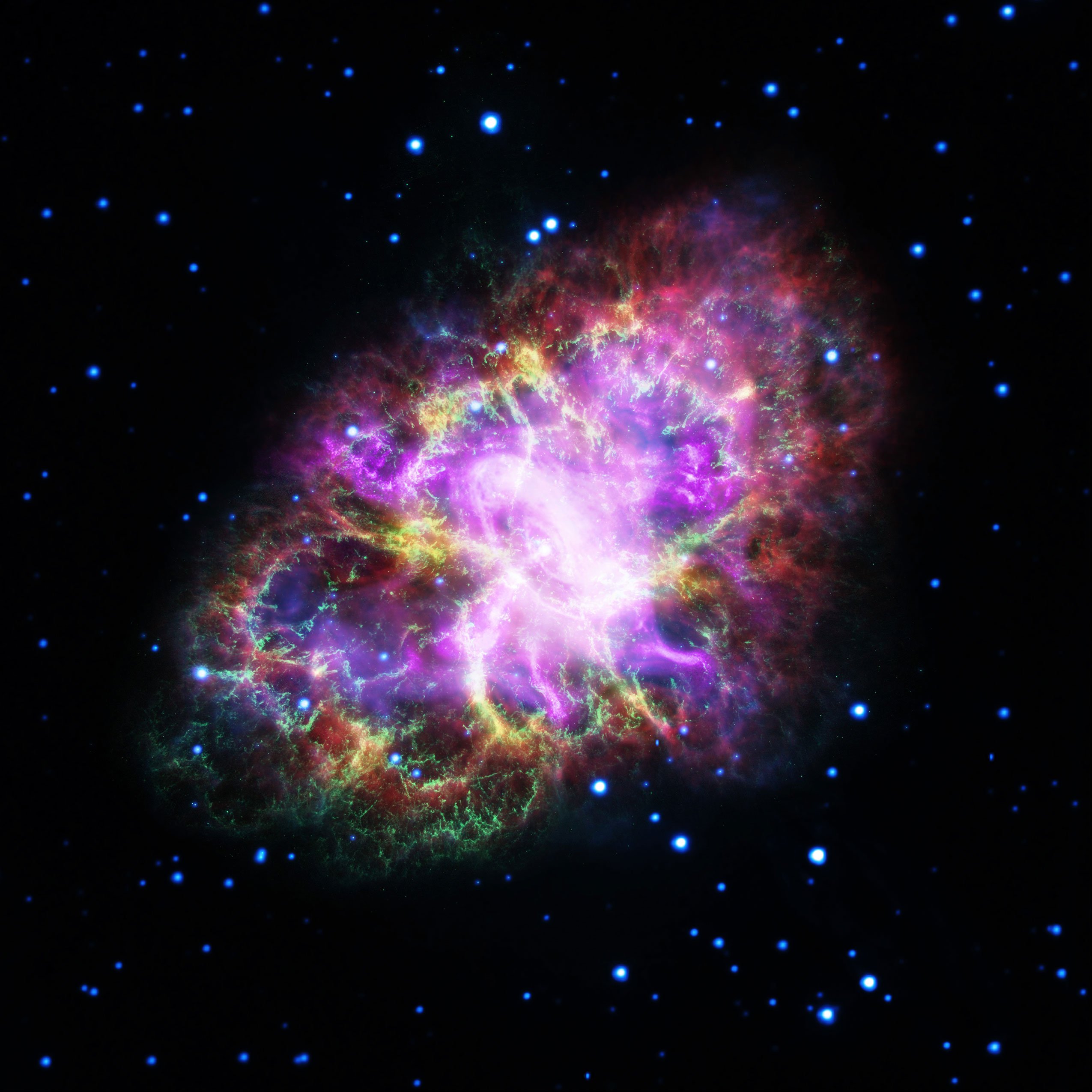
A long-lived heavy neutrino could have reshaped the early universe’s expansion and tipped the balance toward matter, according to a theory that predicts traces in primordial gravitational waves.
If matter and antimatter had annihilated each other completely after the Big Bang, the universe would have been left with energy and no matter. Explaining why matter survived, when current theories suggest the two should have wiped each other out, remains one of the biggest puzzles in modern physics.
Physicists at the University of Southampton and the Indian Institute of Technology Kanpur have proposed an explanation involving a particle largely overlooked for decades. Known as a “decoupled” heavy neutrino, it is a heavier relative of the neutrino, one of the lightest particles in the universe. Most theories explaining the matter-antimatter imbalance have ignored this heavy relative because its interactions with other particles were considered too weak to have an impact.
“The fact that we are here at all proves that an asymmetry between matter and antimatter occurred,” said study author Dr. Rishav Roshan of the University of Southampton.

The new research, published in Physical Review Letters, connects that imbalance to the early universe’s expansion. Co-author Dr. Sudipta Show of the Indian Institute of Technology Kanpur said the findings change our understanding of how quickly the cosmos expanded after the Big Bang.
Roshan explained, “This decoupled heavy neutrino has long been dismissed as an irrelevant background detail in particle physics.
“However, it decays incredibly slowly. As the cosmos cooled after the Big Bang, the particle lived long enough that it temporarily took over the energy density of the universe and triggered a matter-dominated period.”
A matter-dominated period describes the universe’s energy budget, with matter contributing more energy than radiation. That is different from an imbalance between matter and antimatter. In the team’s proposed account, the connection between the two depends on how this period changed the conditions for other particles.
“The decoupled neutrino shifted the temperature in the early universe at which fundamental particles—like electrons and other leptons—interacted with their anti-particles with the help of Standard Model Higgs boson,” Roshan said.
“This temperature acts like a switch that shapes how the matter-antimatter imbalance was built up.”
Possible traces in primordial gravitational waves
Show said, “It offers us a new explanation for how matter won.
“The dramatic shift in the early expansion of the cosmos leaves distinct but detectable imprints of changes, for example on primordial gravitational waves.
“These gravitational wave signatures open up new avenues for us to unravel the evolution of the early universe after the Big Bang.”
Reference: “Delayed Charged Lepton Yukawa Equilibration in Minimal Seesaw” by Rishav Roshan and Sudipta Show, 8 September 2026, Physical Review Letters.
DOI: 10.1103/nfkx-q6z7
Never miss a breakthrough: Join the SciTechDaily newsletter.
Follow us on Google and Google News.
1 Comment
Particles are not point-like entities, but rather stable vortex structures or local excitations within a vortex network embedded in this medium.When two systems become entangled, this can be interpreted as a non-local topological connection. By emphasizing topological connection, it indicates that they do not first become two completely independent vortices and then get linked by some mysterious action; instead, they form a single topological vortex cluster or holistic field configuration through interaction.In this sense:(1) The vortex at location A is a local excitation of the holistic configuration;(2) The vortex at location B is another local excitation of the same holistic configuration;(3) Measurement at A does not send a superluminal signal to B, but rather imposes a local perturbation on the holistic topological configuration;(4) Since the configuration itself is indivisible, the state at B is consequently determined.Therefore, the “non-local correlation” in TVT should, strictly speaking, be formulated as: the local dynamic response of a holistic topological configuration. Perhaps Einstein’s persistent intuition for local realism stemmed precisely from this geometric reality.