
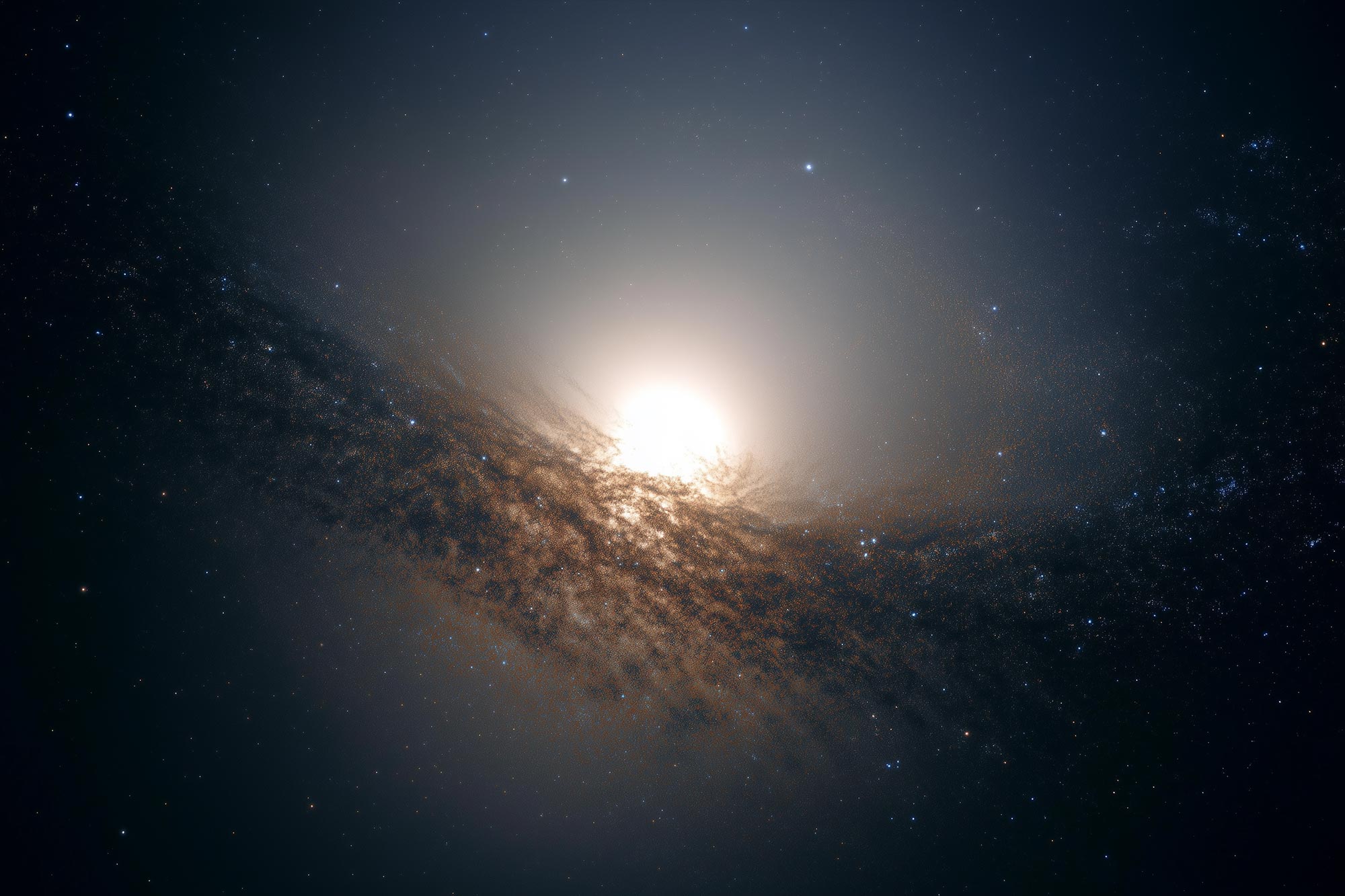
Japanese physicists have revived Kelvin’s old idea of cosmic knots, showing how these tangled fields might explain why matter won the universe’s first great battle over antimatter.
In 1867, Lord Kelvin proposed that atoms might be tiny knots woven into the fabric of the aether. The idea was eventually disproven as scientists uncovered the true nature of atoms, but his imaginative concept may still contain a hidden clue to one of the universe’s greatest mysteries: why anything exists at all.
Today, researchers in Japan have demonstrated for the first time that such knots can naturally emerge within a realistic particle physics model. Their study, published in Physical Review Letters, connects these formations to several long-standing puzzles, including the origins of neutrino masses, dark matter, and the strong CP problem. The team suggests that these “cosmic knots” may have briefly shaped the infant universe, decaying in a way that favored matter over antimatter and leaving behind a faint vibration in spacetime that future observatories might one day detect—a rare opportunity to investigate one of physics’ most elusive questions.
“This study addresses one of the most fundamental mysteries in physics: why our Universe is made of matter and not antimatter,” said study corresponding author Muneto Nitta, professor (special appointment) at Hiroshima University’s International Institute for Sustainability with Knotted Chiral Meta Matter (WPI-SKCM2) in Japan.
“This question is important because it touches directly on why stars, galaxies, and we ourselves exist at all.”
The universe’s missing antimatter
According to the Big Bang theory, the universe should have been born with equal amounts of matter and antimatter, each annihilating the other until only light remained. Yet what we observe today is almost entirely matter, with antimatter virtually absent. Scientists have calculated that everything from atoms to galaxies exists because, for every billion matter–antimatter pairs, a single extra particle of matter somehow survived.
The Standard Model of particle physics, while remarkably successful in many areas, cannot explain this imbalance. Its predictions fall far short of the tiny excess needed to create our universe. Solving this mystery, known as baryogenesis, remains one of the most important open questions in modern physics.
Researchers Muneto Nitta and Minoru Eto of Hiroshima University’s WPI-SKCM2, an institute dedicated to exploring knotted and chiral structures across different scientific fields, together with Yu Hamada of the Deutsches Elektronen-Synchrotron in Germany, believe they may have uncovered a long-overlooked clue that points to the answer.
By combining a gauged Baryon Number Minus Lepton Number (B-L) symmetry with the Peccei–Quinn (PQ) symmetry, the team showed that knots could naturally form in the early universe and generate the observed surplus.
Eto is also a professor at Yamagata University, and all three researchers are affiliated with Keio University in Japan.
Ghost particles
These two long-studied extensions of the Standard Model patch some of its most puzzling gaps. The PQ symmetry solves the strong CP problem, the conundrum of why experiments don’t detect the tiny electric dipole moment that theory predicts for the neutron, and in the process, introduces the axion, a leading dark matter candidate. Meanwhile, the B–L symmetry explains why neutrinos, ghostlike particles that can slip through entire planets unnoticed, have mass.
Keeping the PQ symmetry global, rather than gauging it, preserves the delicate axion physics that solves the strong-CP problem. In physics, “gauging” a symmetry means letting it act freely at every point in spacetime. But that local freedom comes at a cost. To preserve consistency, nature must introduce a new force carrier to smooth out the equations. By gauging the B–L symmetry, the researchers not only guaranteed the presence of heavy right-handed neutrinos—required to keep the theory anomaly-free and central to leading baryogenesis models—but also introduced a superconducting behavior that provided the magnetic backbone for possibly some of the universe’s earliest knots.
Writhing cosmic relics
As the universe cooled after the Big Bang, its symmetries fractured through a series of phase transitions and, like ice freezing unevenly, may have left behind thread-like defects called cosmic strings, hypothetical cracks in spacetime that many cosmologists believe may still be out there. Though thinner than a proton, an inch of string could outweigh mountains. As the cosmos expanded, a writhing web of these filaments would have stretched and tangled, carrying imprints of the primordial conditions that once prevailed.
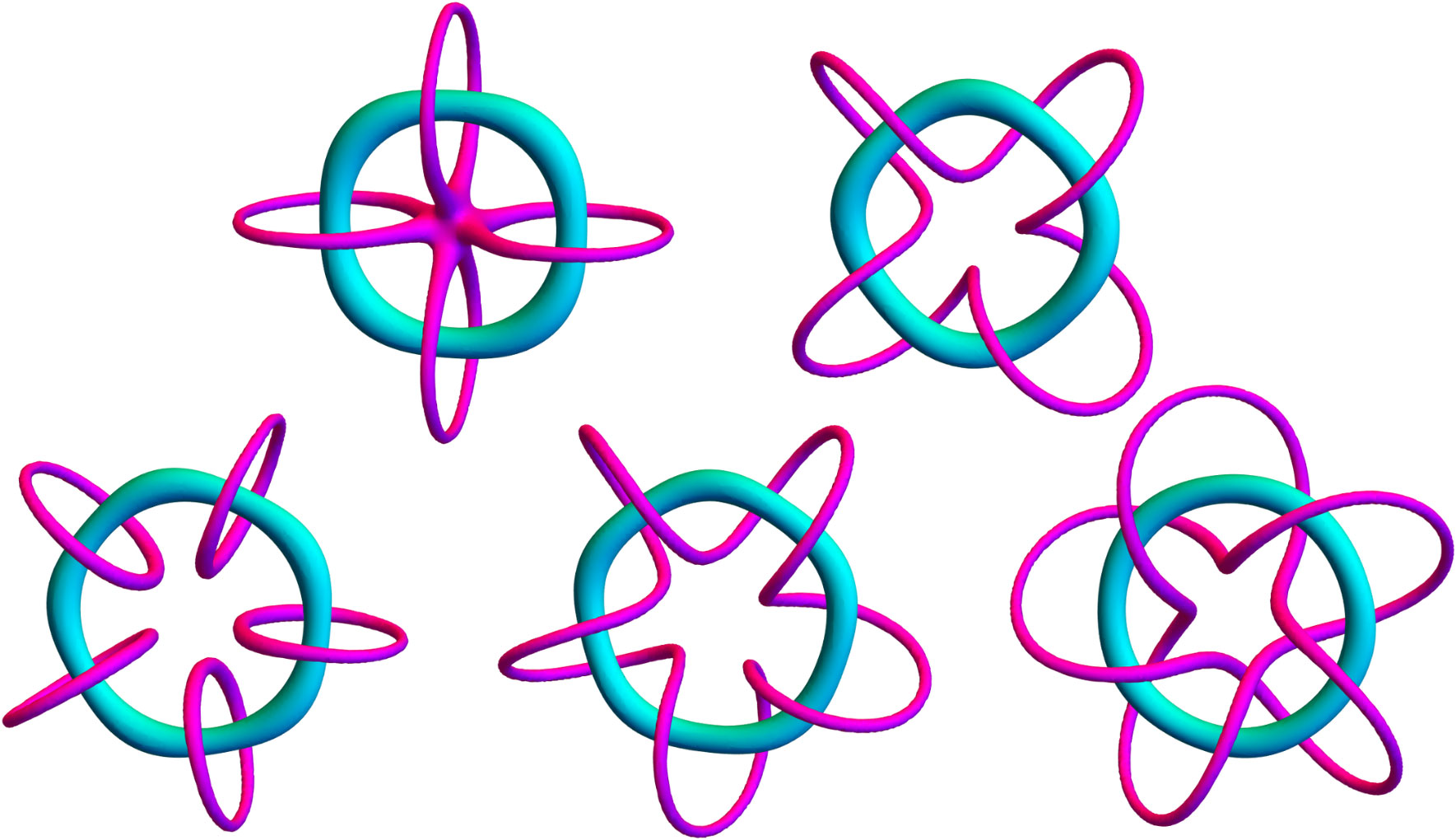
The breaking of the B–L symmetry produced magnetic flux tube strings, while the PQ symmetry gave rise to flux-free superfluid vortices. Their very contrast is what makes them compatible. The B-L flux tube gives the PQ superfluid vortex’s Chern–Simons coupling something to latch on. And in turn, the coupling lets the PQ superfluid vortex pump charge into the B-L flux tube, countering the tension that would normally make the loop snap. The result was a metastable, topologically locked configuration called a knot soliton.
“Nobody had studied these two symmetries at the same time,” Nitta said. “That was kind of lucky for us. Putting them together revealed a stable knot.”
Phantomlike barrier crossings
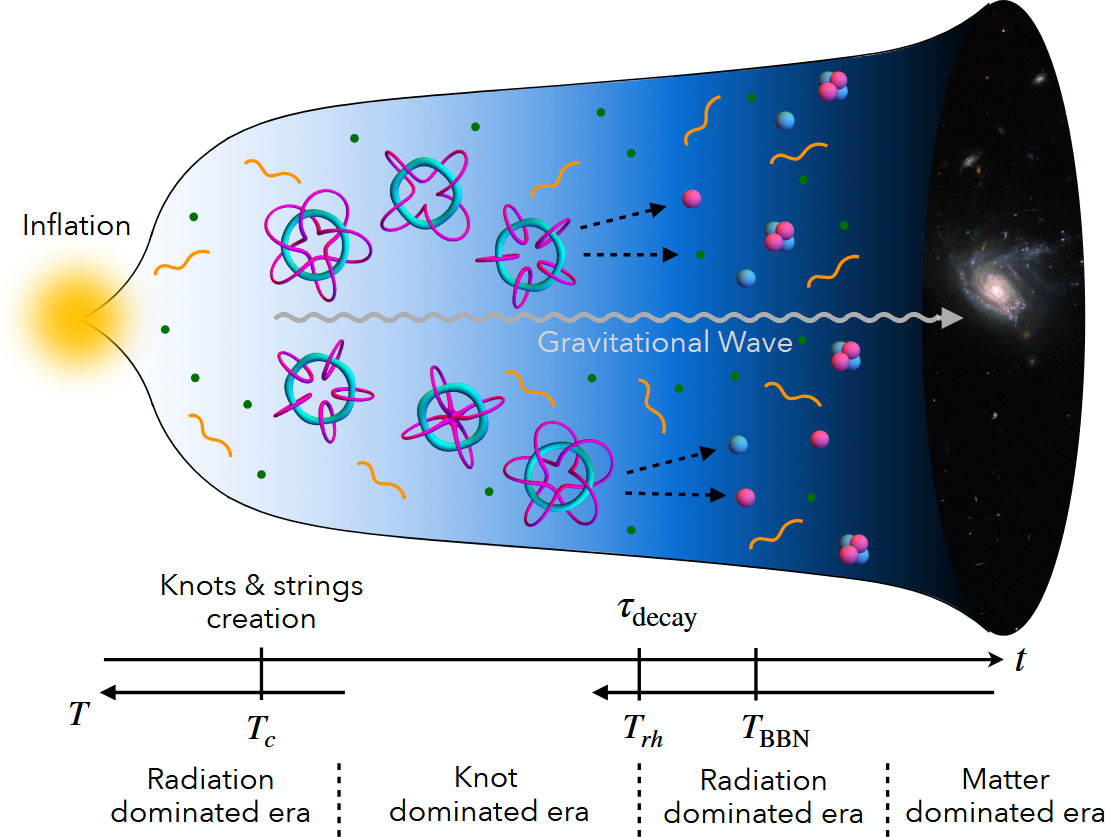
While radiation lost energy as its waves stretched with spacetime, the knots behaved like matter, fading far more slowly. They soon overtook everything else, ushering in a knot-dominated era when their energy density, not radiation’s, ruled the cosmos. But that reign didn’t last. The knots eventually untangled through quantum tunneling, a phantomlike process in which particles slip through energy barriers as if they weren’t there at all. Their collapse generated heavy right-handed neutrinos, a built-in consequence of the B–L symmetry woven into their structure. These massive ghostly particles then decayed into lighter, more stable forms with a faint bias toward matter over antimatter, giving us the universe we now know.
“Basically, this collapse produces a lot of particles, including the right-handed neutrinos, the scalar bosons, and the gauge boson, like a shower,” study co-author Hamada explains. “Among them, the right-handed neutrinos are special because their decay can naturally generate the imbalance between matter and antimatter. These heavy neutrinos decay into lighter particles, such as electrons and photons, creating a secondary cascade that reheats the universe.”
“In this sense,” he added, “they are the parents of all matter in the universe today, including our own bodies, while the knots can be thought of as our grandparents.”
Tying it together
When the researchers followed the math encoded in their model—how efficiently the knots produced right-handed neutrinos, how massive those neutrinos were, and how hot the cosmos reheated after they decayed—the matter–antimatter imbalance we observe today emerged naturally from the equation. Rearranging the formula and plugging in a realistic mass of 10¹² giga-electronvolts (GeV) for the heavy right-handed neutrinos, and assuming the knots channeled most of their stored energy into creating these particles, the model naturally landed at a reheating temperature of 100 GeV. That temperature coincidentally marks the universe’s final window for making matter. Any colder, and the electroweak reactions that convert a neutrino imbalance into matter would shut down for good.
Reheating to 100 GeV would also have reshaped the universe’s gravitational-wave chorus, tilting it toward higher frequencies. Future observatories such as the Laser Interferometer Space Antenna (LISA) in Europe, Cosmic Explorer in the United States, and the Deci-hertz Interferometer Gravitational-wave Observatory (DECIGO) in Japan could one day listen for that subtle change in tune.
“Cosmic strings are a kind of topological soliton, objects defined by quantities that stay the same no matter how much you twist or stretch them,” Eto said. “That property not only ensures their stability, it also means our result isn’t tied to the model’s specifics. Even though the work is still theoretical, the underlying topology doesn’t change, so we see this as an important step toward future developments.”
While Kelvin originally conjectured knots as the fundamental building blocks of matter, the researchers argued that their findings “provide, for the first time, a realistic particle physics model in which knots may play a crucial role in the origin of matter.”
“The next step is to refine theoretical models and simulations to better predict the formation and decay of these knots, and to connect their signatures with observational signals,” Nitta said. “In particular, upcoming gravitational-wave experiments such as LISA, Cosmic Explorer, and DECIGO will be able to test whether the Universe really passed through a knot-dominated era.”
The researchers hope to unravel whether knots were essential to the origin of matter and, in doing so, tie together a fuller story of the universe’s beginnings.
Reference: “Tying Knots in Particle Physics” by Minoru Eto, Yu Hamada and Muneto Nitta, 29 August 2025, Physical Review Letters.
DOI: 10.1103/s3vd-brsn
Funding: Japan Society for the Promotion of Science, Deutsche Forschungsgemeinschaft
Never miss a breakthrough: Join the SciTechDaily newsletter.
Follow us on Google and Google News.
13 Comments
Too much hand waving. Jeeez……..
Energy doesn’t knot. It achieves balance according to charge and momentum.
You keep thinking things are things.
I’m so glad that we’re matter instead of antimatter. I think I’d be really unhappy being antimatter in an antimatter universe.
“What the heck is the matter with us?”
Because it’s what is the antimatter what’s wrong with you.
I’m so glad that we’re matter instead of antimatter. I think I’d be really unhappy being antimatter in an antimatter universe.
“What the heck is the matter with us?”
Because it’s what is the antimatter what’s wrong with you.
(My comment was rejected. Because they said I’ve posted it before. I did not.)
Yes, but what if we’re in fact antimatter that just thinks it’s matter?
VERY GOOD!
Based on the Topological Vortex Theory (TVT), strictly speaking, the antimatter of any substance (or things) is itself. This is the unity of opposites described by mathematics and philosophy.
Through vortex quantization (Γ = nκ) and the BKT transition mechanism, Topological Vortex Theory (TVT) bridges the gap between quantum mechanics and classical physics, reflects a progression from concrete physical phenomena to abstract mathematical modeling and, ultimately, to interdisciplinary unification.
——Excerpted from https://t.pineal.cn/blogs/4569/An-Overview-of-the-Development-of-Topological-Vortex-Theory-TVT.
My original comment was rejected as a duplicate. False. Fix your problem.
Pics or it didn’t happen!
The predicted gravitational wave spectrum might fit any number of models, hence this theory is not uniquely testable.
There is a lack of antimatter because there was no ‘Big Bang’.
thanks