
A decade-long investigation into puzzling neutrino behavior has now ruled out one of the most widely discussed explanations: the sterile neutrino.
After a decade of gathering and studying data, scientists, including researchers from Rutgers, have overturned a long-standing theory about a mysterious type of particle.
The results, reported in Nature, were produced by the MicroBooNE experiment at the U.S. Department of Energy’s Fermi National Accelerator Laboratory (Fermilab) in Batavia, Illinois. (The acronym MicroBooNE stands for “Micro Booster Neutrino Experiment.”)
By studying two neutrino beams with a highly sensitive liquid-argon detector, the team was able to rule out the presence of a single sterile neutrino with 95 percent confidence.
Andrew Mastbaum, an associate professor in the Department of Physics and Astronomy in the Rutgers School of Arts and Sciences and a member of the MicroBooNE leadership team, described the outcome as a major moment for the field.
“This result will spark innovative ideas across neutrino research to understand what is really going on,” he said. “We can rule out a great suspect, but that doesn’t quite solve a mystery.”

Neutrinos are extremely small subatomic particles that interact so weakly with matter that they can move straight through entire planets. According to the Standard Model, which serves as the central framework of particle physics, there are three known varieties of neutrinos: electron, muon, and tau. Each type can shift into another through a phenomenon known as oscillation.
The Sterile Neutrino Hypothesis
Earlier experiments, however, revealed neutrino behavior that did not align with the predictions of the Standard Model. To account for these unexpected results, scientists suggested the possibility of a fourth kind of neutrino called the sterile neutrino. This particle would be even harder to observe than the others because it would not interact with matter in any way other than through gravity.
MicroBooNE scientists tested this idea by observing neutrinos from two different beams and measuring how they oscillate. After ten years of data collection and analysis, the team found no sign of sterile neutrinos, closing the door on one of the most popular explanations for strange neutrino behavior.
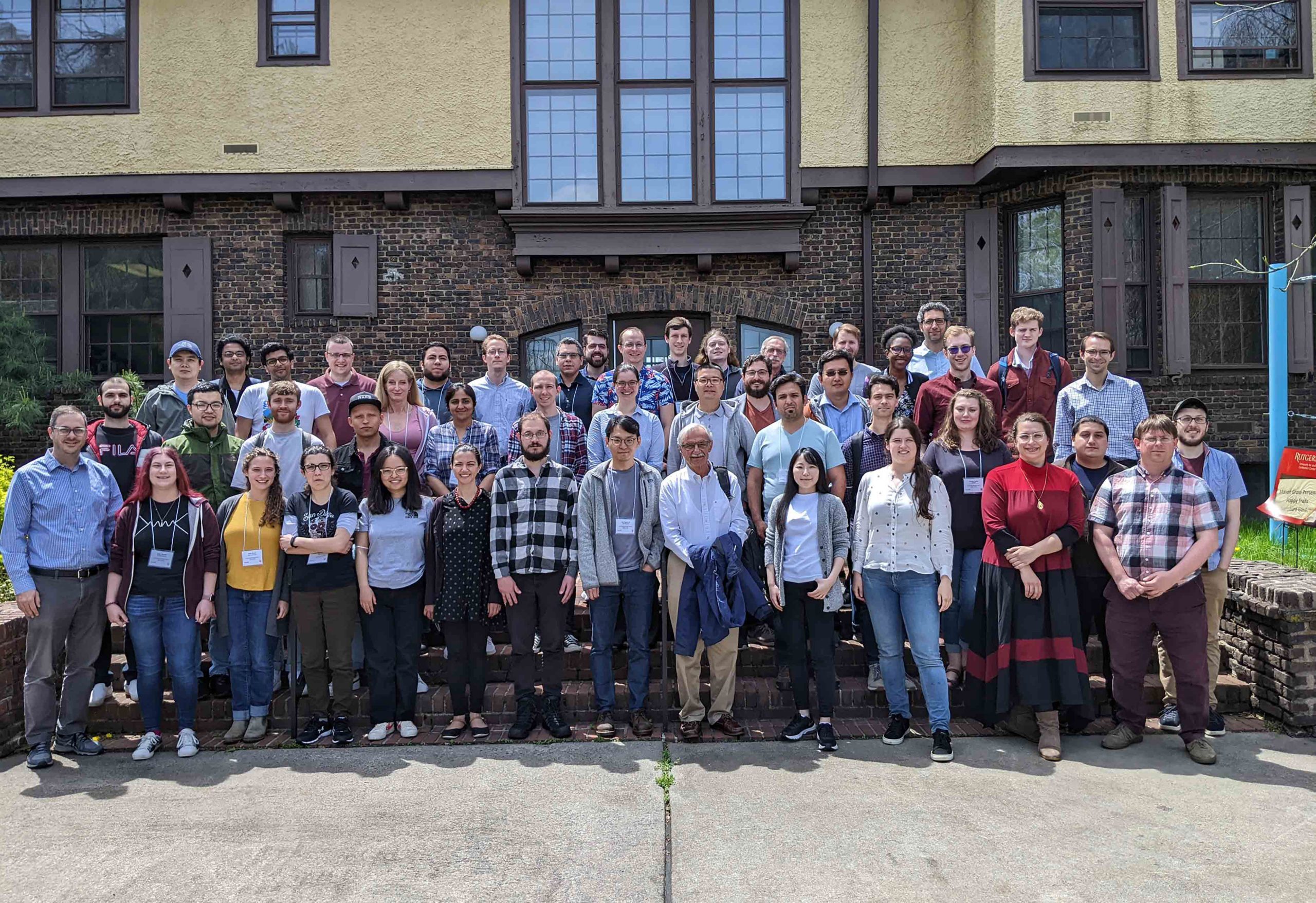
Mastbaum helped lead the experiment’s analysis program as co-coordinator for analysis tools and techniques, overseeing how scientists turned raw data into meaningful physics results. He previously led the team that worked out what the research team refers to as systematic uncertainties, which are the possible sources of error in the measurements. This includes understanding how neutrinos interact with atomic nuclei, how many neutrinos are in the beam, and how the detector responds.
Getting these uncertainties right is critical because it allows scientists to make strong, reliable statements about what the data really shows, Mastbaum said.
Contributions From Rutgers Scientists
Panagiotis Englezos, a doctoral student in the Department of Physics and Astronomy at the Rutgers School of Arts and Sciences, served on the MicroBooNE Data Management Team, helping to process data and produce supporting simulations. Keng Lin, also a doctoral student in the department, helped validate the neutrino flux from Fermilab’s NuMI (Neutrinos from the Main Injector) beam, one of the two neutrino beams used in this analysis. These efforts ensured the accuracy and reliability of the experiment’s findings.
This result is important, Mastbaum said, because it rules out a major theory about new physics. The Standard Model doesn’t explain everything, including dark matter, dark energy, or gravity, he said, so scientists are searching for clues that point beyond the model. Eliminating one possibility helps focus the search on other ideas that could lead to breakthroughs in understanding the universe.
Rutgers scientists played a crucial role in analyzing the data and improving techniques for measuring neutrino interactions in liquid argon. These advances will help future experiments, including the Deep Underground Neutrino Experiment (DUNE).
“With careful modeling and clever analysis approaches, the MicroBooNE team has squeezed an incredible amount of information out of this detector,” Mastbaum said. “With the next generation of experiments, such as DUNE, we are already using these techniques to address even more fundamental questions about the nature of matter and the existence of the universe.”
Reference: “Search for light sterile neutrinos with two neutrino beams at MicroBooNE” by The MicroBooNE Collaboration, 3 December 2025, Nature.
DOI: 10.1038/s41586-025-09757-7
Funding: U.S. Department of Energy, U.S. National Science Foundation, Science and Technology Facilities Council, Royal Society, UK Research and Innovation
Never miss a breakthrough: Join the SciTechDaily newsletter.
Follow us on Google and Google News.
4 Comments
By studying two neutrino beams with a highly sensitive liquid-argon detector, the team was able to rule out the presence of a single sterile neutrino with 95 percent confidence.
VERY GOOD.
Please ask researchers to think deeply:
1. Are the neutrinos high-dimensional spacetime matter or low dimensional spacetime matter?
2. Are the topological vortices high-dimensional spacetime matter or low dimensional spacetime matter?
3. Can low dimensional spacetime matter be the basis of high-dimensional spacetime matter?
4. Is the most fundamental spacetime structure in nature called neutrinos or the geometric shape of low dimensional spacetime?
5. Why can mathematics become the language of science?
6. Do physical entities not have geometric shapes?
7. What are you planning to use to analyze the hierarchical structure of matter?
8. How do you understand topological materials and topological shapes?
Please forget about the so-called quantum or the so-called neutrinos! Topological materials are reshaping the future of science and human society.
When we pursue the ultimate truth of all things, the space in which our bodies and all things exist may itself be the final and deepest puzzle we need to explore. This is not only the pursuit of physics, but also the most magnificent exploration of the origin of the universe by human reason.
Based on the Topological Vortex Theory (TVT), space is an uniformly incompressible physical entity. Space-time vortices are the products of topological phase transitions of the tipping points in space, are the point defects in spacetime. Point defects do not only impact the thermodynamic properties, but are also central to kinetic processes. They create all things and shape the world through spin and self-organization.
In today’s physics, some so-called peer-reviewed journals—including Physical Review Letters, Nature, Science, and others—stubbornly insist on and promote the following:
1. Even though θ and τ particles exhibit differences in experiments, physics can claim they are the same particle. This is science.
2. Even though topological vortices and antivortices have identical structures and opposite rotational directions, physics can define their structures and directions as entirely different. This is science.
3. Even though two sets of cobalt-60 rotate in opposite directions and experiments reveal asymmetry, physics can still define them as mirror images of each other. This is science.
4. Even though vortex structures are ubiquitous—from cosmic accretion disks to particle spins—physics must insist that vortex structures do not exist and require verification. Only the particles that like God, Demonic, or Angelic are the most fundamental structures of the universe. This is science.
5. Even though everything occupies space and maintains its existence in time, physics must still debate and insist on whether space exists and whether time is a figment of the human mind. This is science.
6. Even though space, with its non-stick, incompressible, and isotropic characteristics, provides a solid foundation for the development of physics, physics must still insist that the ideal fluid properties of space do not exist. This is science.
and go on.
Is this the counterintuitive science they widely promote? Compromising with pseudo academic publications and peer review by pseudo scholars is an insult to science and public intelligence. Some so-called scholars no longer understand what shame is. The study of Topological Vortex Theory (TVT) reminds us that the most profound problems in physics often lie at the intersection of different theories. By exploring these border regions, we can not only resolve contradictions in existing theories but also discover new physical phenomena and application possibilities.
Under the topological vortex architecture, it is highly challenging for even two hydrogen atoms or two quarks to be perfectly symmetrical, let alone counter-rotating two sets of cobalt-60. Contemporary physics and so-called peer-reviewed publications (including Physical Review Letters, Science, Nature, etc.) stubbornly believe that two sets of counter rotating cobalt-60 are two mirror images of each other, constructing a more shocking pseudoscientific theoretical framework in the history of science than the “geocentric model”. This pseudo scientific framework and system have seriously hindered scientific progress and social development.
For nearly a century, physics has been manipulated by this pseudo scientific theoretical system and the interest groups behind it, wasting a lot of manpower, funds, and time. A large amount of pseudo scientific research has been conducted, and countless pseudo scientific papers have been published, causing serious negative impacts on scientific and social progress, as well as humanistic development.
Complexity does not necessarily mean that there is no logical and architectural framework to follow. Mathematics is the language and tool that reveals the motion of spacetime, rather than the motion itself. Although the physical form of spacetime vortices is extremely simple, their interaction patterns are highly complex, and we must develop more and richer mathematical languages to describe and understand them.
The development of the Topological Vortex Theory (TVT) reflects a progression from concrete physical phenomena to abstract mathematical modeling and, ultimately, to interdisciplinary unification. Its core innovation lies in forging the continuous spacetime geometry of general relativity with the discrete interactions of quantum field theory within the same topological dynamical system.
——Excerpted from https://scitechdaily.com/microscope-spacecrafts-most-precise-test-of-key-component-of-the-theory-of-general-relativity/#comment-909171.
Never miss a breakthrough: Please join the SciTechDaily Comments.
Off hand 95% is not really good enough to settle this matter. It reduces the likelihood. But usually even 3 sigma is not considered proof of anything in physics, I thought.
{o.o}