
New results from the MicroBooNE experiment rule out the existence of a sterile neutrino, reshaping how scientists think about long-standing neutrino anomalies.
After many years of investigation, researchers working on the Micro Booster Neutrino Experiment (MicroBooNE) have concluded that a proposed particle known as the sterile neutrino does not exist. This particle had been widely discussed as a possible answer to unresolved problems in particle physics. Reporting their findings in the journal Nature, the team has significantly narrowed the list of explanations for one of the most persistent mysteries involving neutrinos.
“Neutrinos are elusive fundamental particles that are difficult to detect experimentally, yet are among the most abundant particles in the universe,” said UC Santa Barbara assistant physics professor David Caratelli, who was the physics coordinator for the experiment when this analysis was carried out.
As Caratelli explained, earlier experiments produced results that conflicted with established understanding of neutrinos, prompting scientists to consider the existence of a fourth type of neutrino — a “sterile” neutrino. The new MicroBooNE measurements, however, do not support this idea, showing that the data are inconsistent with such a particle.
Caratelli described the outcome as an important step forward for the field, noting that eliminating this long-standing hypothesis helps sharpen the search for other exotic particles. It also provides valuable guidance for the next generation of larger experiments designed to probe the fundamental nature of neutrinos.
The work received partial funding from the U.S. Department of Energy’s Office of Science and the National Science Foundation.
A neutrino puzzle
The Standard Model offers a robust and internally consistent framework for understanding the particles and forces that shape the universe, and many of its predictions have been confirmed through experiments. Even so, certain aspects remain unexplained, continuing to challenge physicists.
“We know that the Standard Model does a great job describing a host of phenomena in the natural world,” said Matthew Toups, Fermilab senior scientist and co-spokesperson for MicroBooNE. “And at the same time, we know it’s incomplete. It doesn’t account for dark matter, dark energy or gravity.”
One such gap in understanding is in the realm of neutrinos, which the model initially predicted to have no mass. However, a series of experiments in the latter half of the 20th century that measured neutrinos as they came in from outer space hinted that something odd was happening with these so-called “ghost” particles. Essentially, these experiments noted that certain neutrino “flavors” — they come in either electron, muon or tau flavors — were disappearing as they were traveling, leading scientists to conclude that these particles were oscillating between the flavors, changing their identities as they traveled.
“The only way this oscillation can happen is if neutrinos have mass,” Caratelli explained. “This is something that the Standard Model did not predict.”
Further investigations conducted in the 1990s at the Liquid Scintillator Neutrino Detector (LSND) at Los Alamos National Laboratory and the MiniBooNE experiment at Fermilab into neutrino oscillation turned up another puzzle: muon neutrinos oscillating into electron neutrinos in a way that is not possible with only three neutrino flavors. “The most popular explanation to these anomalies for the past 30 years has been a hypothetical sterile neutrino,” explained Justin Evans, a professor at the University of Manchester and co-spokesperson for MicroBooNE.
Compared to the three known neutrinos, which couple to their charged counterparts via the electroweak force, this hypothetical fourth neutrino would not couple to a charged counterpart via the weak force.
Enter MicroBooNE, a more sensitive detector built at Fermilab to observe with greater resolution these seemingly anomalous oscillations.
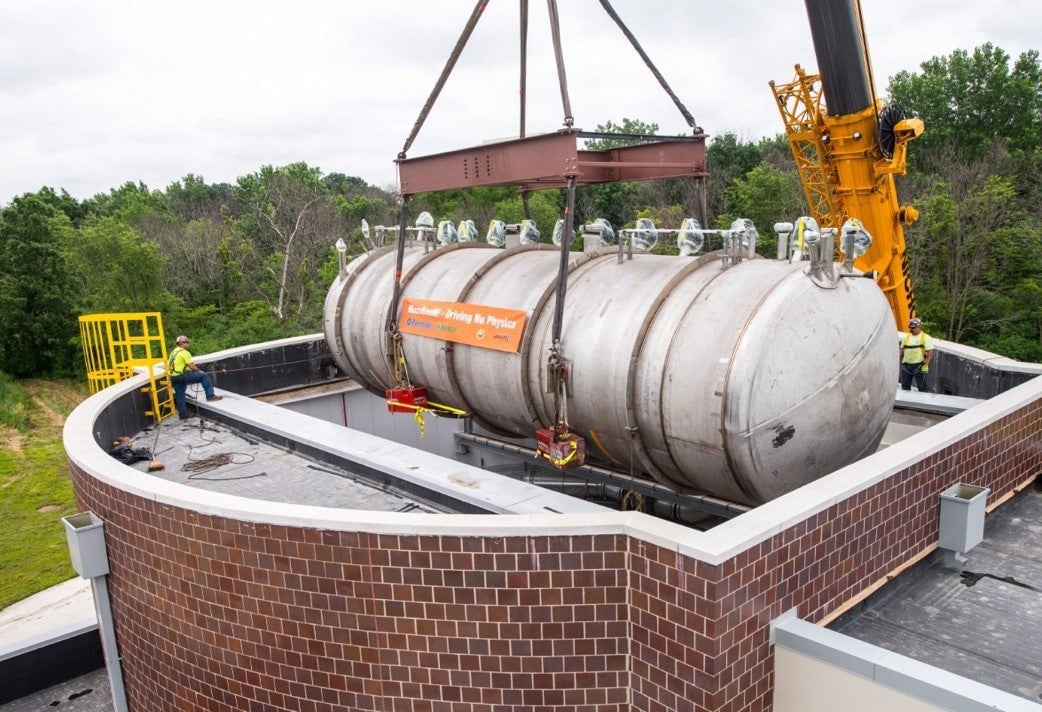
To investigate, the MicroBooNE collaboration took data from two neutrino beams at the Fermilab campus from 2015 to 2021. These beams direct neutrinos toward the MicroBooNE liquid-argon time projection chamber, an instrument that allows the researchers to observe neutrinos as they interact with the highly sensitive liquid argon inside the chamber.
“We produce neutrinos of one kind and place our detectors at optimal positions so that we could maximize the probability of finding this sterile neutrino,” Caratelli said. “In practice, what we did is produce muon neutrinos and if a sterile neutrino were to exist, we would see an appearance of electron neutrinos.”
They then measured how many electron neutrinos reached the detector, and tested the data against the rates they would get if there was a sterile neutrino, and also against the prediction if there wasn’t a sterile neutrino. “Basically, what we were looking for is the effect of the appearance of new electron neutrinos caused by this oscillation phenomenon.”
What they saw, Caratelli said, was consistent with no oscillations into a sterile neutrino, thus ruling out the existence of this hypothetical particle. This work followed an earlier result led by the UCSB group published in Physics Review Letters in the summer of 2025, which ruled out an excess of electron neutrinos.
A ‘paradigm shift’
While the collaboration has closed the door on the sterile neutrino hypothesis, the mystery unearthed by LSND and MiniBooNE remains, one that the scientists are eager to dive into with more, and more powerful detectors.
“I think it’s a bit of a paradigm shift for us,” Caratelli said. After ruling out the roughly 30-year-old sterile neutrino hypothesis, the researchers look forward to investigating a much broader landscape of theories that could explain this anomaly and, more generally, address open questions in particle physics, including uncovering the nature of dark matter.
“We have a much more varied menu of options that we’re investigating,” Caratelli added. And to do this, the researchers also have the benefit of the technology and methods they developed and perfected in their work with MicroBooNE to take to multi-detector approaches.
One such option looks into whether photons, from a possible mis-modeled background or alternative new physics explanation, may be responsible for these anomalies. UCSB physics professor and MicroBooNE collaborator Xiao Luo recently released a first analysis that begins to investigate this new hypothesis. The broader Short Baseline Neutrino program at Fermilab, to which the UCSB team contributes, will be able to study these questions in even greater detail in the coming years.
Meanwhile, preparation and construction are underway for the Deep Underground Neutrino Experiment (DUNE). Located a mile underground at the Sanford Underground Research Facility in South Dakota, the particle detector, which will be the largest of its kind ever built, will receive the world’s most intense beam of high energy neutrinos fired through the ground from Fermilab, 800 miles away.
“MicroBooNE is big — it’s the size of a school bus. But DUNE is football field-scale,” said Caratelli, who is a member of the DUNE collaboration. Its sensitivity, precision, and the amount of data it will generate could give scientists insights not just into neutrino oscillations, but also other mysteries of physics that neutrinos are associated with, such as why the universe has more matter than antimatter.
One of the key things that MicroBooNE did was give us all confidence and teach us how to use this technology to measure neutrinos with high precision,” Caratelli said. “What we learned with MicroBooNE on how to analyze the data that comes to the detector all directly applies to DUNE.”
Reference: “Search for light sterile neutrinos with two neutrino beams at MicroBooNE” by The MicroBooNE Collaboration, 3 December 2025, Nature.
DOI: 10.1038/s41586-025-09757-7
Never miss a breakthrough: Join the SciTechDaily newsletter.
Follow us on Google and Google News.
8 Comments
I’m going out a limb here and say that each neutrino has a characteristic that emanates from it’s initiation point that being said as it travels and comes into contact with something it changes it’s makeup so over distance each neutrino has different modes of detection probably as great of a number of differences as there are in snow flakes and to detect a neutrino of the same set of the sensory detectors would be phenomenal between observations .
I am going out on a limb here and say that you are missing your period… on your keyboard, of course. Plus, a few screws in your head.
New results from the MicroBooNE experiment rule out the existence of a sterile neutrino, reshaping how scientists think about long-standing neutrino anomalies.
VERY GOOD!
Please ask researchers to think deeply:
1. Where do the neutrinos in space come from?
2. What could happen in space if space had ideal fluid characteristics?
When we pursue the ultimate truth of all things, the space in which our bodies and all things exist may itself be the final and deepest puzzle we need to explore. This is not only the pursuit of physics, but also the most magnificent exploration of the origin of the universe by human reason.
Based on the Topological Vortex Theory (TVT), space is an uniformly incompressible physical entity. Space-time vortices are the products of topological phase transitions of the tipping points in space, are the point defects in spacetime. Point defects do not only impact the thermodynamic properties, but are also central to kinetic processes. They create all things and shape the world through spin and self-organization.
In today’s physics, some so-called peer-reviewed journals—including Physical Review Letters, Nature, Science, and others—stubbornly insist on and promote the following:
1. Even though θ and τ particles exhibit differences in experiments, physics can claim they are the same particle. This is science.
2. Even though topological vortices and antivortices have identical structures and opposite rotational directions, physics can define their structures and directions as entirely different. This is science.
3. Even though two sets of cobalt-60 rotate in opposite directions and experiments reveal asymmetry, physics can still define them as mirror images of each other. This is science.
4. Even though vortex structures are ubiquitous—from cosmic accretion disks to particle spins—physics must insist that vortex structures do not exist and require verification. Only the particles that like God, Demonic, or Angelic are the most fundamental structures of the universe. This is science.
5. Even though everything occupies space and maintains its existence in time, physics must still debate and insist on whether space exists and whether time is a figment of the human mind. This is science.
6. Even though space, with its non-stick, incompressible, and isotropic characteristics, provides a solid foundation for the development of physics, physics must still insist that the ideal fluid properties of space do not exist. This is science.
and go on.
Is this the counterintuitive science they widely promote? Compromising with pseudo academic publications and peer review by pseudo scholars is an insult to science and public intelligence. Some so-called scholars no longer understand what shame is. The study of Topological Vortex Theory (TVT) reminds us that the most profound problems in physics often lie at the intersection of different theories. By exploring these border regions, we can not only resolve contradictions in existing theories but also discover new physical phenomena and application possibilities.
Under the topological vortex architecture, it is highly challenging for even two hydrogen atoms or two quarks to be perfectly symmetrical, let alone counter-rotating two sets of cobalt-60. Contemporary physics and so-called peer-reviewed publications (including Physical Review Letters, Science, Nature, etc.) stubbornly believe that two sets of counter rotating cobalt-60 are two mirror images of each other, constructing a more shocking pseudoscientific theoretical framework in the history of science than the “geocentric model”. This pseudo scientific framework and system have seriously hindered scientific progress and social development.
For nearly a century, physics has been manipulated by this pseudo scientific theoretical system and the interest groups behind it, wasting a lot of manpower, funds, and time. A large amount of pseudo scientific research has been conducted, and countless pseudo scientific papers have been published, causing serious negative impacts on scientific and social progress, as well as humanistic development.
Complexity does not necessarily mean that there is no logical and architectural framework to follow. Mathematics is the language and tool that reveals the motion of spacetime, rather than the motion itself. Although the physical form of spacetime vortices is extremely simple, their interaction patterns are highly complex, and we must develop more and richer mathematical languages to describe and understand them.
The development of the Topological Vortex Theory (TVT) reflects a progression from concrete physical phenomena to abstract mathematical modeling and, ultimately, to interdisciplinary unification. Its core innovation lies in forging the continuous spacetime geometry of general relativity with the discrete interactions of quantum field theory within the same topological dynamical system. The core idea of TVT — space is physical, and matter is its topological excitation—already provides a solid and elegant scientific path for understanding the origin of all things.
——Excerpted from https://scitechdaily.com/microscope-spacecrafts-most-precise-test-of-key-component-of-the-theory-of-general-relativity/#comment-909171 and https://t.pineal.cn/blogs/6255/A-Mathematical-and-Physical-Analysis-On-the-Origin-of-Objects.
The standard model was completed in the 1970s. Since then many particles have been “predicted” by tweaking models but none of them has ever turned up.
Model-driven speculative particle physics is a very expensive *failure*.
This is what comes of abandoning realism and empiricism (i.e. letting evidence drive theory).
Failure is only a failure if we fail to learn from it. These experiments teach us a great deal about physics, and generally cost less than one ICBM.
Thank you for browsing and commenting.
Not all of the public are fools. The game and farce where one acts as both an athlete and a referee are no longer sustainable.
Topological Vortex Theory (TVT) demonstrates significant scientific rationality in explaining two-dimensional physical systems, optical vortex rings, and cosmological phenomena. Spacetime and the complex phenomena it contains originate from the self-organization of simple elements within these two-dimensional physical systems.
Once formed, spacetime vortices self-organize through interactions, giving rise to more complex higher-dimensional spacetime structures. This process is not a disorderly accumulation but follows specific rules—such as superposition, entanglement, deflection, and locking—leading to changes in the system’s symmetry, transitioning from one symmetry state to another.
As P. W. Anderson pointed out in his classic paper “More is Different”: “The ability to reduce everything to simple fundamental laws does not imply the ability to start from those laws and reconstruct the entire universe.” The richness and diversity of nature are not a negation of the fundamental laws but rather a rich expression thereof. “More” is not just a quantitative increase but also a qualitative transition. Differences are not merely oppositions but also diverse manifestations of unity. In this picture, the complexity and simplicity of the universe are harmoniously unified, collectively revealing the profound beauty of natural laws.
——https://t.pineal.cn/blogs/4527/The-Simplicity-and-Explanatory-Power-of-Topological-Vortex-Theory-TVT.