
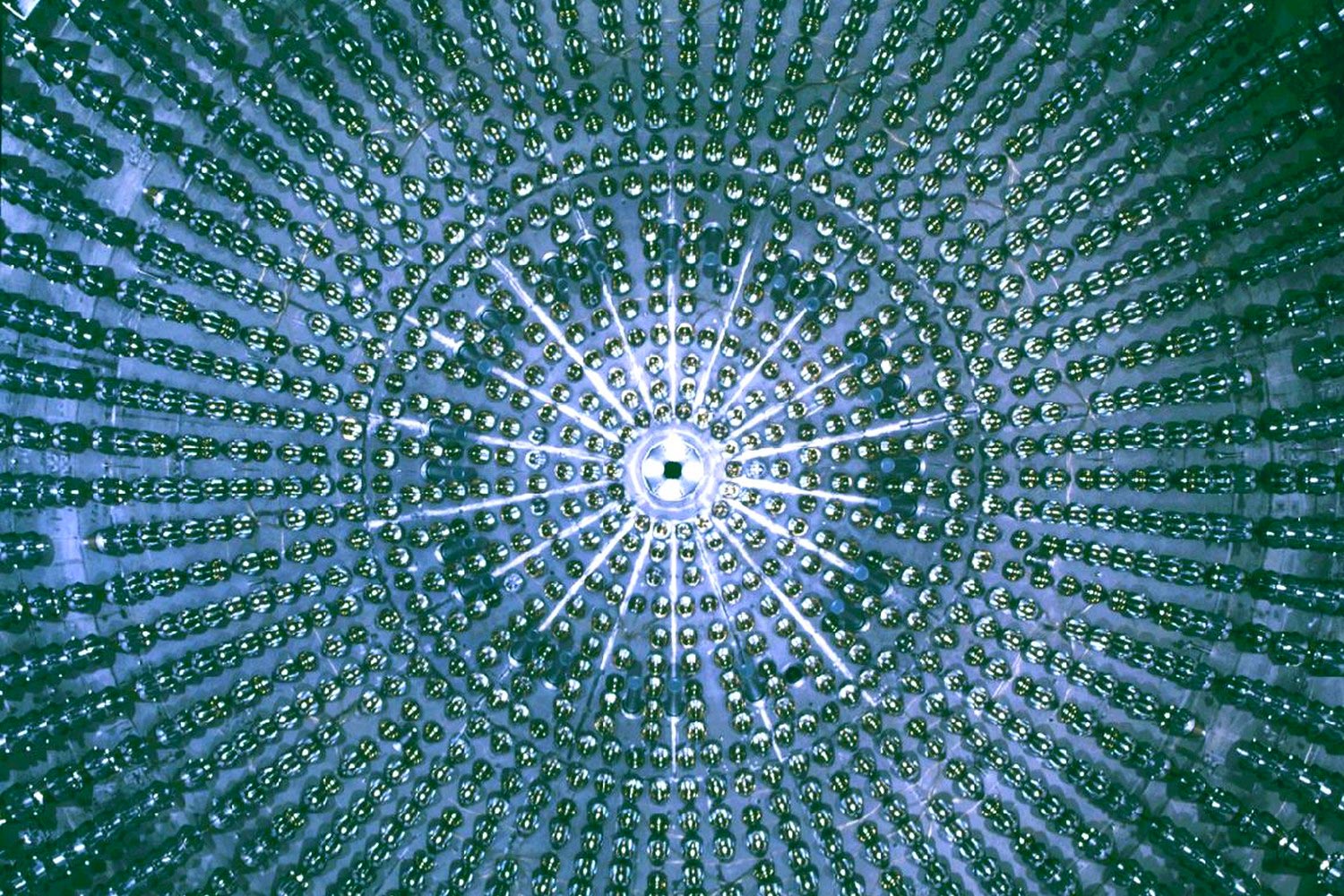
In a chilling Italian lab, scientists utilize extreme cold and ancient materials to challenge existing physics laws.
Their research, aiming to detect phenomena like neutrinoless double beta decay, could redefine understanding of matter and antimatter in the universe, involving students in groundbreaking experiments.
Exploring the Universe’s Mysteries: The Italian Lab
In a subterranean laboratory nestled beneath the Apennine Mountains in Italy, where the coldest temperatures in the known universe have been achieved, teams of international scientists are working to unravel one of particle physics’ greatest mysteries.
Among the more than 150 leading researchers contributing to this groundbreaking work is Cal Poly physics professor Thomas Gutierrez. As the principal investigator of a $340,000, three-year grant funded by the National Science Foundation, Gutierrez plays a key role in the project.

The Quest for Forbidden Nuclear Decay
The research takes place at the Gran Sasso National Laboratory, located near Assergi, Italy, roughly 80 miles northeast of Rome. This cutting-edge facility draws scientists from prestigious institutions, including UC Berkeley, UCLA, Yale, MIT, Johns Hopkins, Cal Poly, and prominent universities across Europe and Asia.
The NSF funding covers costs associated with Cal Poly travel and experiments involving students. With other scientists, Gutierrez and his Cal Poly student team are exploring unproven theories related to nuclear decay, also known as radioactive decay, the process by which an unstable atomic nucleus loses energy through radiation. Their work strives to help better explain why the universe is full of matter, and to address other mysteries that have befuddled scientists for generations.
Unlocking the Secrets of Neutrinos
“If you can find something that breaks the laws of physics, then that’s discovery,” Gutierrez said. “We’re currently looking for is a type of nuclear decay that is currently forbidden by the laws of physics. It’s not supposed to happen. So, if it does, which is what we’re looking for, it tells you a lot about the way the world works.”
The research continues scientific collaboration started under the international CUORE (Cryogenic Underground Observatory for Rare Events) program, which now is called CUPID (CUORE Upgrade with Particle Identification). The word “cuore” means heart in Italian; thus the acronym using “cupid” for the subsequent, latest stage of the program.
Gutierrez’s field of study focuses on neutrinos, which are tiny particles with very slight amounts of mass. Abundant in the universe at the Big Bang and traveling at near lightspeeds, neutrinos can also come from violent bursts like exploding stars. Neutrinos are often created by radioactive decay. Because they don’t interact very much and are neutral, they can help explain the enigmas of the universe related to matter and antimatter.

Challenging Matter-Antimatter Symmetry
In modern physics, all particles have antiparticles, their own antimatter counterpart: electrons have antielectrons (positrons), quarks have antiquarks, and neutrons and protons (which make up the nuclei of atoms) have antineutrons and antiprotons.
“Under the laws of physics, there should have been equal amounts of matter and antimatter, and they should have all annihilated, gone away, and we shouldn’t exist,” Gutierrez said. “Yet this little sliver of matter that got left over is us. Why do we even exist? Why is that sliver there at all? So that’s kind of a puzzle.”
Under a longstanding scientific theory, neutrinos – which are neutral in charge – may be their own antiparticles. But this concept has never been proven. The CUPID work hopes to reveal the possibility of neutrinoless double-beta decay, a radioactive process in which an atomic nucleus releases two electrons but no neutrinos. Observing this decay would support the hypothesis that neutrinos are their own antiparticles.
“If neutrinoless double beta decay happens, it tells us all this information about the foundations of how matter, not just this matter, but all matter exists,” Gutierrez said. “This is very powerful.”

Innovations in Particle Detection Technology
Gutierrez and the international science team are collaborating on a study of tellurium dioxide crystals, a mixture of the element tellurium and oxygen.
“There is a hypothesis that a tellurium isotope can undergo a neutrinoless double beta decay,” Gutierrez said.
About a third of the tellurium nuclei in this chunk of crystal is the right isotope, Gutierrez said.
“The idea is to use a detector out of this crystal where it measures its own decay,” Gutierrez said. “It will deposit a very certain amount of energy, raising the temperature, which we can observe. Through this testing, in a best-case scenario, what we’d like to be able to say is whether or not the neutrino is its own antiparticle.”
The Significance of Ancient Materials in Modern Research
The Italian lab site shields cosmic rays and other natural radioactivity through about a kilometer of rock in each direction and a protective, six-centimeter-thick shield fabricated from boiled-down lead retrieved from an ancient Roman merchant shipwreck. The ancient lead used as a protective guard for the lab’s research is free of its own radioactive material because of a natural process that takes centuries to transpire, demonstrating the effectiveness or centuries-old lead for science.
The Italian facility is the largest underground research center in the world. The cold research conditions have been designed for temperatures of around 10 milliKelvin or -441.74 degrees Fahrenheit, the coldest volume of its size anywhere in the universe. Such cold temperatures help with particle science because when particles are cooled, they move far slower, allowing scientists to more precisely study their behaviors.
People have been “pounding their heads against the wall trying to understand” theories around antimatter versus matter, and how neutrinos might be involved, Gutierrez said.
“There are a lot of different avenues people have been exploring, but about 30 years ago this idea that if this decay occurs, then that tells us about the properties of matter, and that it would imply that the universe actually does favor matter over antimatter ever so slightly,” Gutierrez said.
Cal Poly students already have contributed and will continue to do so, including Reagen Garcia, a physics major, of Morro Bay, California. Part of her work includes conducting remote detector operation shifts of the experiment taking place in Italy.
“CUORE needs to be constantly monitored, so remote detector operation shifts are an important part of the experiment,” Garcia said. “The grant will help students take part in these shifts. It will also help send students to Italy or other universities that are part of the collaboration.”
Garcia also conducted summer work at Yale University’s Wright Laboratory, a collaborating institution for the CUPID experiment, where Garcia conducted testing of a particle detector system.
“It was exciting to be part of such detailed, specific aspects of experimental design,” Garcia said. “This past summer at Yale was the most exciting and rewarding research experience I have had the opportunity to be part of.”
Never miss a breakthrough: Join the SciTechDaily newsletter.
Follow us on Google and Google News.