
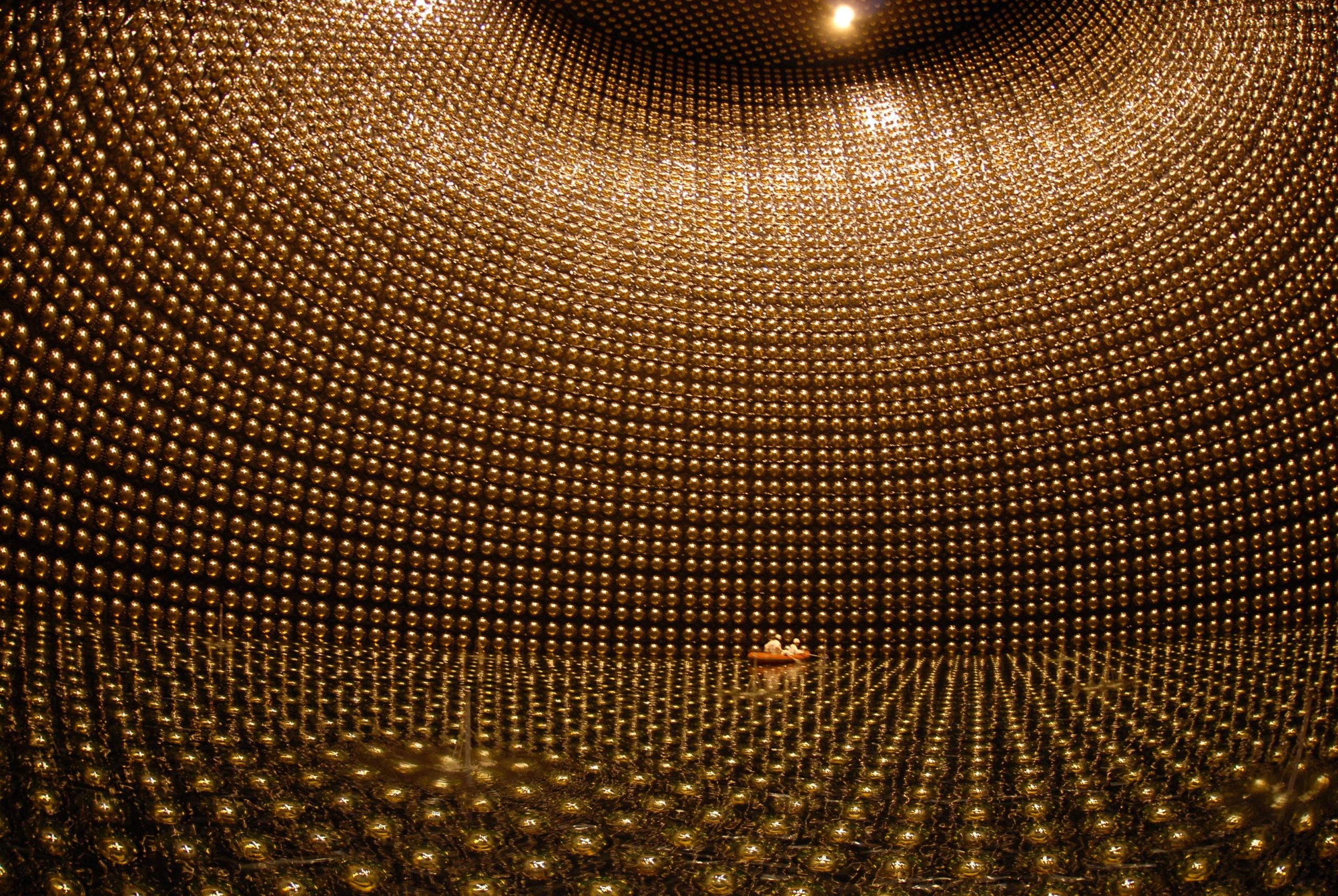
A joint effort between two of the world’s largest neutrino experiments has brought scientists closer to understanding how the universe survived its violent beginnings.
The findings could reveal why matter exists at all — and why everything didn’t vanish long ago.
Scientists Unite to Explore Why the Universe Exists
A Michigan State University researcher has helped lead a groundbreaking collaboration that could bring scientists closer to understanding how the universe came to be.
For the first time, two of the world’s largest neutrino experiments — T2K in Japan and NOvA in the United States — combined their data to gain new insight into neutrinos, the ghostlike particles that constantly stream through space but almost never interact with other matter.
Their joint analysis, published in Nature, offers some of the most precise measurements ever made of how neutrinos shift between types as they travel. This achievement lays important groundwork for future experiments that could reshape our understanding of how the universe evolved — or reveal that current theories are incomplete.
Kendall Mahn, a physics and astronomy professor at Michigan State University and co-spokesperson for T2K, played a leading role in coordinating the project. By working together, the two experiments reached a level of precision that neither could have achieved on its own.
“This was a big victory for our field,” Mahn said. “This shows that we can do these tests, we can look into neutrinos in more detail, and we can succeed in working together.”
A Cosmic Imbalance: Why Matter Survived
Physicists believe that when the universe first formed, matter and antimatter should have existed in equal amounts. If that were true, the two would have destroyed each other completely. Yet matter somehow survived, allowing stars, planets, and life to form — and scientists still don’t fully understand why.
Many now suspect that neutrinos could hold the answer. These tiny, nearly massless particles may help explain how matter gained the upper hand over antimatter. Researchers are particularly interested in a process called neutrino oscillation, in which neutrinos spontaneously change their “flavor” or type as they move through space.
“Neutrinos are not well understood,” said MSU postdoctoral associate Joseph Walsh, who worked on the project. “Their very small masses mean they don’t interact very often. Hundreds of trillions of neutrinos from the sun pass through your body every second, but they will almost all pass straight through. We need to produce intense sources or use very large detectors to give them enough chance to interact for us to see them and study them.”
How T2K and NOvA Track Elusive Particles
Both T2K and NOvA are what scientists call long-baseline experiments. Each one fires a focused beam of neutrinos toward two detectors: a near detector close to where the beam is produced, and a far detector hundreds of miles away. By comparing measurements from the two, researchers can track how neutrinos change as they travel.
Although T2K and NOvA share similar goals, they differ in their distances and energy ranges. That makes their data complementary — and combining them gives scientists a more complete picture of neutrino behavior.
“By making a joint analysis you can get a more precise measurement than each experiment can produce alone,” NOvA collaborator Liudmila Kolupaeva said. “As a rule, experiments in high-energy physics have different designs even if they have the same science goal. Joint analyses allow us to use complementary features of these designs.”
The Neutrino Mass Puzzle
One of the biggest mysteries in particle physics is called “neutrino mass ordering” — determining which type of neutrino is the lightest. The answer isn’t straightforward because each neutrino “flavor” is a blend of three mass states, and each mass state behaves differently.
There are two main possibilities. In the “normal” ordering, two mass states are light and one is heavy. In the “inverted” ordering, the pattern is reversed. These arrangements influence how neutrinos and their antimatter partners, known as antineutrinos, change flavors.
In the normal case, muon neutrinos are more likely to turn into electron neutrinos, while muon antineutrinos are less likely to do the same. In the inverted case, the situation is flipped. If neutrinos and antineutrinos behave differently, that would mean they violate charge-parity (CP) symmetry — a principle that says matter and antimatter should mirror each other. This violation could help explain why the universe contains matter at all.
What the Results Reveal
The combined analysis from NOvA and T2K does not yet favor either mass ordering. If the normal arrangement is correct, the data so far are unclear about CP symmetry. But if future results confirm the inverted ordering, the findings published now suggest that neutrinos may indeed violate CP symmetry.
If CP symmetry violation does not occur, scientists would lose one of their strongest explanations for why matter exists in greater quantities than antimatter. Either way, this joint study marks an essential step toward solving one of physics’ most enduring mysteries.
A Global Effort in Discovery
While the findings do not yet solve the puzzle of neutrinos, they add valuable knowledge about how these particles behave and demonstrate what large-scale scientific cooperation can achieve.
The NOvA collaboration includes more than 250 scientists and engineers from 49 institutions across eight countries. The T2K team involves over 560 members from 75 institutions in 15 countries. Their combined work began in 2019, drawing on eight years of NOvA data and ten years of T2K. Both experiments continue to collect new data to refine and expand the analysis.
“These results are an outcome of a cooperation and mutual understanding of two unique collaborations, both involving many experts in neutrino physics, detection technologies, and analysis techniques, working in very different environments, using different methods and tools,” T2K collaborator Tomáš Nosek said.
Reference: “Joint neutrino oscillation analysis from the T2K and NOvA experiments” by The NOvA Collaboration, and The T2K Collaboration, 22 October 2025, Nature.
DOI: 10.1038/s41586-025-09599-3
Never miss a breakthrough: Join the SciTechDaily newsletter.
Follow us on Google and Google News.
12 Comments
Can they explain why universe is so crappy place to live, too?
Simple answer. The deliberate vindictiveness of human beings turns a paradise into hell.
The universe is a symmetric state that requires matter and antimatter to coexist at all. The entanglement of these fundamental structures is what makes the universe completely functional. It is nonsensical to suggest that matter and antimatter cannot simultaneously exist. There is absolutely no experimental evidence or postulates to confirm these findings.
Very good research
The article is presented with fine clarìty and value to make the goal of statement evaluated to own part,correctly,that màtter dominates to antimater in the universe,to exist.
BibhutibhusanPatel, Please think:
1. Are the neutrinos high-dimensional spacetime matter or low dimensional spacetime matter?
2. Are the topological vortices high-dimensional spacetime matter or low dimensional spacetime matter?
3. Can low dimensional spacetime matter be the basis of high-dimensional spacetime matter?
4. Is the most fundamental spacetime structure in nature called neutrinos or the geometric shape of low dimensional spacetime?
5. Why can mathematics become the language of science?
6. Do physical entities not have geometric shapes?
7. What are you planning to use to analyze the hierarchical structure of matter?
8. How do you understand topological materials and topological shapes?
The interaction between topological vortices and their fractal structures is extremely complex. Physics requires the development of a rich mathematical language to understand and describe them.
I’m not necessarily disagreeing, but I’m sure you’d run into more than enough problems in this “paradise” even without humans.
I had the same question my friend. I am computer scientist and mathematician but this question is transcending science
You will find the answer in the bible. God created and maintained the world and us in perfect harmony in it. But we decided we will do a better job than God,
“For God knows that in the day you eat of it, your eyes will be opened and you will be like God, knowing good and evil.”. And so God let us be our will and follow the serpent and do our experiment and see how well we will do. So now we live in the dominion of the serpent as the bible says. But the good news is that through the blood of Christ we can return to Gods kingdom.
And if that sounds like a made up concept, just dig and examine the evidence for all that had been claimed in both the old and new testament.
My favored hypothesis is that the 4th dimension is collapsing. We experience this collapse as time passing. We also experience the other dimensions as expanding, although this is an illusion as we are also as a universe collapsing with the 4th dimension. The other dimensions are relative to us, stable.
Physicists believe that when the universe first formed, matter and antimatter should have existed in equal amounts. If that were true, the two would have destroyed each other completely.
VERY GOOD!
Please ask physicists to think deeply:
Under what circumstances can topological vortices and their antivortices destroy each other completely? Don’t be fooled by pseudoscience anymore. Scientific research should understand what shame is.
When we pursue the ultimate truth of all things, the space in which our bodies and all things exist may itself be the final and deepest puzzle we need to explore. This is not only the pursuit of physics, but also the most magnificent exploration of the origin of the universe by human reason.
Based on the Topological Vortex Theory (TVT), space is an uniformly incompressible physical entity. Space-time vortices are the products of topological phase transitions of the tipping points in space, are the point defects in spacetime. Point defects do not only impact the thermodynamic properties, but are also central to kinetic processes. They create all things and shape the world through spin and self-organization.
In today’s physics, some so-called peer-reviewed journals—including Physical Review Letters, Nature, Science, and others—stubbornly insist on and promote the following:
1. Even though θ and τ particles exhibit differences in experiments, physics can claim they are the same particle. This is science.
2. Even though topological vortices and antivortices have identical structures and opposite rotational directions, physics can define their structures and directions as entirely different. This is science.
3. Even though two sets of cobalt-60 rotate in opposite directions and experiments reveal asymmetry, physics can still define them as mirror images of each other. This is science.
4. Even though vortex structures are ubiquitous—from cosmic accretion disks to particle spins—physics must insist that vortex structures do not exist and require verification. Only the particles that like God, Demonic, or Angelic are the most fundamental structures of the universe. This is science.
5. Even though everything occupies space and maintains its existence in time, physics must still debate and insist on whether space exists and whether time is a figment of the human mind. This is science.
6. Even though space, with its non-stick, incompressible, and isotropic characteristics, provides a solid foundation for the development of physics, physics must still insist that the ideal fluid properties of space do not exist. This is science.
and go on.
Is this the counterintuitive science they widely promote? Compromising with pseudo academic publications and peer review by pseudo scholars is an insult to science and public intelligence. Some so-called scholars no longer understand what shame is. The study of Topological Vortex Theory (TVT) reminds us that the most profound problems in physics often lie at the intersection of different theories. By exploring these border regions, we can not only resolve contradictions in existing theories but also discover new physical phenomena and application possibilities.
Under the topological vortex architecture, it is highly challenging for even two hydrogen atoms or two quarks to be perfectly symmetrical, let alone counter-rotating two sets of cobalt-60. Contemporary physics and so-called peer-reviewed publications (including Physical Review Letters, Science, Nature, etc.) stubbornly believe that two sets of counter rotating cobalt-60 are two mirror images of each other, constructing a more shocking pseudoscientific theoretical framework in the history of science than the “geocentric model”. This pseudo scientific framework and system have seriously hindered scientific progress and social development.
For nearly a century, physics has been manipulated by this pseudo scientific theoretical system and the interest groups behind it, wasting a lot of manpower, funds, and time. A large amount of pseudo scientific research has been conducted, and countless pseudo scientific papers have been published, causing serious negative impacts on scientific and social progress, as well as humanistic development.
Complexity does not necessarily mean that there is no logical and architectural framework to follow. Mathematics is the language and tool that reveals the motion of spacetime, rather than the motion itself. Although the physical form of spacetime vortices is extremely simple, their interaction patterns are highly complex, and we must develop more and richer mathematical languages to describe and understand them.
The development of the Topological Vortex Theory (TVT) reflects a progression from concrete physical phenomena to abstract mathematical modeling and, ultimately, to interdisciplinary unification. Its core innovation lies in forging the continuous spacetime geometry of general relativity with the discrete interactions of quantum field theory within the same topological dynamical system.
——Excerpted from https://scitechdaily.com/microscope-spacecrafts-most-precise-test-of-key-component-of-the-theory-of-general-relativity/#comment-909171.
If it is very difficult to detect neutrinos, how are they sure that so much neutrinos are released from sun that millions pass through our body. So the estimate is based purely on theory, which is still incomplete, and is blatantly wrong. The ‘sea of neutrinos’ is just a fantasy like the ‘sea of aether’ of the past. In my opinion, relatively few neutrinos are released and a significant part of is detected. The ‘sea of neutrinos’ is propped up to save Einstein’s equation.