
A clinical trial has uncovered a molecular change in skeletal muscle that may help explain why exercise improves insulin sensitivity in people with Type 2 diabetes.
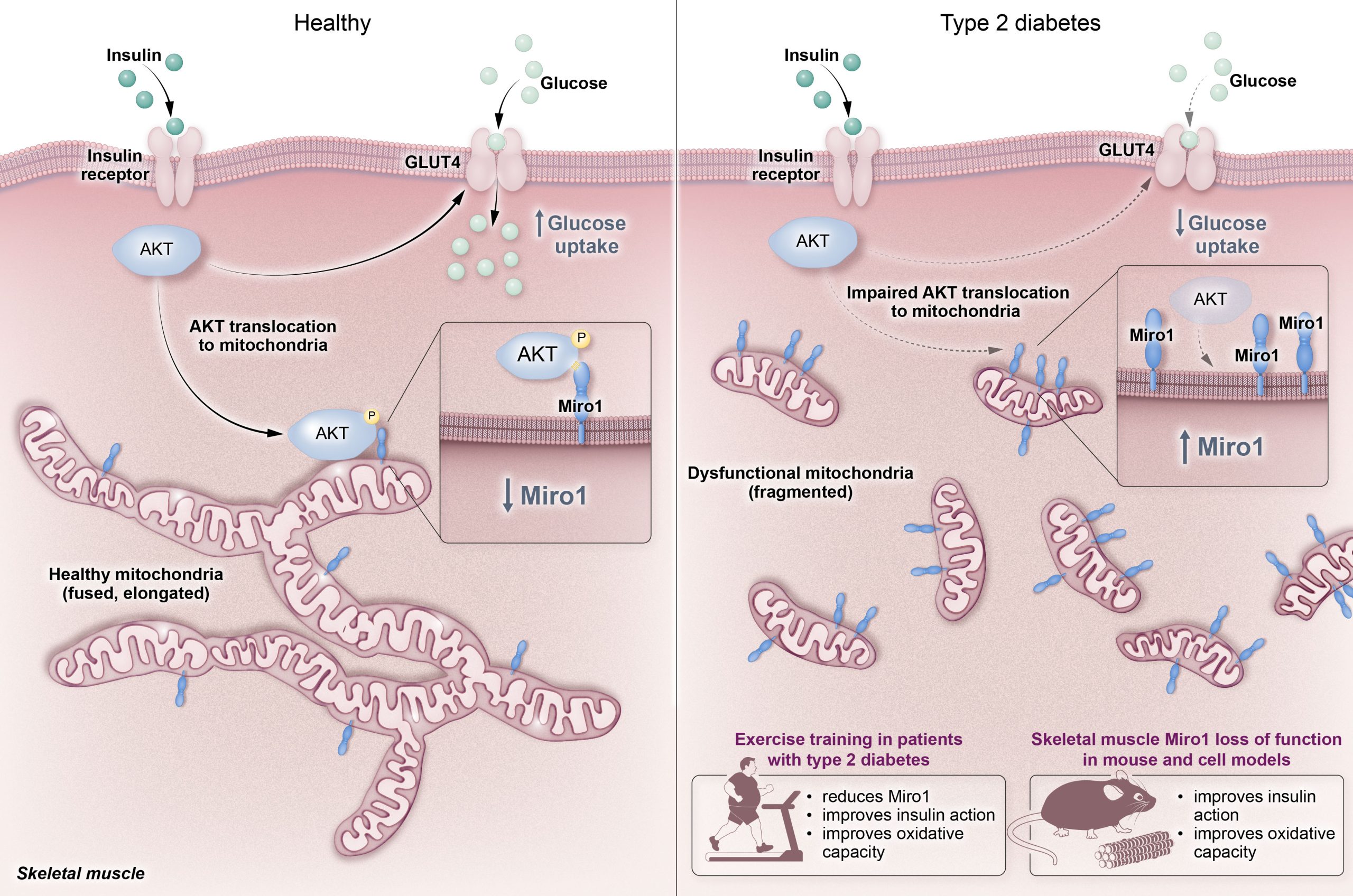
A protein found in unusually high amounts in the muscles of people with Type 2 diabetes may be interfering with the body’s ability to respond to insulin. Researchers discovered that removing the protein, known as Miro1, restored insulin responsiveness in preclinical models, suggesting a possible new approach to treating insulin resistance.
The study, published in Nature Communications, also found that aerobic exercise reduced Miro1 levels in people with Type 2 diabetes. Those reductions occurred alongside improvements in insulin sensitivity and the muscles’ ability to produce energy.
Miro1 (Mitochondrial Rho GTPase1) sits on the outer membrane of mitochondria, the structures responsible for producing much of a cell’s usable energy. Skeletal muscle plays a major role in regulating blood sugar because it absorbs glucose from the bloodstream in response to insulin. When muscle becomes resistant to insulin, glucose is less effectively removed from the blood, contributing to the elevated blood sugar associated with Type 2 diabetes.
To investigate Miro1’s involvement, scientists examined its effects in cells, preclinical models, and people with Type 2 diabetes. Their experiments showed that excess Miro1 impaired insulin responses in muscle, while removing the protein reversed those effects in preclinical models.
“Insulin resistance in muscle is at the heart of Type 2 diabetes, and its molecular causes have remained frustratingly unclear. This study, the product of years of work, identifies Miro1 as a key part of the answer. By tracing Miro1 from cells to preclinical models to patients, we show that Miro1 accumulation impairs the muscle’s response to insulin, that removing it causally restores that response in our models, and that exercise reverses its buildup in people. For the field, this is a new therapeutic target. For patients, it deepens our understanding of why exercise is so effective and opens a path toward treatments that could one day complement it,” said senior author Dr. John P. Kirwan.
The researchers also conducted a randomized controlled trial involving participants with obesity and Type 2 diabetes. One group performed aerobic exercise, while another received standard medical care. Participants assigned to exercise showed lower Miro1 levels in their muscles, together with improved insulin sensitivity and mitochondrial energy production.
These human findings support a connection between exercise, Miro1, and metabolic health. However, they do not establish that reducing Miro1 is responsible for the benefits of exercise. The preclinical experiments provide more direct evidence that the protein can influence insulin responses.
Kirwan led the research while working at LSU’s Pennington Biomedical Research Center. He has since been appointed executive director of the OU Health Harold Hamm Diabetes Center at the University of Oklahoma, where he will continue investigating the biological mechanisms of diabetes and potential treatments.
The study’s first author, Elizabeth Heintz, conducted research as a doctoral candidate in Pennington Biomedical’s Integrated Physiology and Molecular Medicine Laboratory. Co-corresponding author Christopher Axelrod has since joined Kirwan at the Harold Hamm Diabetes Center.
“This research exemplifies the breadth of scientific discovery at Pennington Biomedical, where research spans all levels, from basic science that reveals the biological mechanisms underlying disease to clinical studies and population-based research that informs public health,” said Dr. Jennifer Rood, Interim Senior Vice Chancellor and Executive Director of Pennington Biomedical. “Dr. Kirwan and his team’s findings on Miro1 demonstrate the value of this integrated approach, connecting fundamental discoveries about muscle function with insights into insulin resistance and the benefits of exercise in people with Type 2 diabetes. This work is advancing our understanding of diabetes and helping lay the foundation for future approaches to prevention and treatment.”
Although removing Miro1 improved insulin responses in experimental models, researchers have not yet established whether targeting the protein would be safe or effective as a treatment for people. Further studies will need to clarify how Miro1 contributes to insulin resistance and whether modifying its activity can improve blood sugar regulation.
At the Harold Hamm Diabetes Center, Kirwan plans to build on these findings through research that connects laboratory discoveries with studies involving people with diabetes.
“Type 2 diabetes is an affliction in Oklahoma and nationally,” he said. “Ultimately, we are looking for cures, and we hope these recent findings could be part of the solution.”
Reference: “Miro1 mediates skeletal muscle insulin resistance in type 2 diabetes” by Elizabeth C. Heintz, Wagner S. Dantas, Analisa L. Taylor, Elizabeth R. M. Zunica, Kathryn P. Belmont, Jackson M. Slone, Jacob T. Mey, Robbie Beyl, Bolormaa Vandanmagsar, Hailey A. Parry, Peter Ajayi, Brian Glancy, Christopher L. Axelrod and John P. Kirwan, 19 October 2026, Nature Communications.
DOI: 10.1038/s41467-026-77278-6
The research was supported by the National Institute of Diabetes and Digestive and Kidney Diseases, the National Institute on Aging, the National Center for Complementary and Integrative Health, the National Heart, Lung, and Blood Institute, and the National Institute of General Medical Sciences.
Never miss a breakthrough: Join the SciTechDaily newsletter.
Follow us on Google and Google News.