
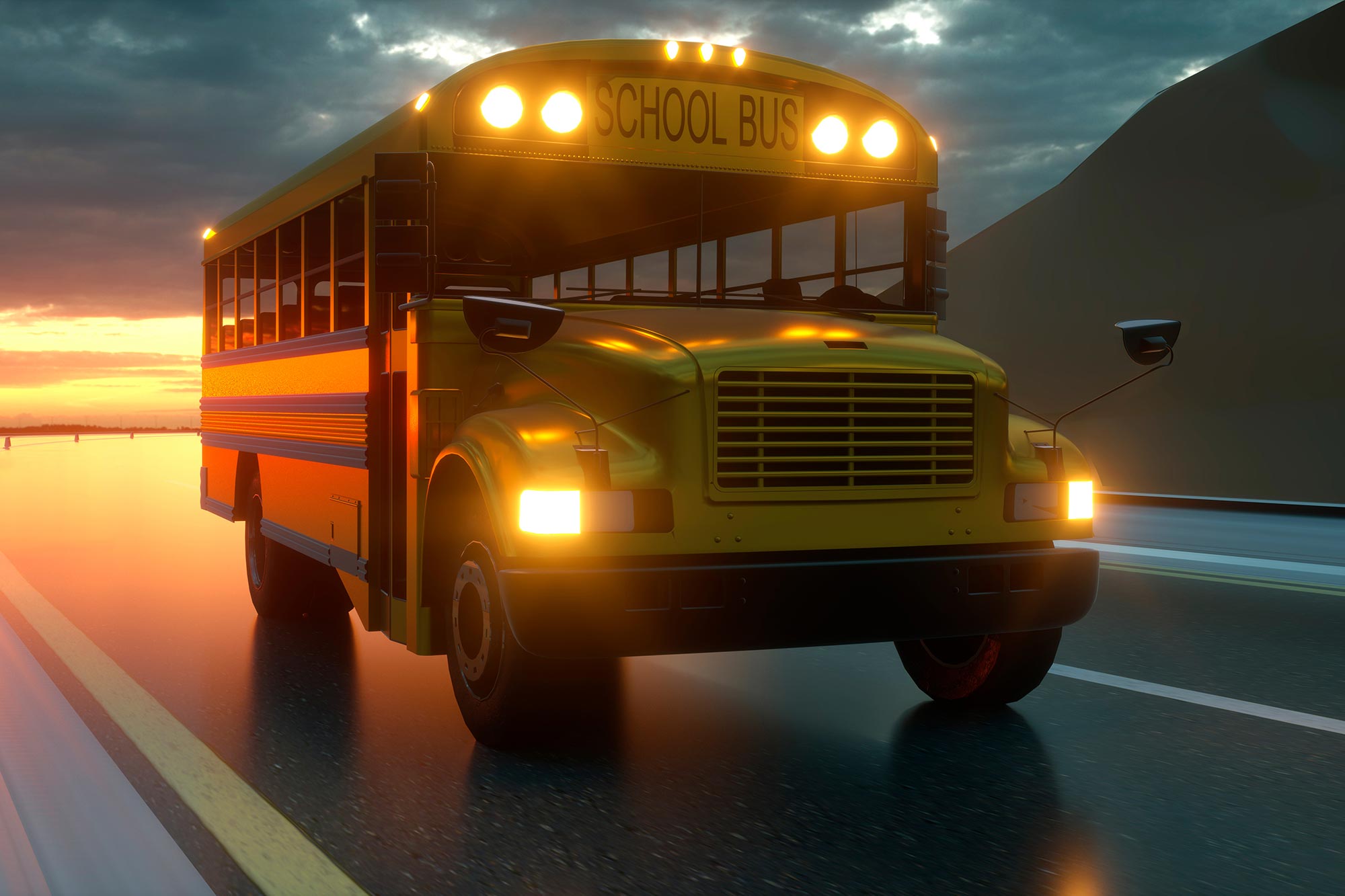
Permanent daylight saving time could leave some states with roughly ten times as many dark school commutes, sharpening concerns about children’s safety and sleep.
Keeping daylight saving time through the winter would move sunrise an hour later on the clock, leaving children with fixed school schedules to make more trips in the dark. University of Washington researchers estimate that a nationwide shift would add at least 2 billion dark school commutes compared with the current system of switching between daylight saving time and standard time twice a year.
The U.S. House of Representatives passed a bill this past summer that would make daylight saving time (DST) permanent, ending the fall return to standard time. Nineteen states, including Washington, have already preapproved the change, which would take effect in those states if the bill is signed into law. The legislation is stalled in the U.S. Senate, with school start times a central issue because mornings would be darker from November through March.
Dark mornings raise safety and sleep concerns
The study, published October 29 in Current Biology, examined both school schedules and U.S. traffic collision data. The collision analysis found that a fatal crash involving a school-aged pedestrian was roughly twice as likely to occur during a dark morning as after sunrise.
Morning light also helps set the circadian clock, the body’s internal timing system, which helps regulate mood, sleep, and appetite. Without that light, the body has more difficulty regulating these functions.
“When we send kids to school in the dark, we are depriving them from an opportunity to get that morning daylight,” said lead author Guadalupe Rodríguez Ferrante, a UW postdoctoral scholar in biology. “We were asking what’s the cost for these children. We wanted actual numbers, a real number of kids based on the geographic location of each school.”
Horacio de la Iglesia, UW professor of biology, discusses how permanent Daylight Saving Time will affect commutes for school children. Credit: Sarah McQuate/University of Washington
Early school starts mean more dark commutes
For 14 of the 19 states that had preapproved permanent DST, the researchers combined school start times, enrollment data, and latitude and longitude measurements. They calculated how many days each child would travel to school in the dark, then added those trips together to compare permanent DST with the current system.
All 14 states would see an increase. Washington would have almost 35 million additional dark trips to school, while Georgia would have the largest increase among the states studied, at 71 million.
Communities on the western edge of their time zones, such as Forks, Washington, would be particularly affected, as would those with early school start times. In Mississippi and Alabama, schools start before 8 a.m. on average. Each state would go from about 2 million dark school commutes under the current system to more than 20 million under permanent DST.
“Some districts probably never experience a dark commute under the current system, and, if this passes, suddenly they will wake up to this new reality that their kids are going to school in the dark,” Rodríguez Ferrante said. “Keep in mind that we used the actual start time listed for each school, and a lot of schools offer breakfast or other things before school, so the kids could be getting there even earlier.”
The nationwide estimate came from extrapolating the results from the 14 states to the rest of the country, with an assumption that makes the total likely conservative.
“For the estimation, we assumed students would be leaving home around 8 a.m.,” Rodríguez Ferrante said. “That’s pretty late, so our calculation is likely an underestimation of the real number.”
Delaying school could erase the evening benefit
“It’s called the ‘Sunshine Protection Act’ because you get an extra hour of light at the end of the day. But you will take that hour from the morning. You could call it the Sunshine Destruction Act,” said senior author Horacio de la Iglesia, a UW professor of biology. “These dark mornings will inequitably affect children who have to go to school at a certain time. It’s a very tangible metric that anybody from any state or socioeconomic background can relate to. Nobody wants their kids to go to school in the dark.”
The researchers also argue that permanent DST would undo the benefits of delayed start times for high school students. Those later starts are intended to accommodate teenagers’ circadian clocks, which are shifted compared with those of younger children and adults.
“I’ve heard the argument, ‘If we’re in permanent DST, we can just delay the school start time to address these issues,'” de la Iglesia said. “Well, if we do that, you will end up going to work later. And everything is going to get delayed. You will get out of work an hour later, and you will miss the opportunity to enjoy your evening light. And essentially, we’re just going to be realigning everybody to solar time. That, by definition, is Standard Time.”
Reference: “Over a billion more dark-morning school commutes for K–12 children under the Sunshine Protection Act” by Guadalupe Rodríguez Ferrante, Nirekh S. Dasika, Alicia Nam, Jessie Lu, Navneet Tumber, Elena Kully-Rivera, Viridian Klei, Daniel Zhang, Micaela E. Romero and Horacio O. de la Iglesia, 29 October 2026, Current Biology.
DOI: 10.1016/j.cub.2026.10.014
Never miss a breakthrough: Join the SciTechDaily newsletter.
Follow us on Google and Google News.