
Close Menu
    Facebook X (Twitter) Instagram
    SciTechDaily
    • Biology
    • Chemistry
    • Earth
    • Health
    • Physics
    • Science
    • Space
    • Technology
    Facebook X (Twitter) Pinterest YouTube RSS
    SciTechDaily
    Home»Science»Sleep Mystery Solved With Math: Cytoplasmic Traffic Jam Disrupts Sleep-Wake Cycles
    Science

    Sleep Mystery Solved With Math: Cytoplasmic Traffic Jam Disrupts Sleep-Wake Cycles

    By KAISTDecember 14, 2020No Comments4 Mins Read
    Facebook Twitter Pinterest Telegram LinkedIn WhatsApp Email Reddit
    Share
    Facebook Twitter LinkedIn Pinterest Telegram Email Reddit
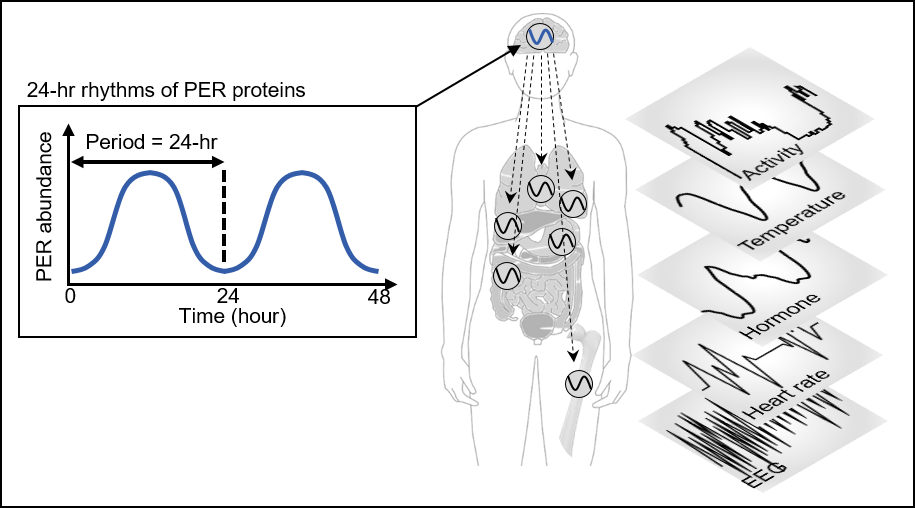
    PER Abundance Oscillates in a Circadian Manner
    Figure 1. PER abundance oscillates in a circadian manner through an autoregulatory negative feedback loop. This oscillation enables robust timekeeping of circadian-timed physiological and behavioral processes including sleep. Credit: KAIST

    KAIST mathematicians and their collaborators at Florida State University have identified the principle of how aging and diseases like dementia and obesity cause sleep disorders. A combination of mathematical modeling and experiments demonstrated that the cytoplasmic congestion caused by aging, dementia, and/or obesity disrupts the circadian rhythms in the human body and leads to irregular sleep-wake cycles. This finding suggests new treatment strategies for addressing unstable sleep-wake cycles.

    Human bodies adjust sleep schedules in accordance with the ‘circadian rhythms,’ which are regulated by our time keeping system, the ‘circadian clock.’ This clock tells our body when to rest by generating the 24-hour rhythms of a protein called PERIOD (PER) (See Figure 1).

    The amount of the PER protein increases for half of the day and then decreases for the remaining half. The principle is that the PER protein accumulating in the cytoplasm for several hours enters the cell nucleus all at once, hindering the transcription of PER genes and thereby reducing the amount of PER.

    However, it has remained a mystery how thousands of PER molecules can simultaneously enter into the nucleus in a complex cell environment where a variety of materials co-exist and can interfere with the motion of PER. This would be like finding a way for thousands of employees from all over New York City to enter an office building at the same time every day.
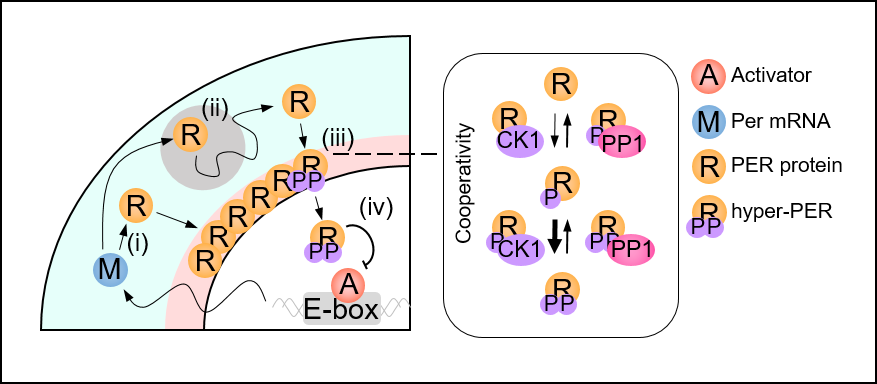
    Spatial Stochastic Model of the Circadian Clock
    Figure 2. Spatial Stochastic model of the circadian clock. After Per mRNA, M, is translated to protein, R, in the cytoplasm (i), PER transits toward the perinucleus, past obstacles while being hypophosphorylated (ii; gray circle). The accumulated PER in the perinucleus is hyperphosphorylated in a cooperative manner (iii). Then it enters the nucleus and inhibits the transcriptional activity of the activator, A (iv). Credit: KAIST

    A group of researchers led by Professor Jae Kyoung Kim from the KAIST Department of Mathematical Sciences solved the mystery by developing a spatiotemporal and probabilistic model that describes the motion of PER molecules in a cell environment.

    This study was conducted in collaboration with Professor Choogon Lee’s group from Florida State University, where the experiments were carried out, and the results were published in the Proceedings of the National Academy of Sciences (PNAS) last month.

    The joint research team’s spatial stochastic model (See Figure 2) described the motion of PER molecules in cells and demonstrated that the PER molecule should be sufficiently condensed around the cell nucleus to be phosphorylated simultaneously and enter the nucleus together (See Figure 3 Left). Thanks to this phosphorylation synchronization switch, thousands of PER molecules can enter the nucleus at the same time every day and maintain stable circadian rhythms.
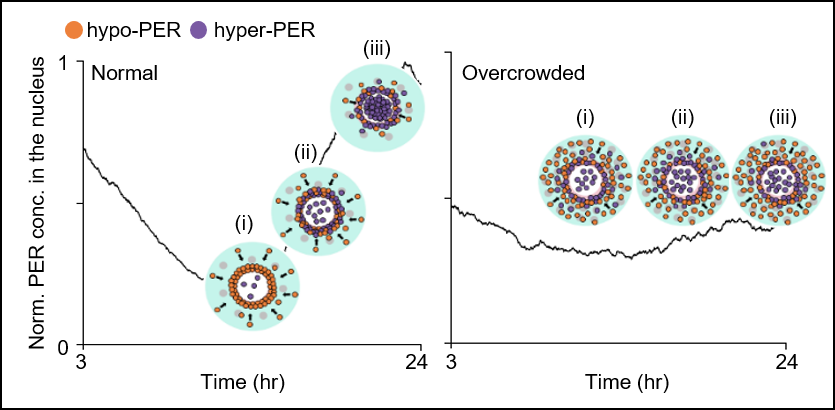
    Cytoplasmic Flux Increases PER Abundance
    Figure 3. In normal cell (left), the cytoplasmic flux over several hours increases PER abundance in the perinucleus (pink region in Figure 2) compared with the peripheral cytoplasm (cyan region in Figure 2) (i). This induces a sharp switch-like hyperphosphorylation in the perinucleus due to the cooperativity (ii), followed by synchronous nuclear entry within a narrow time window (iii). When a cell is overcrowded (right), the cytoplasmic flux is hindered, and thus PER does not accumulate in the same gradient as in the normal cell (i). This disables the sharp switch-like PER hyperphosphorylation and nuclear entry (ii and iii). Credit: KAIST

    However, when aging and/or diseases including dementia and obesity cause the cytoplasm to become congested with increased cytoplasmic obstacles such as protein aggregates and fat vacuoles, it hinders the timely condensation of PER molecules around the cell nucleus (See Figure 3 Right). As a result, the phosphorylation synchronization switch does not work and PER proteins enter into the nucleus at irregular times, making the circadian rhythms and sleep-wake cycles unstable, the study revealed.

    Professor Kim said, “As a mathematician, I am excited to help enable the advancement of new treatment strategies that can improve the lives of so many patients who suffer from irregular sleep-wake cycles. Taking these findings as an opportunity, I hope to see more active interchanges of ideas and collaboration between mathematical and biological sciences.”

    Reference: “Wake-sleep cycles are severely disrupted by diseases affecting cytoplasmic homeostasis” by  Stephen Beesley, Dae Wook Kim, Matthew D’Alessandro, Yuanhu Jin, Kwangjun Lee, Hyunjeong Joo, Yang Young, Robert J. Tomko Jr, John Faulkner, Joshua Gamsby, Jae Kyoung Kim and Choogon Lee, 26 October 2020, Proceedings of the National Academy of Sciences.
    DOI: 10.1073/pnas.2003524117

    This work was supported by the National Institutes of Health and the National Science Foundation in the US, and the International Human Frontiers Science Program Organization and the National Research Foundation of Korea.

    Never miss a breakthrough: Join the SciTechDaily newsletter.
    Follow us on Google and Google News.

    Aging Circadian Rhythm Dementia Korea Advanced Institute of Science and Technology Mathematics Sleep Science
    Share. Facebook Twitter Pinterest LinkedIn Email Reddit

    Related Articles

    This Common Habit Could Signal Serious Health Problems in Later Life

    This AI Tool Can Tell If Your Brain Is Aging Too Fast

    Scientists Uncover Simple 20-Minute Trick To Reduce Morning Fatigue

    Sleepier During the Day? It May Double Your Dementia Risk

    Rewiring Time: How Synchronizing Your Internal Clocks Can Ease Jet Lag and Aging

    Forget 8 Hours – Scientists Discover Ideal Amount of Sleep in Middle and Old Age

    Catastrophizing: Why We Wake Around 3am and Dwell on Our Fears and Failures

    Tooth Loss Is a Risk Factor for Cognitive Impairment and Dementia

    Mathematics and LEGO: The Deeper Meaning of Combined Systems and Networks

    Leave A Reply Cancel Reply

    • Facebook
    • Twitter
    • Pinterest
    • YouTube

    Don't Miss a Discovery

    Subscribe for the Latest in Science & Tech!

    Trending News

    Popular Sugar-Free Sweetener Linked to Liver Disease, Study Warns

    What Is Hantavirus? The Deadly Disease Raising Alarm Worldwide

    Scientists Just Discovered How the Universe Builds Monster Black Holes

    Scientists Unveil New Treatment Strategy That Could Outsmart Cancer

    A Simple Vitamin May Hold the Key to Treating Rare Genetic Diseases

    Scientists Think the Real Fountain of Youth May Be Hiding in Your Gut

    Ravens Don’t Follow Wolves, They Predict Them

    This Common Knee Surgery May Be Doing More Harm Than Good

    Follow SciTechDaily
    • Facebook
    • Twitter
    • YouTube
    • Pinterest
    • Newsletter
    • RSS
    SciTech News
    • Biology News
    • Chemistry News
    • Earth News
    • Health News
    • Physics News
    • Science News
    • Space News
    • Technology News
    Recent Posts
    • Popular Supplement Ingredient Linked to Shorter Lifespan in Men
    • Scientists May Have Found a Way To Repair Nerve Damage in Multiple Sclerosis
    • GLP-1 Weight Loss Linked To Dramatically Lower Risk of Sleep Apnea, Kidney Disease and More
    • Scientists Uncover the Surprising Source of Strange Clouds Near the Milky Way’s Supermassive Black Hole
    • This Dazzling Green Snake Was Hiding in Plain Sight for Decades
    Copyright © 1998 - 2026 SciTechDaily. All Rights Reserved.
    • Science News
    • About
    • Contact
    • Editorial Board
    • Privacy Policy
    • Terms of Use

    Type above and press Enter to search. Press Esc to cancel.