
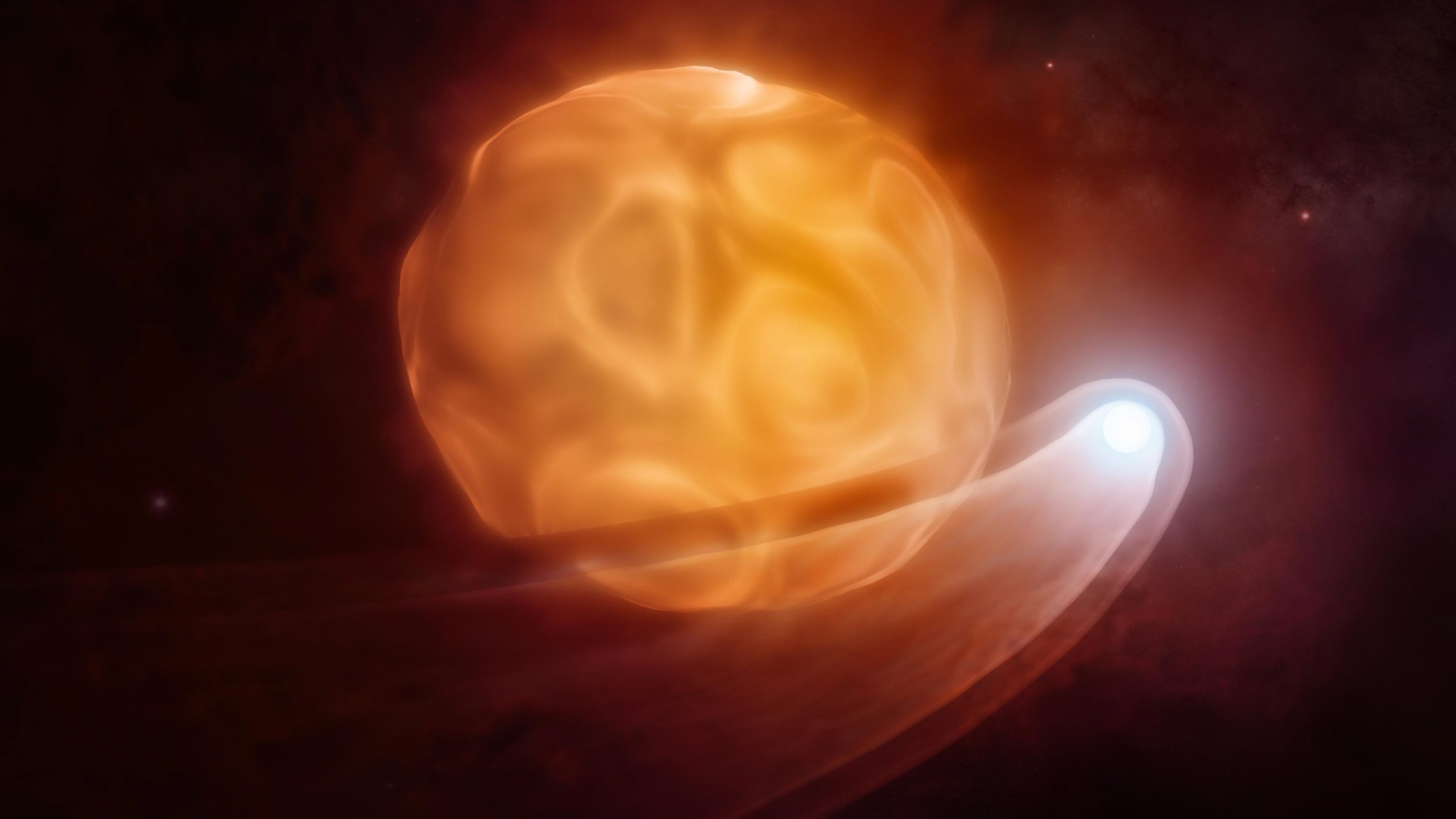
Radio images suggest a link between Betelgeuse’s changing outline and its companion’s expected orbit, offering clues to how a smaller star may influence a giant’s later life.
Betelgeuse, the bright red supergiant marking Orion’s shoulder, may have another star stirring its atmosphere from within. Its recently identified companion, Siwarha, is thought to orbit at a distance of only about twice the giant’s radius. New radio observations suggest that this close neighbor is leaving a visible mark on the shape of Betelgeuse’s outer gas, even though the companion itself is too faint to appear in those observations.
Researchers proposed Siwarha’s existence in 2024 to explain Betelgeuse’s mysterious 2,100-day brightness cycle. Direct imaging and spectroscopic studies of the star’s light have since supported its existence. The companion’s name means “her bracelet,” a reference to Betelgeuse’s Arabic meaning, “the hand of al-Jawza.”
Betelgeuse’s shape hints at Siwarha’s influence
The new study was led by Dr. Lynn D. Matthews, Principal Research Scientist and Assistant Director at MIT Haystack Observatory, with colleagues from the Center for Astrophysics | Harvard & Smithsonian, the University of Manchester, and the European Southern Observatory. The team combined observations from the U.S. National Science Foundation’s Karl G. Jansky Very Large Array (NSF VLA) and the Atacama Large Millimeter/submillimeter Array (ALMA), collected between 2021 and 2026 at seven radio frequencies ranging from 22 to 485 GHz.
Radio waves at different frequencies reveal different depths in a star’s atmosphere. Using both observatories allowed the researchers to build a picture of Betelgeuse layer by layer, from just above its visible surface to several times the star’s radius.
“It was the combination of the incredible data from the NSF VLA and ALMA that gave us a convincing result here,” said Matthews. “The fact that we can use these facilities to actually resolve the disks of nearby stars is amazing.”
Detecting Siwarha directly was beyond the observations’ reach. The team calculated that the companion would be tens to hundreds of times too faint to see at radio wavelengths. They could, however, measure the ellipticity of Betelgeuse’s radio-emitting atmosphere, meaning how stretched or egg-shaped it appeared, at different observing times.
The atmosphere looked noticeably more elongated near the times when Siwarha was expected to be at its greatest apparent separation from Betelgeuse. It appeared rounder when the companion was expected to pass in front of or behind the giant star. That correspondence suggests that the smaller star’s gravity and movement are disturbing the surrounding gas.
“This companion is orbiting so close to the star that it actually passes through its extended atmosphere,” Matthews explained. Its passage could leave a wake, much as a boat leaves one as it moves through water.
The team will need observations covering more of Siwarha’s orbit, particularly at frequencies that have not yet been well sampled, to confirm and refine these findings.
Warming again after the Great Dimming
The same radio data also show that Betelgeuse’s extended atmosphere has largely recovered from a much more conspicuous disturbance. In late 2019 and early 2020, the star faded to its faintest level in more than a century of record-keeping. During that episode, known as the Great Dimming, Betelgeuse ejected a billion tons of stellar material that partially blocked our view.
Months before the dimming, a 2019 study led by Matthews had found that Betelgeuse’s atmosphere was unusually cool at radio wavelengths. That team proposed that convection, the circulation of gas carrying heat from deep within the star, had triggered a shock wave. The wave could have disturbed gas in the outer layers, setting the stage for the massive dust-forming outburst that followed.
The new measurements show that the atmosphere’s brightness temperature, a temperature inferred from the strength of its radio emission, has returned to more typical levels at those same wavelengths. At a distance from the center of about 2.7 times Betelgeuse’s radius, the gas now registers around 3,500 kelvin, or about 5,840°F. That is comparable to the temperature of the star’s visible surface.
A temperature dip above Betelgeuse’s surface
Closer to the surface, the highest-frequency ALMA measurements revealed a much cooler layer. These observations probed nearer to Betelgeuse’s surface than previous radio measurements and found temperatures of roughly 2,200 kelvin, or about 3,500°F. That is more than 1,000 kelvin cooler than the photosphere, the star’s visible surface.
The measurements confirm a long-suspected “temperature minimum” between the photosphere and the chromosphere, an atmospheric layer above it. This cool region coincides with the “MOLsphere,” a shell of molecular gas that astronomers had long inferred from infrared observations but had rarely examined so directly at radio wavelengths.
Future observatories, including the Next Generation Very Large Array now in development, are expected to make such detailed studies more routine. Sharper views could help researchers understand how red supergiants shed material and evolve in the final stages of their lives, and how the gravitational pull of a nearby companion might shape that process.
Reference: “New Spatially Resolved Observations of Betelgeuse from the VLA and ALMA: Evidence for Atmospheric Perturbations from a Close Companion” by L. D. Matthews, A. K. Dupree, A. M. S. Richards and W. R. F. Dent, 32 August 2026, The Astronomical Journal.
DOI: 10.3847/1538-3881/ae953d
Never miss a breakthrough: Join the SciTechDaily newsletter.
Follow us on Google and Google News.