
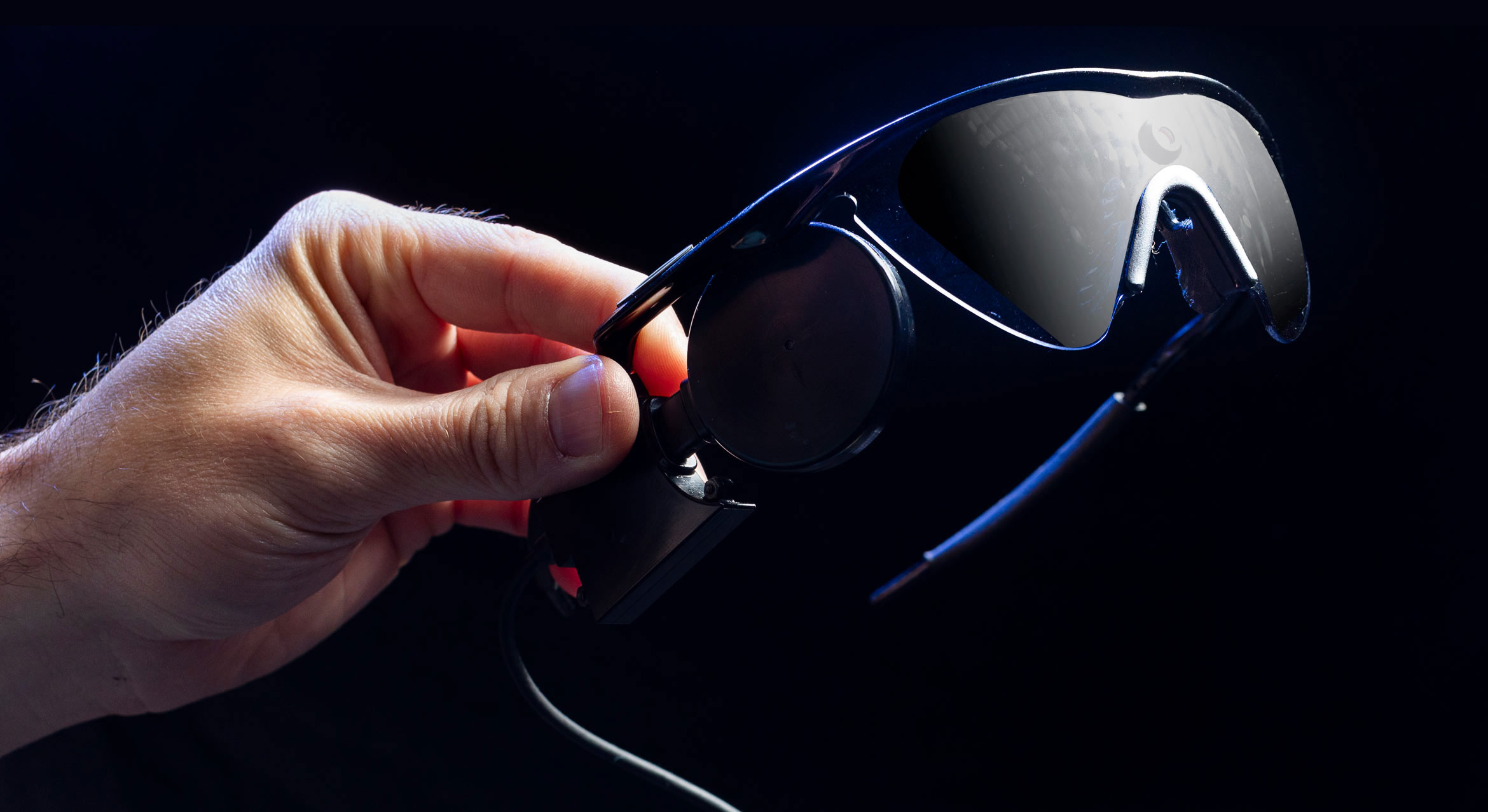
Researchers have used artificial intelligence to improve how a brain implant stimulates the visual cortex of a blind person, potentially advancing the development of bionic eyes.
Artificial intelligence could make future bionic eyes more precise and responsive by improving how electrical signals communicate with the brain. In a study published in Neuron, researchers used deep learning to control brain stimulation in a blind man, producing more accurate neural responses with less electrical current.
The findings could advance visual prostheses that bypass damaged eyes and optic nerves, stimulating the visual cortex directly to generate perceptions of light.
Testing AI in a Blind Participant
Researchers from UC Santa Barbara, ETH Zurich, and Miguel Hernández University (MHU) tested the approach in a 27-year-old man who lost his sight following a traumatic brain injury. At a hospital in Spain, a temporary implant containing 96 electrodes stimulated his visual cortex, producing phosphenes, perceived as flashes or shapes of light.
Led in part by UCSB professor Michael Beyeler, the team trained a deep neural network to predict brain responses to different stimulation patterns. The AI model also incorporated measurements of resting brain activity, allowing it to account for changes in the brain’s condition before each test.
Why Brain Activity Matters More Than Electrical Signals
The AI-designed stimulation patterns produced targeted neural responses more accurately and required less electrical current than comparison approaches. Researchers also found that recorded brain activity predicted the participant’s visual perceptions better than the electrical settings alone.
“Engineers naturally want to treat phosphenes like pixels: stimulate more electrodes, and you should get a more complete image,” Beyeler said. “But the brain does not work that way. Electrodes interact, neural responses fluctuate, and what we put into the brain is not necessarily what the person perceives. The challenge is to learn more about that transformation.”
The implant could both stimulate neurons and record their responses, enabling the AI to learn from actual brain activity. The participant also described perceived flashes, including their brightness, size, shape, and color.
Toward More Personalized Bionic Vision
The technology could eventually help people who lose their sight through injuries or neurological and inherited conditions. Beyeler emphasized those “who have been able to see for part of their life, but then, because of an inherited eye disease or an accident, have lost their vision,” adding, “For those people, the desire may be very strong to get some vision back.”
Describing the international research effort as “a true collaboration,” Beyeler said the study demonstrated how computational models could influence experiments involving human participants.
“Building a model in the abstract is one thing,” he said. “Seeing it shape an experiment with a person is something else entirely. That ability to go from theory to something that may one day help people is what drives much of the work in our lab.”
Although the research remains an early proof of concept, it suggests that future visual prostheses may work better by continuously adjusting stimulation to an individual’s neural responses.
“A useful visual prosthesis cannot rely on a fixed recipe,” Beyeler said. “It has to learn how an individual brain responds and adapt the stimulation accordingly. Ultimately, the device should adapt to the person, not the other way around.”
Reference: “Deep learning-based control of electrically evoked activity in human visual cortex” by Pehuén Moure, Jacob Granley, Fabrizio Grani, Leili Soo, Antonio Lozano, Rocío López-Peco, Adrián Villamarín-Ortiz, Cristina Soto-Sánchez, Shih-Chii Liu, Michael Beyeler and Eduardo Fernández, 7 August 2026, Neuron.
DOI: 10.1016/j.neuron.2026.07.006
Never miss a breakthrough: Join the SciTechDaily newsletter.
Follow us on Google and Google News.