
Close Menu
    Facebook X (Twitter) Instagram
    SciTechDaily
    • Biology
    • Chemistry
    • Earth
    • Health
    • Physics
    • Science
    • Space
    • Technology
    Facebook X (Twitter) Pinterest YouTube RSS
    SciTechDaily
    Home»Biology»Deep-Sea Scientists Capture Extraordinary 4K Footage of a Fish With a See-Through Head
    Biology

    Deep-Sea Scientists Capture Extraordinary 4K Footage of a Fish With a See-Through Head

    By Monterey Bay Aquarium Research InstituteNovember 7, 2026No Comments5 Mins Read
    Facebook Twitter Pinterest Telegram LinkedIn WhatsApp Email Reddit
    Share
    Facebook Twitter LinkedIn Pinterest Telegram Email Reddit
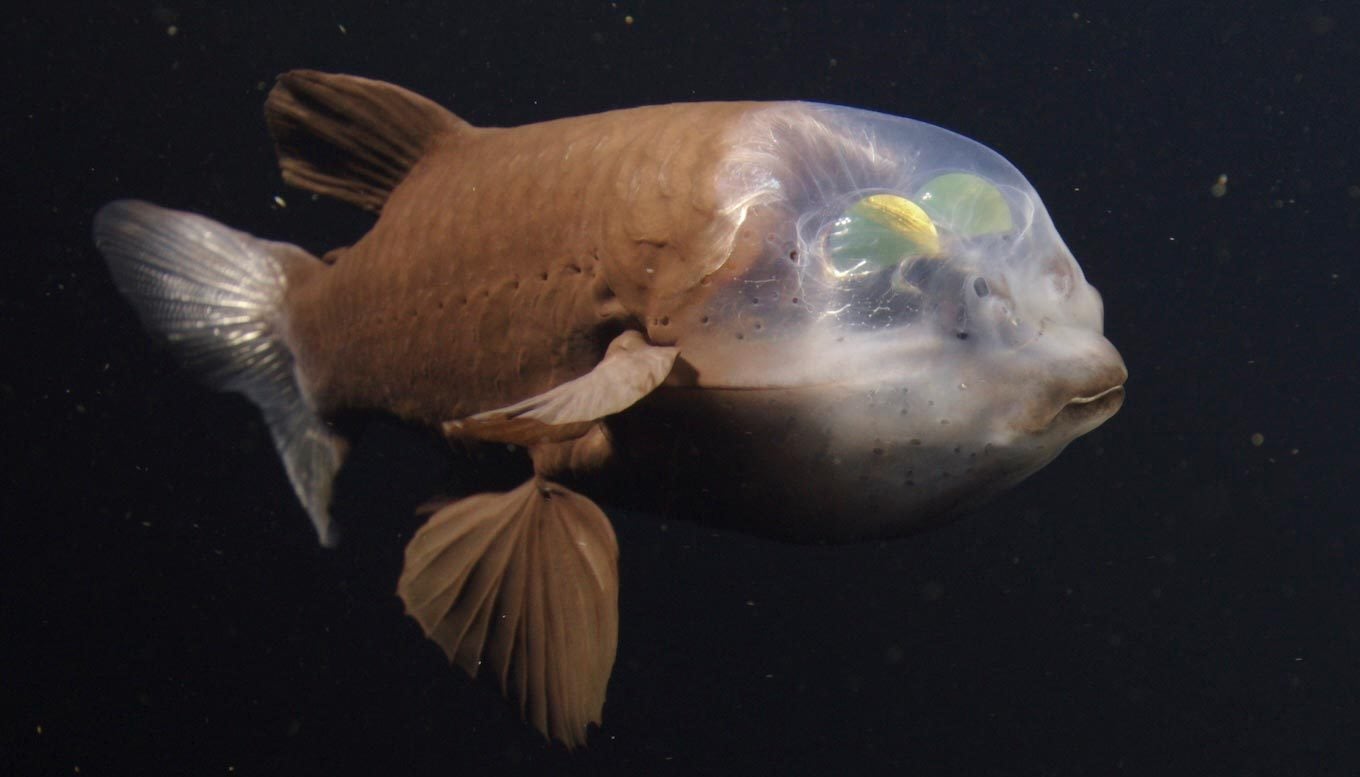
    Barreleye Fish With Transparent Head
    The barreleye fish (Macropinna microstoma) lives in the ocean’s twilight zone, scanning the waters above for food. After spotting a potential meal, those large tubular eyes rotate under a transparent head to keep prey in sight. Credit: 2026 MBARI

    MBARI’s first 4K footage of a barreleye fish offers a rare chance to study how its unusual eyes work in the ocean’s dim twilight zone.

    The day’s deep-sea research was over when a fish with a transparent head came into view. Research Specialist Shannon Johnson spotted it as MBARI’s pilots were “flying” the remotely operated vehicle (ROV) Doc Ricketts back to the surface for recovery, and she called for them to stop.

    The animal was a barreleye fish (Macropinna microstoma), approximately 600 meters (1,970 feet) underwater and 90 kilometers (55 miles) offshore. For the MBARI scientists working aboard the research vessel David Packard, this was only the organization’s eleventh encounter with the species.

    Senior Scientist Steven Haddock and researchers from MBARI’s Biodiversity and Biooptics Team were on the eight-day Diving Deep for Delicate Drifters expedition, studying gelatinous animals such as jellies, siphonophores, and ctenophores, also known as comb jellies. They combined scuba diving in open water near the surface with ROV surveys hundreds of meters below, filming and collecting animals to better understand how they have adapted to life in the deep water column.
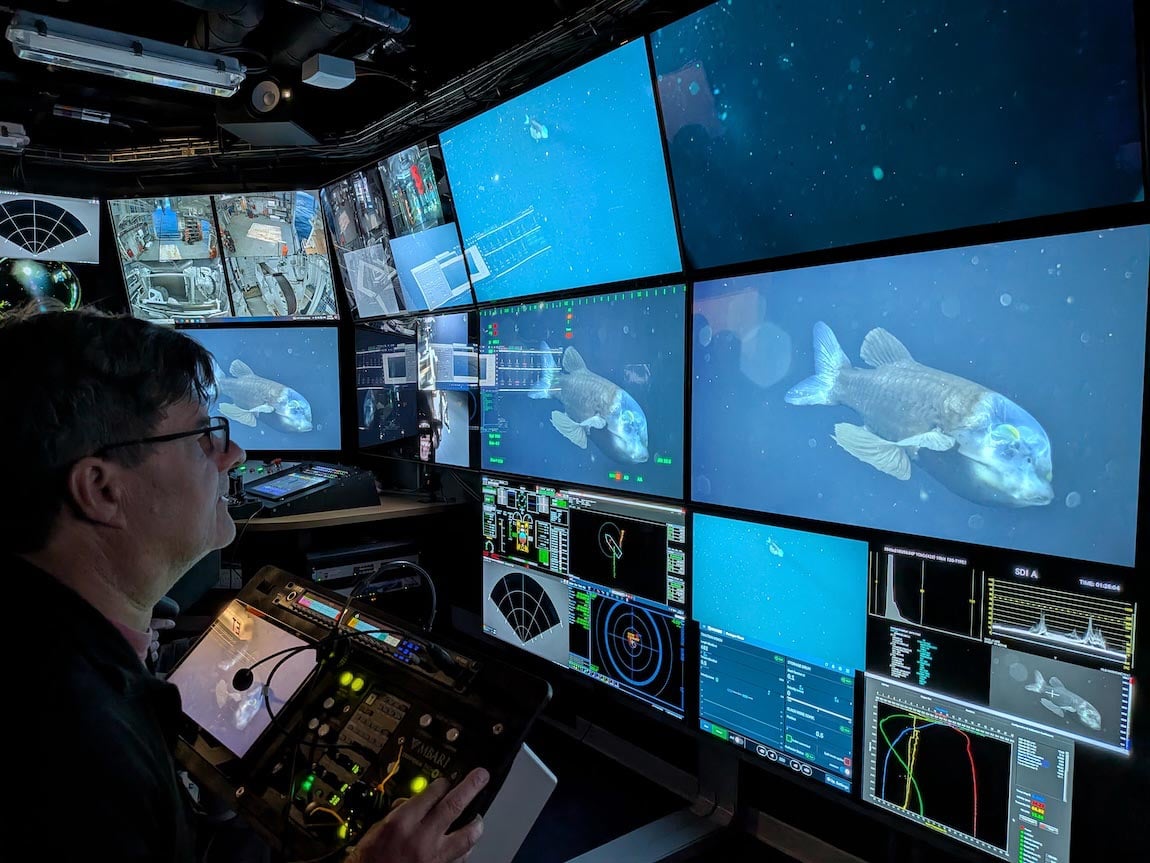
    Steven Haddock Observing Barreleye Fish
    During the Diving Deep for Delicate Drifters expedition aboard MBARI’s R/V David Packard, Senior Scientist Steven Haddock and team had a chance encounter with a barreleye fish (Macropinna microstoma). Credit: Kyra Schlining © 2026 MBARI

    Most of the scientists had already moved to the ship’s wet lab to prepare to catalog the specimens arriving with the ROV. When news of the barreleye reached them, they ran back to the control room. The encounter was an unexpected finish to a long, productive week of research.

    “Seeing a barreleye fish is a rare treat. Crew from across the ship joined the science team in the control room, mesmerized by this remarkable animal. Deep-sea animals capture the imagination, creating wonder and awe that we hope will inspire stewardship of the largest living space on Earth,” said Haddock.

    A rare close-up in 4K

    The team spent approximately 20 minutes observing the fish with Doc Ricketts’ high-resolution 4K camera, examining its body and behavior and experimenting with different lighting conditions to show its transparent head shield. This was MBARI’s first barreleye sighting filmed in 4K and its first from the new flagship research vessel.

    ROV Pilot/Technician Cameron Law also maneuvered Doc Ricketts close enough to record the fish with the vehicle’s virtual reality (VR) camera. The resulting 3D stereo imagery could contribute to future education and outreach efforts.

    MBARI Research Team Watching Barreleye Fish Footage
    Once news spread that the team had encountered a barreleye fish (Macropinna microstoma), it was standing room only in the ROV Doc Ricketts control room. Credit: Kyra Schlining © 2026 MBARI

    MBARI has completed roughly 7,000 ROV dives and recorded more than 41,000 hours of deep-sea video during nearly 40 years of ocean exploration. Its previous sighting of Macropinna was in 2021. This summer, MBARI researchers leading an expedition with Schmidt Ocean Institute in the mid-Atlantic Ocean recorded another species of barreleye, the binocular fish (Winteria telescopa).

    A transparent shield for swiveling eyes

    Earlier MBARI observations by Senior Scientist Bruce Robison and Research Specialist Kim Reisenbichler helped reveal how Macropinna uses its unusual eyes to feed. In the ocean’s dim twilight zone, the fish’s large fins keep it stable and allow it to maneuver as it hovers, looking upward for the silhouettes of prey. Once it spots food, its large, tubular eyes rotate beneath the transparent dome to keep the target in view. The gelatinous shield also protects those eyes when the fish plucks small crustaceans caught in the stinging tentacles of deep-sea siphonophores.
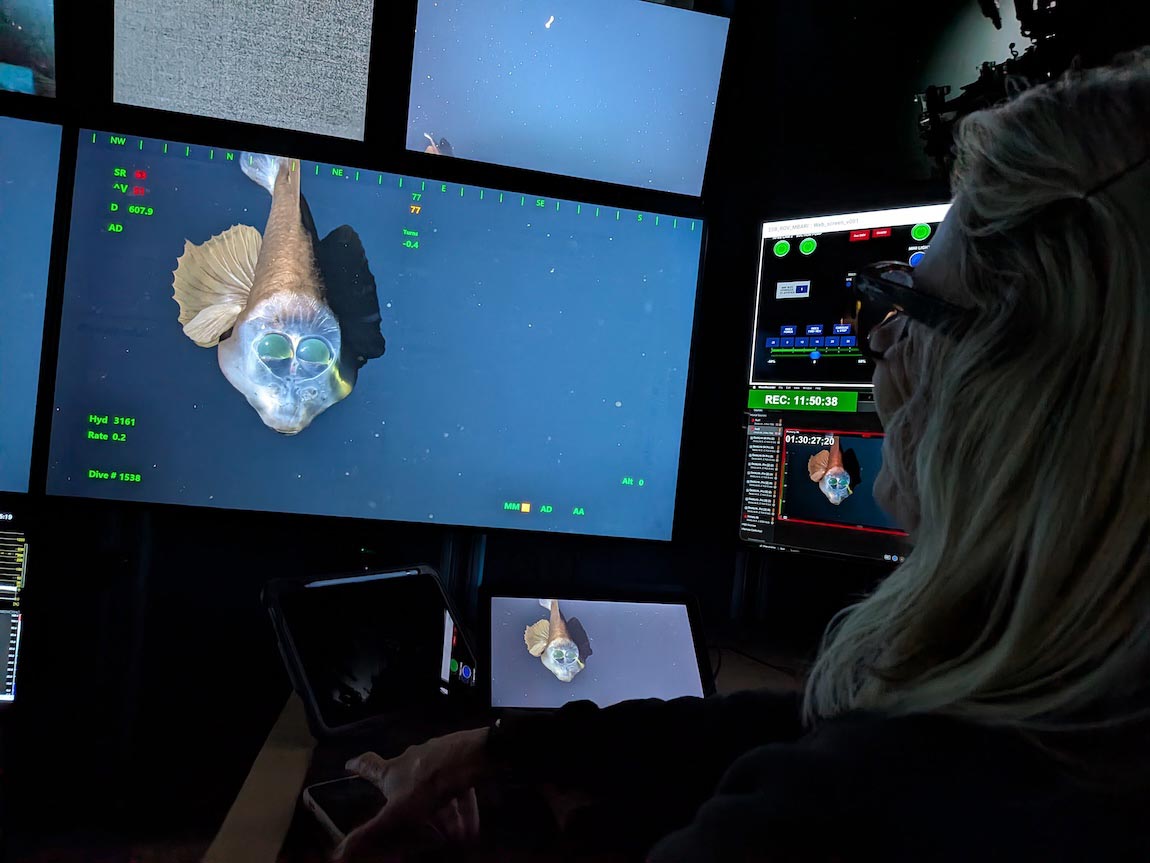
    Shannon Johnson Documenting Barreleye Fish Sighting
    The scientific name Macropinna microstoma translates to “large fins, small mouth.” These distinctive features of the barreleye fish were on full display as Research Specialist Shannon Johnson logged details of this sighting in MBARI’s annotation software. Credit: Kyra Schlining © 2026 MBARI

    The researchers did not collect the barreleye, but their footage will support continued research on this elusive species. The Biodiversity and Biooptics Team studies how marine animals interact with light and has extensively investigated deep-sea visual systems. Its close-up examination of Macropinna’s eyes will help researchers better understand vision in the twilight zone.

    Pigments in the lenses of the fish’s eyes are thought to serve a similar function to the green pigments in the eyes of the strawberry squid (Histioteuthis heteropsis), a deep-sea neighbor the team has previously studied.

    “Macropinna reminds us of the surprising ways that animals have adapted to thrive in the ocean’s midwater,” said Haddock. “So many of them survive by looking for subtle optical cues, like a shadow passing overhead, and this sets off evolutionary competition, pitting bioluminescent camouflage against increasingly sophisticated visual capabilities.”

    Never miss a breakthrough: Join the SciTechDaily newsletter.
    Follow us on Google and Google News.

    Deep Sea Fish Marine Biology Monterey Bay Aquarium Research Institute Oceanography
    Share. Facebook Twitter Pinterest LinkedIn Email Reddit

    Related Articles

    Complexity Yields Simplicity: The Shifting Dynamics and Loss of Biodiversity in Temperate Marine Ecosystems

    Overfishing of Atlantic Cod Likely Did Not Cause Genetic Changes – Hope for Recovery

    Fish Poop Helps Remove 1.65 Billion Tons of Carbon From the Atmosphere Each Year

    Abundance of Life on Coral Reefs Has Been Puzzling Since Charles Darwin’s Day – New Research Provides Answers

    As Oceans Warm, Large Fish Struggle to Extract the Oxygen They Need From Their Environment

    Hidden World Just Below the Surface: Scientists Discover Ocean “Surface Slicks” Are Nurseries for Diverse Fishes

    How Deep-Sea, Ultra-Black Fish Disappear – Science Behind Skin That Absorbs More Than 99.5% of Light

    Bad News for Nemo: Species Can’t Adapt to Rapid Environmental Changes

    Carnivorous Deep Sea Sponge Discovered Off Coast of California

    Leave A Reply Cancel Reply

    • Facebook
    • Twitter
    • Pinterest
    • YouTube

    Don't Miss a Discovery

    Subscribe for the Latest in Science & Tech!

    Trending News

    NASA’s Voyager 1 Is About to Become the First Spacecraft One Light-Day From Earth

    A Woman Who Lived 30,000 Years Ago Is Changing What We Know About Ice Age Europe

    A Rare Radioactive Element Reveals a Hidden Secret About the Heaviest Atoms

    Breakthrough Cancer Treatment Wipes Out Deadly Brain Tumors in Every Mouse Tested

    Something Remarkable Is Happening to Dogs Living Near Chernobyl’s Nuclear Plant

    Hubble Uncovers a Mysterious 93-Billion-Mile Structure Hiding in a Nearby Star System

    Earth’s Oceans Were Slowly Suffocating Millions of Years Before a Devastating Mass Extinction

    Why Are Men Twice As Likely To Develop Parkinson’s? Scientists Discover a Hidden Clue in the Brain

    Follow SciTechDaily
    • Facebook
    • Twitter
    • YouTube
    • Pinterest
    • Newsletter
    • RSS
    SciTech News
    • Biology News
    • Chemistry News
    • Earth News
    • Health News
    • Physics News
    • Science News
    • Space News
    • Technology News
    Recent Posts
    • Deep-Sea Scientists Capture Extraordinary 4K Footage of a Fish With a See-Through Head
    • Scientists Find That Older Brains React Very Differently to a Night of Poor Sleep
    • A Hidden Substance in Drinking Water May Be Linked to Heart Problems in Children
    • Scientists Find a Clever Way to Read Quantum Information Without Destroying It
    • Chemical Breakthrough Could Unlock the “Holy Grail” of Solid-State Battery Technology
    Copyright © 1998 - 2026 SciTechDaily. All Rights Reserved.
    • Science News
    • About
    • Contact
    • Editorial Board
    • Privacy Policy
    • Terms of Use

    Type above and press Enter to search. Press Esc to cancel.