

Close Menu
    Facebook X (Twitter) Instagram
    SciTechDaily
    • Biology
    • Chemistry
    • Earth
    • Health
    • Physics
    • Science
    • Space
    • Technology
    Facebook X (Twitter) Pinterest YouTube RSS
    SciTechDaily
    Home»Space»ESA Image of the Week – The Heart of the Milky Way
    Space

    ESA Image of the Week – The Heart of the Milky Way

    By Philippe Willekens, European Space AgencyMay 14, 2018No Comments4 Mins Read
    Facebook Twitter Pinterest Telegram LinkedIn WhatsApp Email Reddit
    Share
    Facebook Twitter LinkedIn Pinterest Telegram Email Reddit
    The Heart of the Milky Way
    This image reveals the central plane of the Milky Way as seen by ESA’s Planck satellite and the Atacama Pathfinder Experiment (APEX), which is located at an altitude of around 5100m in the Chilean Andes and operated by the European Southern Observatory. Credit: ESO/ATLASGAL consortium; ESA/Planck

    At first glance, this image may resemble red ink filtering through water or a crackling stream of electricity, but it is actually a unique view of our cosmic home. It reveals the central plane of the Milky Way as seen by ESA’s Planck satellite and the Atacama Pathfinder Experiment (APEX), which is located at an altitude of around 5100m (16,700 feet) in the Chilean Andes and operated by the European Southern Observatory.

    This image was released in 2016 as the final product of an APEX survey mapping the galactic plane visible from the southern hemisphere at submillimeter wavelengths (between infrared and radio on the electromagnetic spectrum). It complements previous data from ESA’s Planck and Herschel space observatories.

    Planck and APEX are an ideal pairing. APEX is best at viewing small patches of sky in great detail while Planck data is ideal for studying areas of sky at the largest scales. It covers the entire sky – no mean feat. The two work together well, and offer a unique perspective on the sky.

    This image reveals numerous objects within our galaxy. The bright pockets scattered along the Milky Way’s plane in this view are compact sources of submillimeter radiation: very cold, clumpy, dusty regions that may shed light on myriad topics all the way from how individual stars form to how the entire Universe is structured.
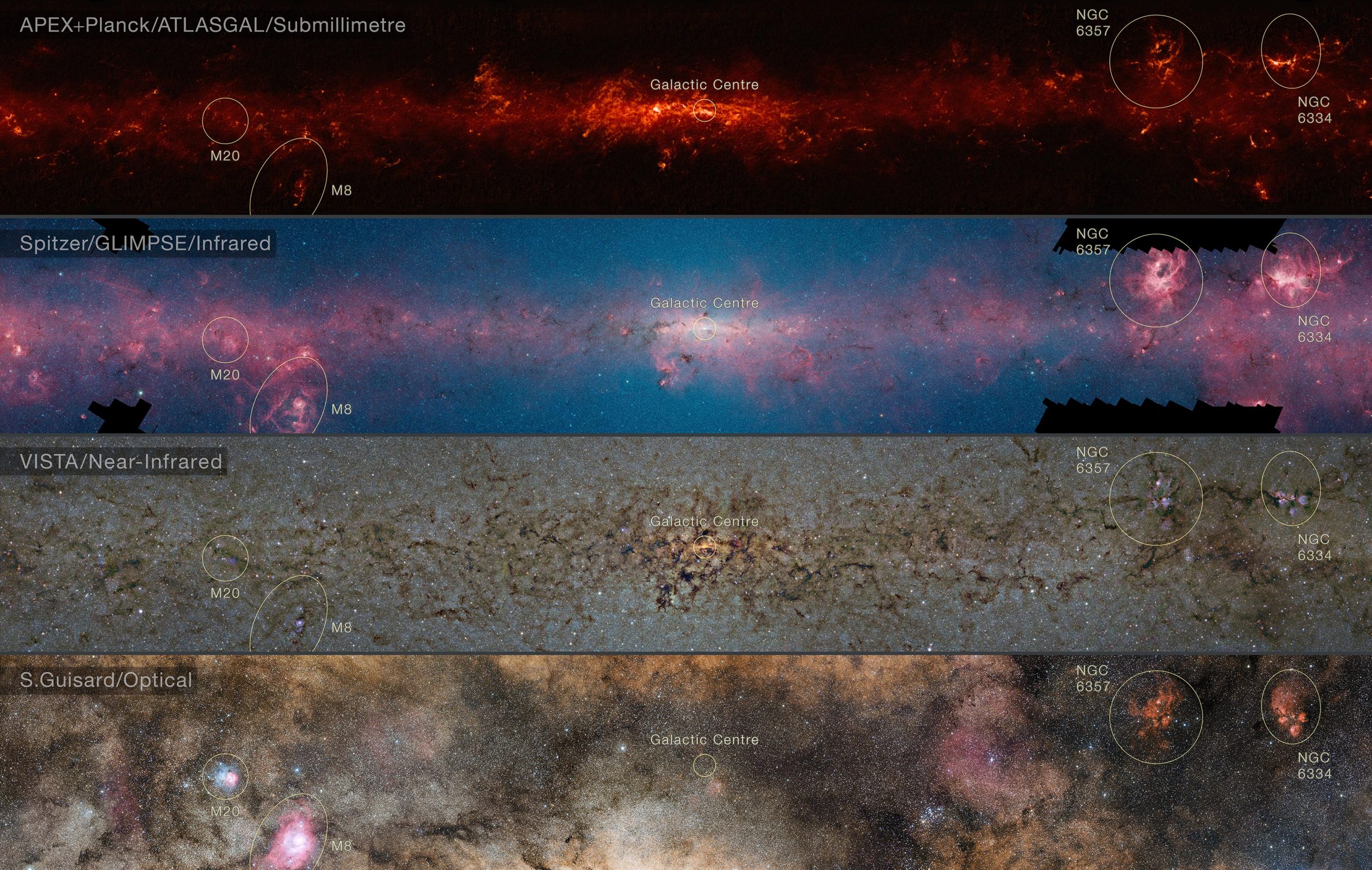
    Comparison of the Central Part of the Milky Way at Different Wavelengths
    This comparison shows the central regions of the Milky Way observed at different wavelengths.
    The top panel shows compact sources of submillimeter radiation detected by APEX as part of the ATLASGAL survey, combined with complementary data from ESA’s Planck satellite, to capture more extended features.
    The second panel shows the same region as seen in shorter, infrared, wavelengths by the NASA Spitzer Space Telescope.
    The third panel shows the same part of sky again at even shorter wavelengths, the near-infrared, as seen by ESO’s VISTA infrared survey telescope at the Paranal Observatory in Chile. Regions appearing as dark dust tendrils here show up brightly in the ATLASGAL view.
    Finally the bottom picture shows the more familiar view in visible light, where most of the more distant structures are hidden from view.
    Credit: ESO/ATLASGAL consortium/NASA/GLIMPSE consortium/VVV Survey/ESA/Planck/D. Minniti/S. Guisard
    Acknowledgement: Ignacio Toledo, Martin Kornmesser, Mahdi Zamani

    From right to left, notable sources include NGC 6334 (the rightmost bright patch), NGC 6357 (just to the left of NGC 6334), the galactic core itself (the central, most extended, and brightest patch in this image), M8 (the bright lane branching from the plane to the bottom left), and M20 (visible to the upper left of M8). A labeled view can be seen above.

    Planck was launched on 14 May 2009 and concluded its mission in October 2013. The telescope returned a wealth of information about the cosmos; its main aim was to study the Cosmic Microwave Background (CMB), the relic radiation from the Big Bang. Among other milestones, Planck produced an all-sky map of the CMB at incredible sensitivity and precision, and took the ‘magnetic fingerprint’ of the Milky Way by exploring the behavior of certain light emitted by dust within our galaxy.

    Its observations are helping scientists to explore and understand how the Universe formed, its composition and contents, and how it has evolved from its birth to present day.

    APEX is a collaboration between the Max Planck Institute for Radio Astronomy, the Onsala Space Observatory, and the European Southern Observatory, ESO. The telescope is operated by ESO.

    Never miss a breakthrough: Join the SciTechDaily newsletter.
    Follow us on Google and Google News.

    APEX Astronomy European Space Agency Milky Way
    Share. Facebook Twitter Pinterest LinkedIn Email Reddit

    Related Articles

    Scientists Discover a Giant, Unexplained Wave Rippling Through the Milky Way

    Gaia Completes Its Stellar Odyssey, Leaving a Cosmic Legacy

    Scientists Surprised by Sleeping Giant – Most Massive Stellar Black Hole in Our Galaxy Found Lurking Nearby

    Starquakes! Gaia Spacecraft Sees Strange Stars in Most Detailed Milky Way Survey to Date

    Gaia Spacecraft Reveals a New Member of the Milky Way Family

    Gaia Spacecraft Discovers Parts of the Milky Way Are Much Older Than Thought

    Planck Space Telescope Reveals the Magnetic Field Lines of the Milky Way

    ESA’s Gaia Spacecraft Ready to Create a 3D Map of the Milky Way Galaxy

    Astronomers Find Bizarre Alignment of Planetary Nebulae in the Milky Way

    Leave A Reply Cancel Reply

    • Facebook
    • Twitter
    • Pinterest
    • YouTube

    Don't Miss a Discovery

    Subscribe for the Latest in Science & Tech!

    Trending News

    Millions Take These IBS Drugs, But a New Study Finds Serious Risks

    Scientists Unlock Hidden Secrets of 2,300-Year-Old Mummies Using Cutting-Edge CT Scanner

    Bread Might Be Making You Gain Weight Even Without Eating More Calories

    Scientists Discover Massive Magma Reservoir Beneath Tuscany

    Europe’s Most Active Volcano Just Got Stranger – Here’s Why Scientists Are Rethinking It

    Alzheimer’s Symptoms May Start Outside the Brain, Study Finds

    Millions Take This Popular Supplement – Scientists Discover a Concerning Link to Heart Failure

    The Universe Is Expanding Too Fast and Scientists Can’t Explain Why

    Follow SciTechDaily
    • Facebook
    • Twitter
    • YouTube
    • Pinterest
    • Newsletter
    • RSS
    SciTech News
    • Biology News
    • Chemistry News
    • Earth News
    • Health News
    • Physics News
    • Science News
    • Space News
    • Technology News
    Recent Posts
    • Simple Blood Test May Predict Alzheimer’s Years Before Brain Scans Show Signs
    • Scientists Say Adding This Unusual Seafood to Your Diet Could Reverse Signs of Aging
    • U.S. Waste Holds $5.7 Billion Worth of Crop Nutrients
    • Scientists Say a Hidden Structure May Exist Inside Earth’s Core
    • Doctors Surprised by the Power of a Simple Drug Against Colon Cancer
    Copyright © 1998 - 2026 SciTechDaily. All Rights Reserved.
    • Science News
    • About
    • Contact
    • Editorial Board
    • Privacy Policy
    • Terms of Use

    Type above and press Enter to search. Press Esc to cancel.