
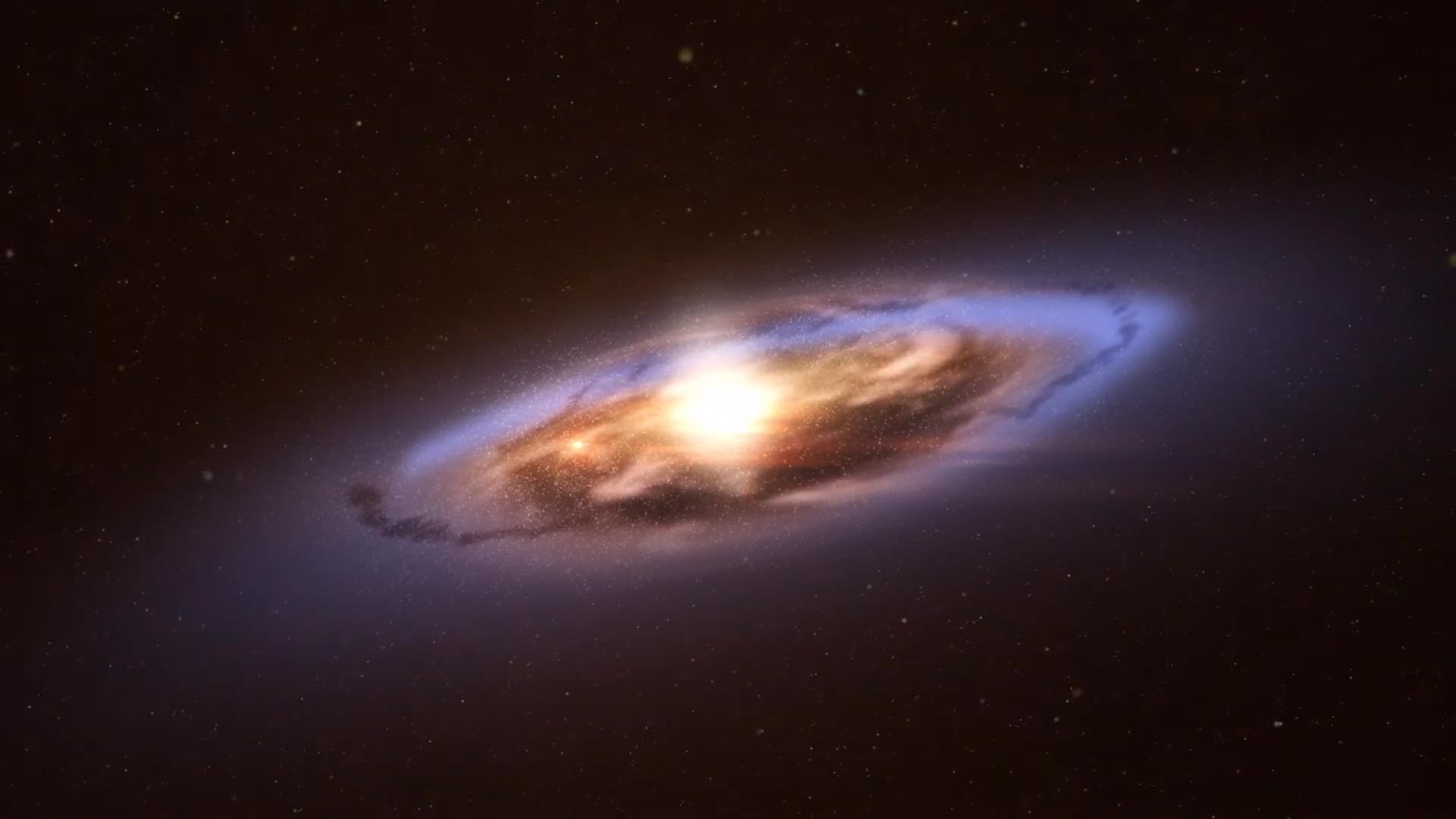
The Milky Way ripples like a vast cosmic wave. Gaia’s precise measurements reveal a colossal motion sweeping through the galaxy’s disc, an echo of something mysterious in our galaxy’s ancient past.
The Milky Way is anything but static. It rotates and it wobbles, and new observations from the European Space Agency’s Gaia space telescope now reveal another motion, a giant wave moving outward from the galaxy’s centre.
For roughly a century, astronomers have known that stars orbit the galactic centre, and Gaia has mapped their speeds and paths. Since the 1950s, researchers have recognized that the Milky Way’s disc is warped. In 2020, Gaia showed that this disc also wobbles over time, similar to a spinning top.
It is now clear that a vast ripple influences stellar motions across distances of tens of thousands of light-years from the Sun. Like waves spreading from a stone dropped into a pond, this stellar ripple spans a large stretch of the Milky Way’s outer disc.
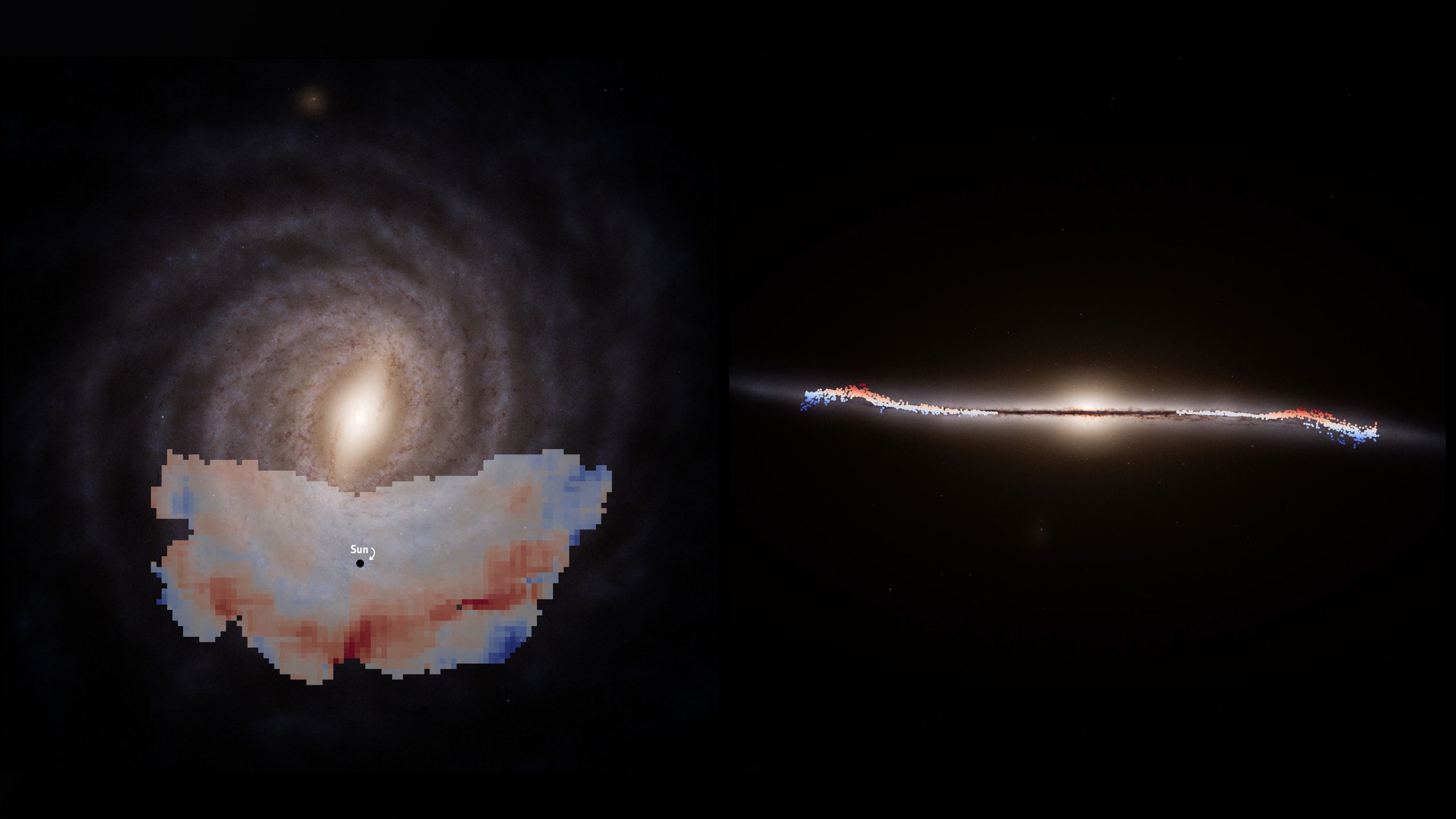
The unexpected galactic ripple is illustrated in this figure above. Here, the positions of thousands of bright stars are shown in red and blue, overlaid on Gaia’s maps of the Milky Way.
In the left image, we look at our galaxy from ‘above’. On the right, we see across a vertical slice of the galaxy and look at the wave side-on. This perspective reveals that the ‘left’ side of the galaxy curves upward and the ‘right’ side curves downward (this is the warp of the disc). The newly discovered wave is indicated in red and blue: in red areas, the stars lie above, and in blue areas, the stars lie below the warped disc of the galaxy.
Even if no spacecraft can travel beyond our galaxy, Gaia’s uniquely accurate vision – in all three spatial directions (3D) plus three velocities (moving towards and away from us, and across the sky) – is enabling scientists to make these top-down and edge-on maps.
The Scale of the Wave
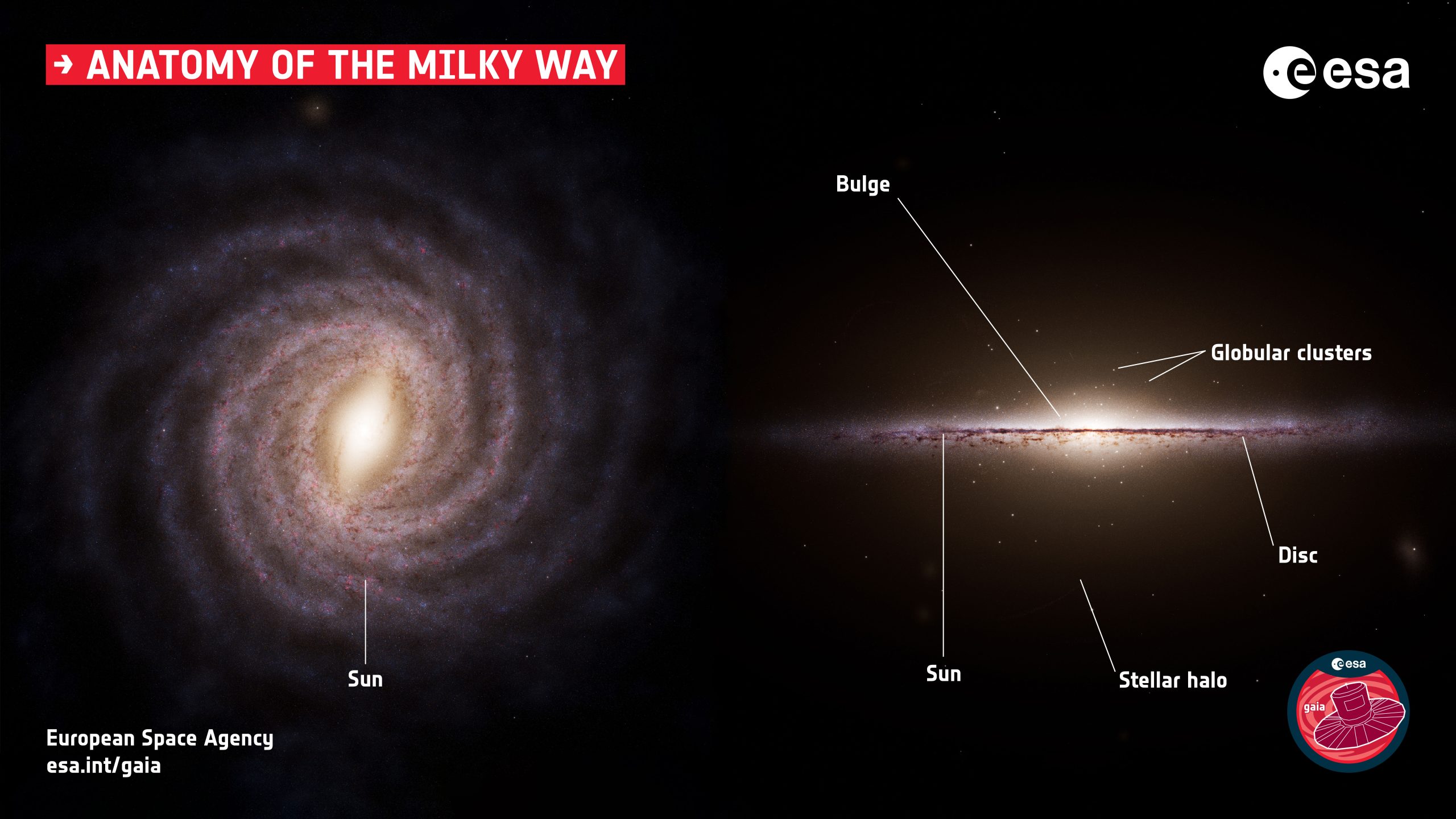
From these, we can see that the wave stretches over a huge portion of the galactic disc, affecting stars around at least 30–65 thousand light-years away from the center of the galaxy (for comparison, the Milky Way is around 100 thousand light-years across).
“What makes this even more compelling is our ability, thanks to Gaia, to also measure the motions of stars within the galactic disc,” says Eloisa Poggio who is an astronomer at the Istituto Nazionale di Astrofisica (INAF) in Italy, and led the team of scientists that discovered the wave.
“The intriguing part is not only the visual appearance of the wave structure in 3D space, but also its wave-like behavior when we analyze the motions of the stars within it.”
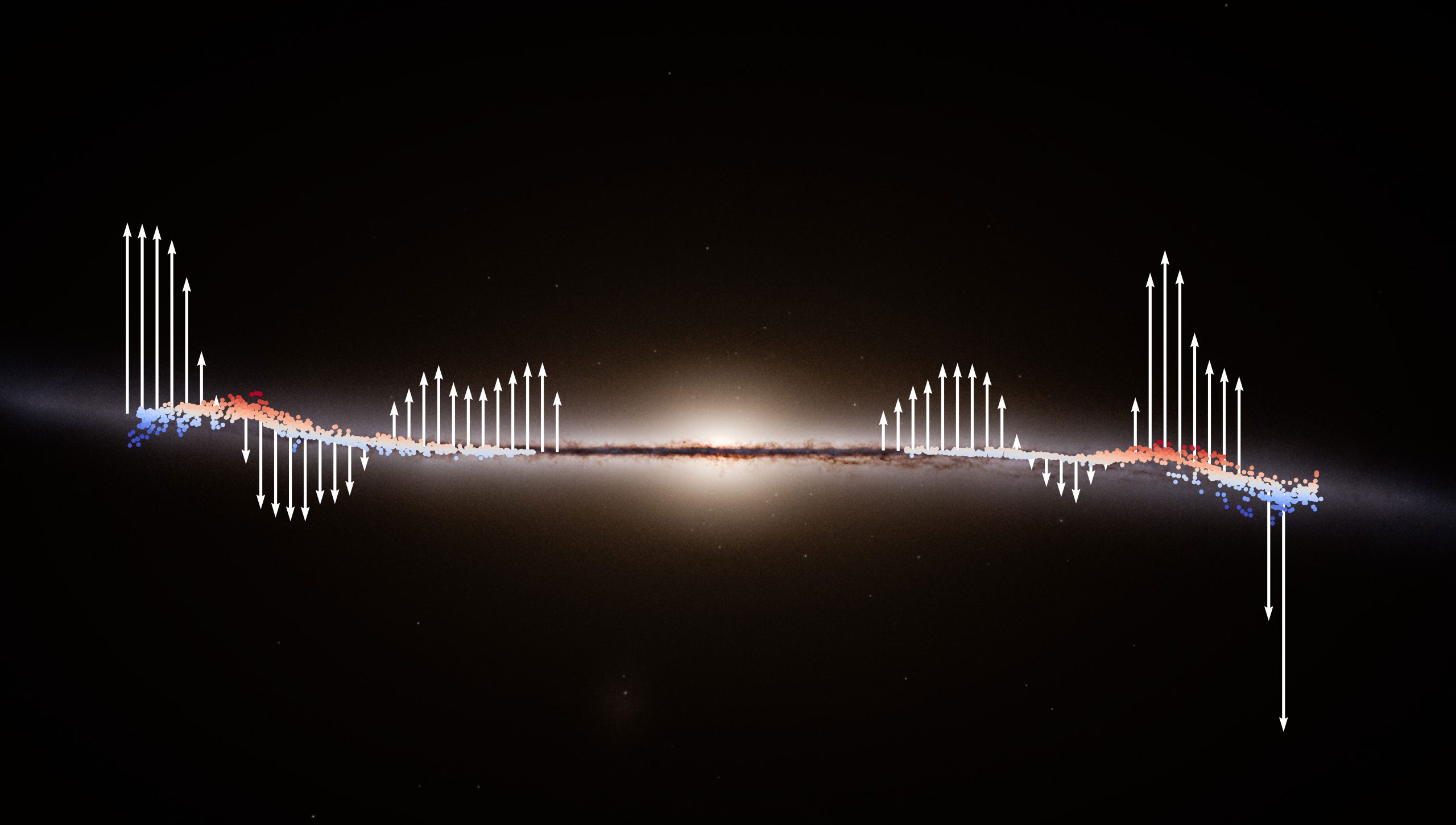
The motions of the stars are made visible with the white arrows in the edge-on image of the Milky Way above. What can be noticed, is that the wave pattern of the vertical motions (represented by the arrows) is slightly shifted horizontally relative to the wave pattern formed by the star’s vertical positions (indicated by the red/blue colors).
“This observed behavior is consistent with what we would expect from a wave,” Eloisa explains.
A Galactic Stadium Wave
Think of a ‘wave’ performed by a crowd in a stadium. Given that galactic timescales are much longer than ours, imagine seeing this stadium wave frozen in time, much like how we observe the Milky Way. Some individuals would be standing upright, some would have just sat down (as the wave passed), and others would be preparing to stand up (as the wave approaches them).
In this analogy, the people standing upright correspond to the regions colored in red in our face-on and edge-on maps. And, if we consider motions, the individuals with the largest positive vertical motions (represented by the largest white arrows pointing upwards) are those who are just starting to stand up, ahead of the incoming wave.
Eloisa and her colleagues were able to track down this surprising motion by studying the detailed positions and movements of young giant stars and Cepheid stars. These are types of stars that vary in brightness in a predicable way, which can be seen by telescopes like Gaia over large distances.
Because young giant stars and Cepheids move with the wave, the scientists think that gas in the disc might also be taking part in this large-scale ripple. It is possible that young stars retain the memory of the wave information from the gas itself, from which they were born.
Origins and Future Research
Scientists do not know the origin of these galactic shakes. A past collision with a dwarf galaxy could be a possible explanation, but they need to investigate further.
The great wave could also be related to a smaller-scale rippling motion seen 500 light-years from the Sun and extending over 9000 light-years, the so-called Radcliffe Wave.
“However, the Radcliffe Wave is a much smaller filament, and located in a different portion of the galaxy’s disc compared to the wave studied in our work (much closer to the Sun than the great wave). The two waves may or may not be related. That’s why we would like to do more research,” Eloisa adds.
“The upcoming fourth data release from Gaia will include even better positions and motions for Milky Way stars, including variable stars like Cepheids. This will help scientists to make even better maps, and thereby advance our understanding of these characteristic features in our home galaxy,” says Johannes Sahlmann, ESA’s Gaia Project Scientist.
Reference: “The great wave – Evidence of a large-scale vertical corrugation propagating outwards in the Galactic disc” by E. Poggio, S. Khanna, R. Drimmel, E. Zari, E. D’Onghia, M. G. Lattanzi, P. A. Palicio, A. Recio-Blanco and L. Thulasidharan, 14 July 2025, Astronomy & Astrophysics.
DOI: 10.1051/0004-6361/202451668
Never miss a breakthrough: Join the SciTechDaily newsletter.
Follow us on Google and Google News.
1 Comment
The spatial extent and velocities in the wave is on the order of 1/10th the thin disk height and rotational speed (i.e. wave vertical heights on the order of 100 pc and velocities on the order of 10 km/s).