
Close Menu
    Facebook X (Twitter) Instagram
    SciTechDaily
    • Biology
    • Chemistry
    • Earth
    • Health
    • Physics
    • Science
    • Space
    • Technology
    Facebook X (Twitter) Pinterest YouTube RSS
    SciTechDaily
    Home»Space»Gaia Satellite Scans the Sky to Measure Positions and Motions of 1.7 Billion Stars [Video]
    Space

    Gaia Satellite Scans the Sky to Measure Positions and Motions of 1.7 Billion Stars [Video]

    By European Space AgencyMay 26, 2020No Comments3 Mins Read
    Facebook Twitter Pinterest Telegram LinkedIn WhatsApp Email Reddit
    Share
    Facebook Twitter LinkedIn Pinterest Telegram Email Reddit
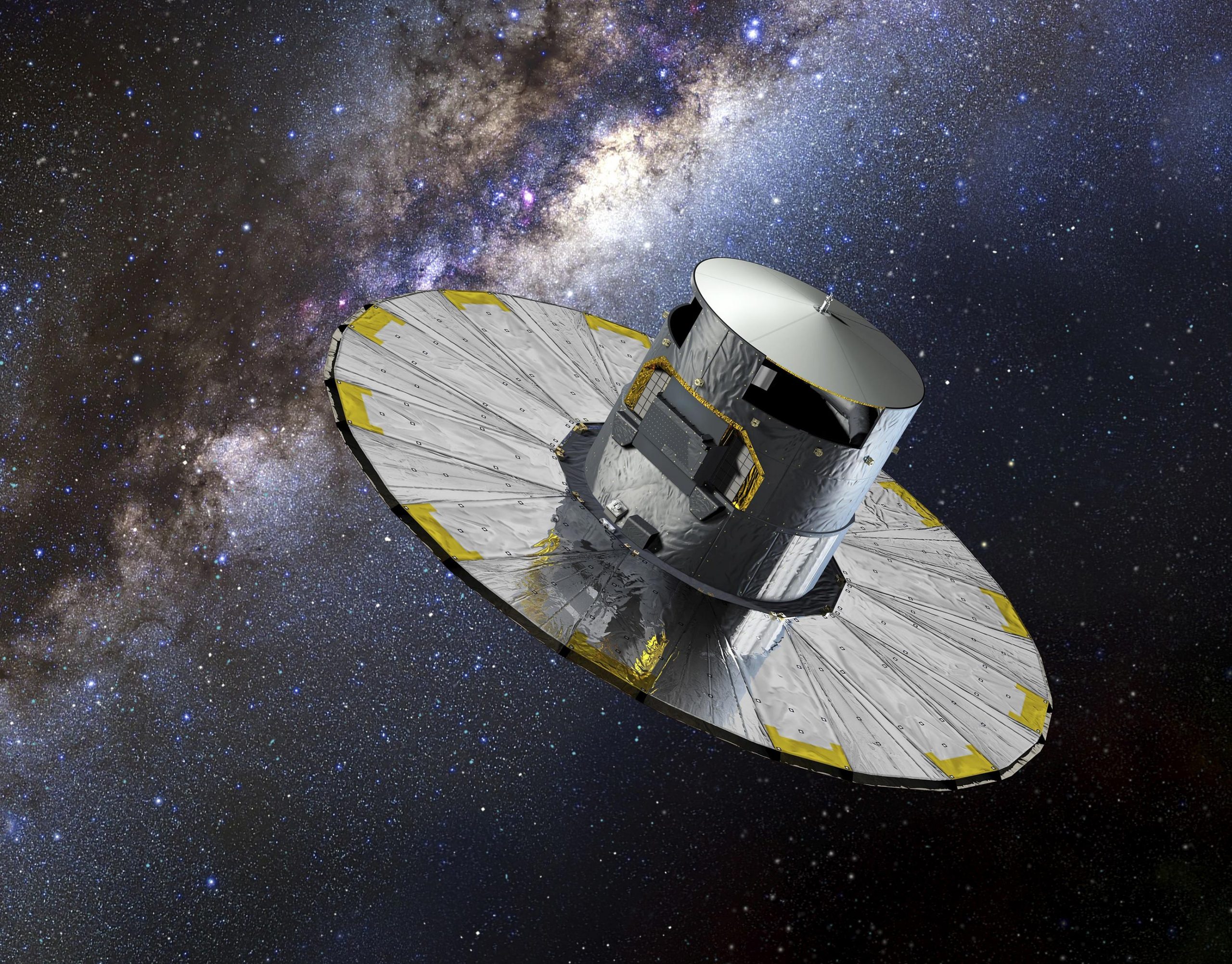
    Gaia Spacecraft Artist's Impression
    Gaia is an ambitious mission to chart a three-dimensional map of our Galaxy, the Milky Way, in the process revealing the composition, formation, and evolution of the Galaxy. Gaia provides unprecedented positional and radial velocity measurements with the accuracies needed to produce a stereoscopic and kinematic census of about one billion stars in our Galaxy and throughout the Local Group. Credit: ESA–D. Ducros, 2013

    Launched in 2013, the Gaia satellite has been scanning the sky to measure the positions, distances and motions of more than one billion stars in our galaxy, the Milky Way. The goal of the mission is to create the most detailed galactic map ever made, in order to investigate the Milky Way’s past and future history like never before.

    The animation below shows the satellite as it scans great circles around the sky. Eventually, the sky is unfolded to reveal the view of the Milky Way and neighboring galaxies, based on measurements of nearly 1.7 billion stars from the second Gaia data release. The map shows the total brightness and color of stars observed by Gaia in each portion of the sky between July 2014 and May 2016. Brighter regions indicate denser concentrations of especially bright stars, while darker regions correspond to patches of the sky where fewer bright stars are observed. In the middle of the image, the Galactic center appears vivid and teeming with stars.


    Animation of data from ESA’s Gaia second release, which was made public on April 25, 2018.

    Sprinkled across the image are also many globular and open clusters – groupings of stars held together by their mutual gravity, as well as entire galaxies beyond our own. The two bright objects in the lower right of the image are the Large and Small Magellanic Clouds, two dwarf galaxies orbiting the Milky Way.

    The animation ends with a pan over the Galactic plane, the bright horizontal structure that hosts most of the stars in our home Galaxy. Darker regions across the Galactic plane correspond to foreground clouds of interstellar gas and dust, which absorb the light of stars located further away, behind the clouds. Many of these conceal stellar nurseries where new generations of stars are being born.  

    The two Gaia data releases, published in 2016 and 2018, have revolutionized the study of the Milky Way, enabling thousands of studies about the structure and motions of our galaxy. More releases are planned in coming years.
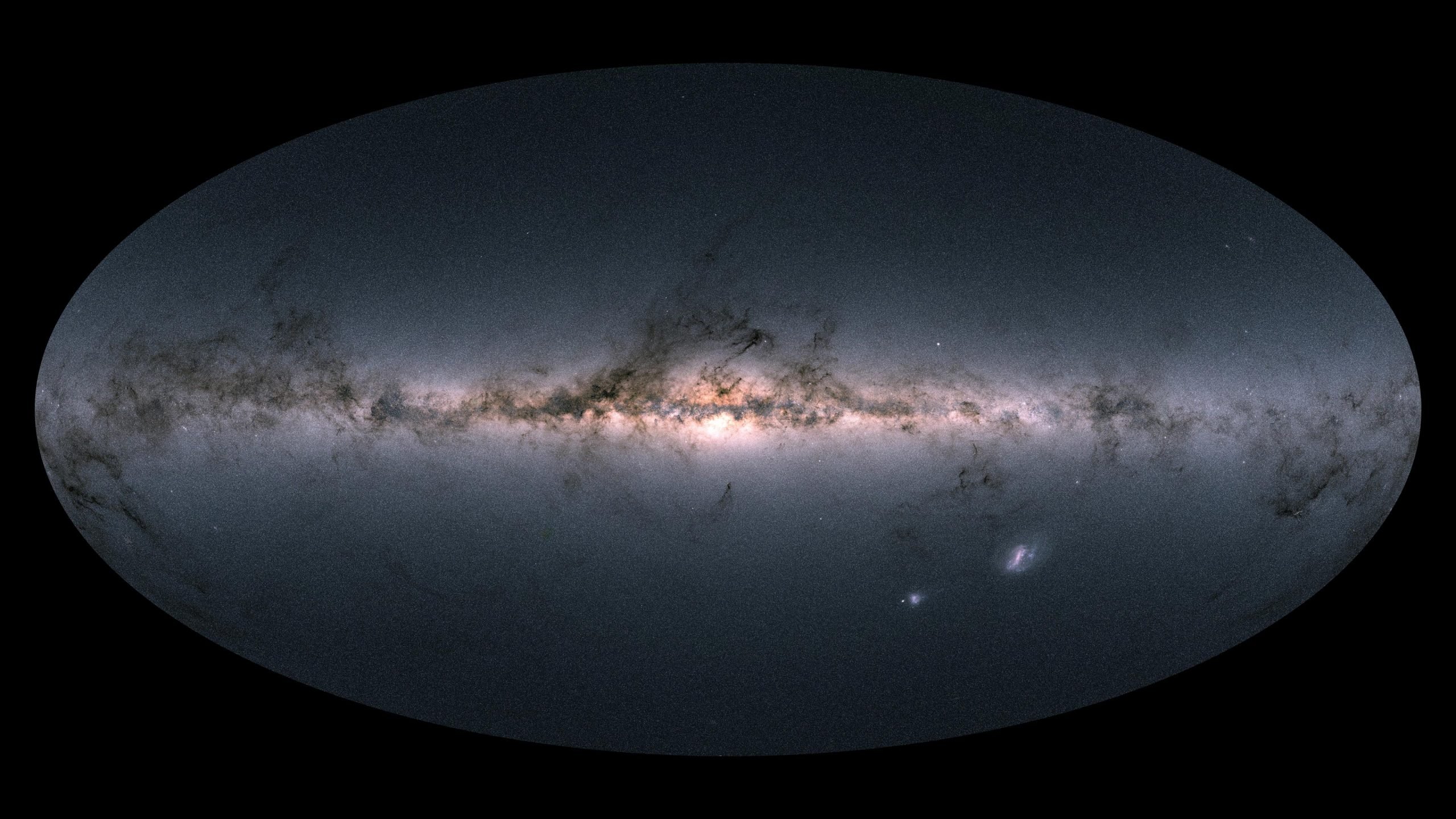
    Gaia's Sky in Color
    Gaia’s all-sky view of our Milky Way Galaxy and neighboring galaxies, based on measurements of nearly 1.7 billion stars. The map shows the total brightness and color of stars observed by the ESA satellite in each portion of the sky between July 2014 and May 2016. Credit: ESA/Gaia/DPAC, CC BY-SA 3.0 IGO

    Data: ESA/Gaia/DPAC; Animation: ESA/ATG medialab, CC BY-SA 3.0 IGO

    Never miss a breakthrough: Join the SciTechDaily newsletter.
    Follow us on Google and Google News.

    Astronomy Astrophysics ESA Gaia Spacecraft European Space Agency Milky Way
    Share. Facebook Twitter Pinterest LinkedIn Email Reddit

    Related Articles

    Scientists Surprised by Sleeping Giant – Most Massive Stellar Black Hole in Our Galaxy Found Lurking Nearby

    Starquakes! Gaia Spacecraft Sees Strange Stars in Most Detailed Milky Way Survey to Date

    Gaia Spacecraft Reveals a New Member of the Milky Way Family

    Gaia Spacecraft Discovers Parts of the Milky Way Are Much Older Than Thought

    Gaia Space Mission Discovers Mysterious Fossil Spiral Arms in Milky Way

    Astronomers Discover a “Break” in One of the Milky Way’s Spiral Arms

    Tantalizing Evidence: Is the Nearest Star Cluster to the Sun Being Destroyed?

    Unexpected Discovery: Hubble Space Telescope Uncovers Concentration of Small Black Holes

    To the Milky Way’s Anticenter and Beyond: Gaia’s New Detailed Data From More Than 1.8 Billion Stars

    Leave A Reply Cancel Reply

    • Facebook
    • Twitter
    • Pinterest
    • YouTube

    Don't Miss a Discovery

    Subscribe for the Latest in Science & Tech!

    Trending News

    Just a Few Breathless Minutes a Day Could Slash Your Risk of 8 Major Diseases

    This Simple Habit Could Cut Your Risk of Dementia by 30%

    Scientists Debunk Rattlesnake Myth That Fooled Hikers and Doctors for Decades

    Scientists Discover Plants Can “Count” – and May Be Smarter Than We Thought

    New Research Reveals Ancient Mars May Have Been Warm, Wet – and Possibly Alive

    This Surprising Daily Habit Could Cut Dementia Risk by 35%

    Just 10 Minutes a Day: Scientists Say This Ancient Chinese Practice Shows Powerful Blood Pressure Benefits

    Scientists Say This Popular Food Could Help Your Body Get Rid of Microplastics

    Follow SciTechDaily
    • Facebook
    • Twitter
    • YouTube
    • Pinterest
    • Newsletter
    • RSS
    SciTech News
    • Biology News
    • Chemistry News
    • Earth News
    • Health News
    • Physics News
    • Science News
    • Space News
    • Technology News
    Recent Posts
    • NASA’s Artemis II Cleared for Moon Flight As Orion Prepares for Critical Engine Burn
    • NASA Artemis II Crew Scrambles To Fix Unexpected Toilet Failure in Space
    • Surviving Burns May Have Changed Human Evolution
    • Scientists Discover Hidden “Footprint of Death” That Could Transform How We Fight Disease
    • Blood-Sucking Parasites Could Revolutionize Treatment for Autoimmune Diseases
    Copyright © 1998 - 2026 SciTechDaily. All Rights Reserved.
    • Science News
    • About
    • Contact
    • Editorial Board
    • Privacy Policy
    • Terms of Use

    Type above and press Enter to search. Press Esc to cancel.