
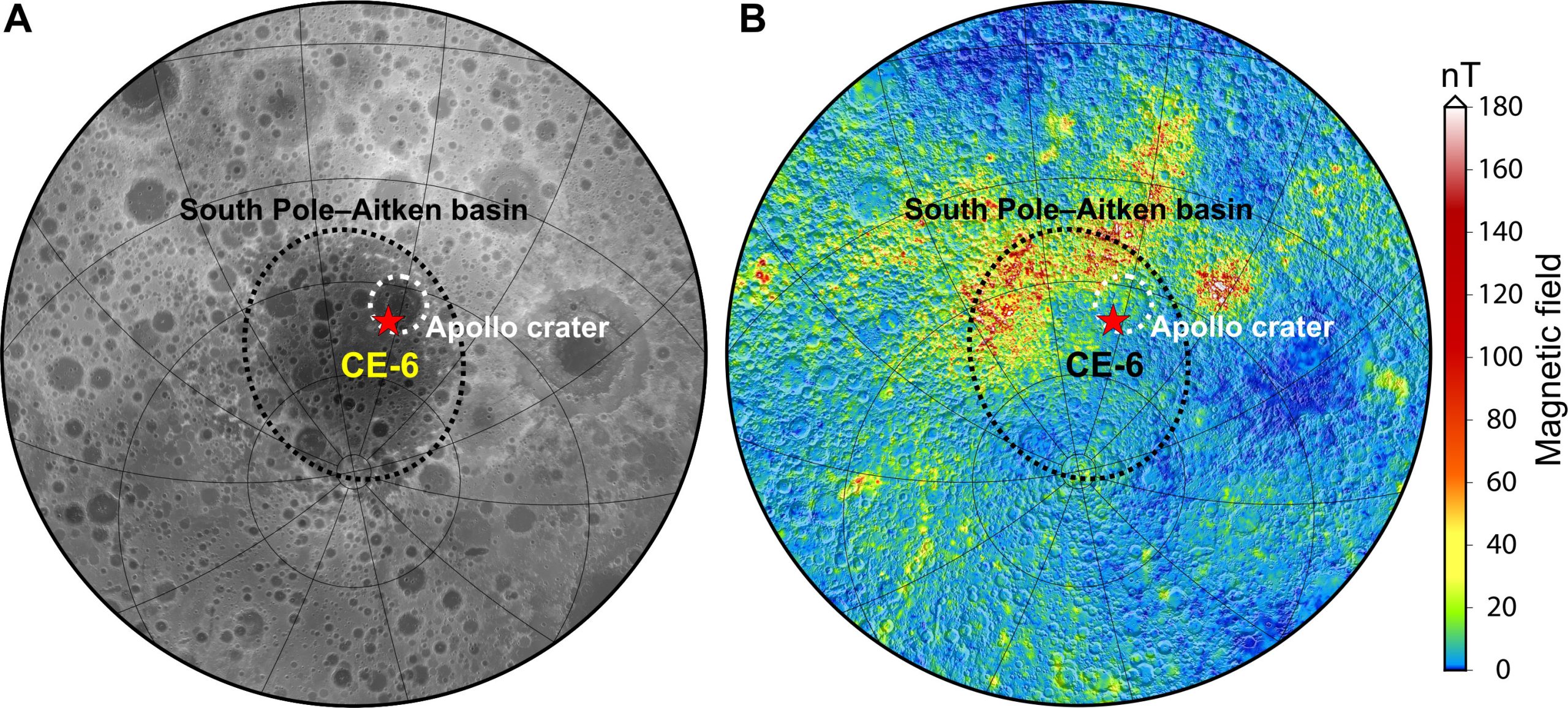
Scientists examining lunar soil collected by China’s Chang’e-6 mission have discovered an unexpected form of iron preserved within microscopic impact glass.
Tiny particles of iron trapped inside lunar glass may preserve evidence of the Moon’s ancient magnetic history. Scientists studying soil returned by China’s Chang’e-6 mission have identified face-centered cubic γ-Fe, an unusual form of metallic iron never before confirmed in natural lunar samples.
The discovery is particularly unexpected because γ-Fe normally exists only at high temperatures and changes into a different crystal structure as it cools. Yet researchers found that this phase of iron had survived inside microscopic glass particles formed during impacts on the lunar surface.
How an Unusual Form of Iron Survived on the Moon
Researchers led by Prof. Haifeng Du of the High Magnetic Field Laboratory at the Hefei Institutes of Physical Science (HFIPS) of the Chinese Academy of Sciences (CAS) examined impact glass containing numerous nanoscale iron particles. Using focused ion beam preparation, transmission electron microscopy, and chemical analysis, they confirmed that γ-Fe was the dominant iron phase in the two glass samples studied. Their findings were published September 16 in the Proceedings of the National Academy of Sciences (PNAS).
Under normal conditions, γ-Fe transforms into α-Fe as temperatures fall. The team proposed that the extreme conditions created by lunar impacts could prevent this transformation. Rapid cooling of molten material, small amounts of carbon and other elements, and the surrounding glassy matrix may have helped preserve the unusual crystal structure at the lunar surface.
Microscopic Iron Particles May Record Ancient Magnetism
The scientists also investigated whether these particles could retain magnetic information. Using off-axis electron holography, a technique that can map magnetic fields at extremely small scales, they examined the magnetic structure of individual γ-Fe nanoparticles. Relatively large particles displayed a stable single-vortex magnetic state, with their magnetization arranged in a circulating pattern. They also maintained a stable magnetic response when exposed to an external magnetic field.
“This tiny magnetic fossil may help us better understand the Moon’s ancient magnetic history,” said Dr. Long Li of HFIPS, a member of the research team.
New Evidence Hidden in Lunar Impact Glass
Although the Moon no longer possesses a global magnetic field, its rocks and soils contain magnetic minerals that can preserve information about past conditions. The newly identified γ-Fe expands the range of materials scientists can investigate when reconstructing that history.
Because γ-Fe and α-Fe develop under different physical conditions and exhibit distinct magnetic properties, they may retain records from different stages of lunar impact events. Further research will be needed to determine how reliably these minerals preserve ancient magnetic signals and what they can reveal about the evolution of magnetism on the Moon.
Reference: “Magnetic vortex state of natural lunar γ-Fe” by Pengfei Liu, Ziliang Jin, Zheng Gong, Long Li, Kang Wang, Xiandi Zeng, Jing Liu, Dongsheng Song, Haifeng Du, Kelei Zhu, Chuanxin Yan, Jinhua Li, Keke Zhang, Wyn Williams and Ann M. Hirt, 16 September 2026, Proceedings of the National Academy of Sciences.
DOI: 10.1073/pnas.2608395123
Never miss a breakthrough: Join the SciTechDaily newsletter.
Follow us on Google and Google News.