

For children with ADHD, the support they receive at school may not always make the difference parents and teachers hope for.
Giving children with attention deficit hyperactivity disorder (ADHD) more time to finish assignments, frequent breaks, or a quieter place to work might seem like straightforward ways to help them succeed in school. These adjustments are widely used in classrooms, yet new research suggests they may do little to improve academic performance or behavior.
A study from Florida International University (FIU), published in JAMA Pediatrics, found that four common accommodations did not produce significant improvements in children with ADHD. The results raise questions about how schools support students whose difficulties with attention, behavior, and completing schoolwork can interfere with their education.
“We were surprised that none of the accommodations we tested had a significant effect, even when combined with behavioral interventions or medication,” said Gregory Fabiano, a psychology professor at FIU and the study’s lead author.

Behavioral treatments show stronger classroom results
Researchers at FIU’s Center for Children and Families conducted a randomized clinical trial involving 255 children with ADHD, ranging from kindergarten through sixth grade. The children entered the study between 2022 and 2025, and 235 completed it.
The research took place through FIU’s Summer Treatment Program, which provides structured classroom and recreational activities for children with ADHD.
Researchers tested four accommodations commonly offered in schools: extended time on assignments, frequent breaks, standing while working at a desk, and completing work in a low-distraction environment. They measured how these adjustments affected classroom rule violations, academic productivity, and quiz scores under different treatment conditions.

The results revealed clear differences between the commonly used accommodations and treatments designed to address ADHD symptoms:
- Behavioral interventions reduced classroom rule violations by 37% compared with a general classroom setting.
- Stimulant medication reduced classroom rule violations by 61% and increased the rate of correctly completed assignments by 22% compared with a placebo.
- Classroom accommodations did not significantly improve behavior or quiz scores, even when combined with behavioral interventions or medication. Some were also associated with reduced academic productivity.
School support plans face new questions
The distinction matters because schools frequently include accommodations in Individualized Education Programs (IEPs) and Section 504 plans, which are designed to meet students’ individual educational needs. Although these adjustments may make classroom tasks more manageable for some children, the findings suggest that routinely providing them does not necessarily improve measurable academic outcomes or behavior.
“These approaches fail to build skills or address motivation,” Fabiano said.
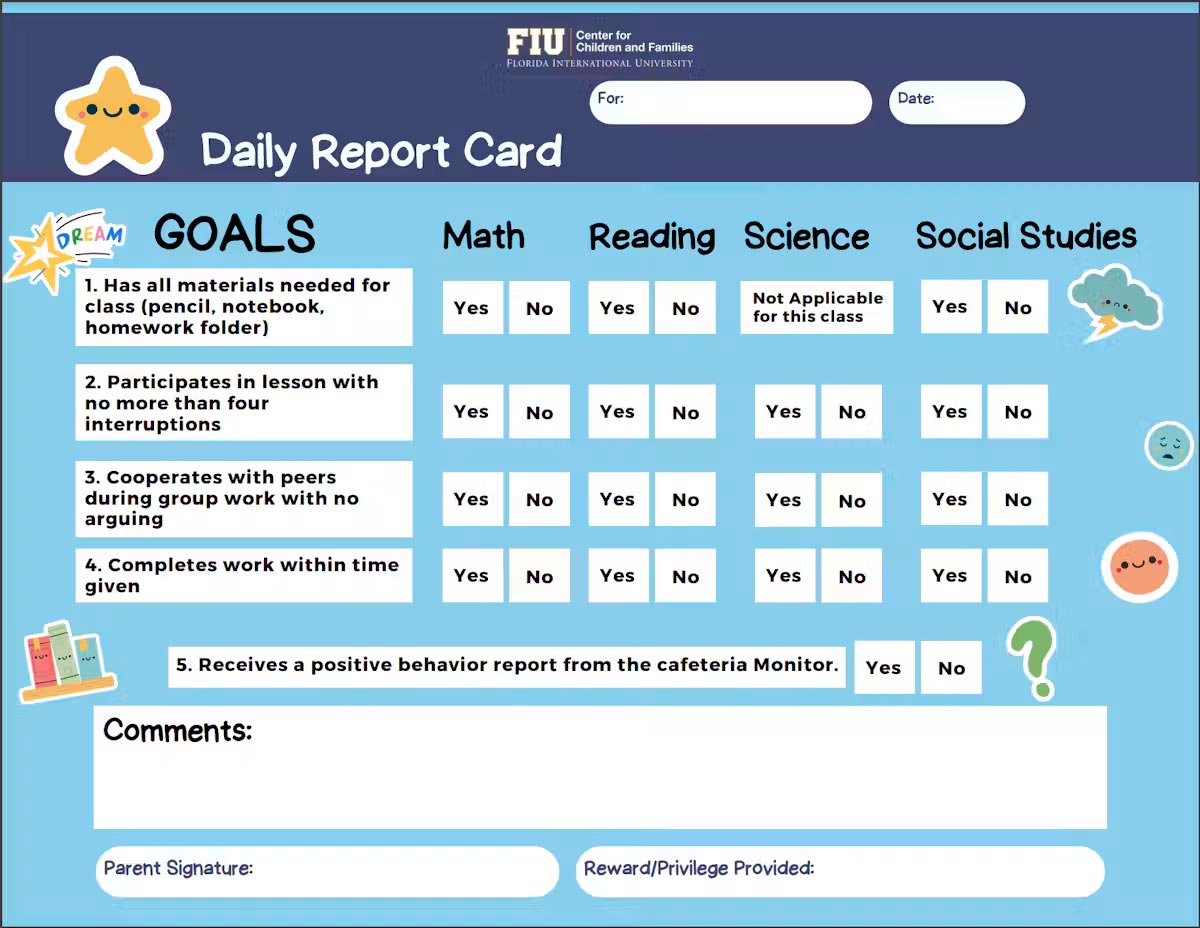
Rather than relying heavily on accommodations, researchers recommend placing greater emphasis on behavioral strategies supported by evidence. These include setting clear expectations, providing consistent feedback, praising positive behavior, and rewarding students for meeting personalized goals.
One approach is the use of daily report cards, which allow teachers to monitor specific behaviors and give students regular feedback on their progress.
The findings do not mean accommodations are never useful. Individual students may benefit from particular adjustments, even if those approaches did not produce significant improvements across the children studied.
“There may be times when accommodations may be helpful, but a ‘one size fits all’ approach to ADHD doesn’t seem to be effective,” he said.
More completed schoolwork does not guarantee learning
The research builds on decades of work by the late William E. Pelham Jr., the founding director of FIU’s Center for Children and Families, who helped design and conduct the study.
A pioneer in ADHD treatment, Pelham also led landmark research showing that stimulant medication improved children’s classroom productivity without significantly improving how much they learned. That earlier finding highlights an important distinction between helping students complete schoolwork and helping them understand and retain information.
The latest study also has limitations. Researchers conducted the trial in structured summer treatment classrooms rather than ordinary schools, where classroom conditions, teaching practices, and available support may differ. Additional research is needed to determine whether the results hold in everyday educational settings.
For Fabiano, the findings underscore the need to reconsider which forms of support schools prioritize for children with ADHD.
“We need to rethink how we’re supporting these students, with greater emphasis on effective treatments in everyday classrooms rather than relying so heavily on accommodations. Every child with ADHD deserves the opportunity to succeed and feel proud of what they’ve accomplished in the classroom, and it is our job to make sure we give them the best chance for that,” Fabiano said.
Reference: “Attention-Deficit/Hyperactivity Disorder Accommodations, Behavior Therapy, and Stimulant Medication: A Randomized Clinical Trial” by Gregory A. Fabiano, Brittany M. Merrill, Rosalia F. Gallo, Marcela Ramos, Morgan Jusko, Devon Tower, Elizabeth M. Gnagy, Amy Boeckel, Jennifer Piscitello, Maya Renaud, Alyssa Dawson, Jennifer Sikov, Carolina Ramirez, Grant C. Edmondson, Michael S. Adragna, Carlos A. Salgado and Timothy B. Hayes, 13 November 2026, JAMA Pediatrics.
DOI: 10.1001/jamapediatrics.2026.5973
This study was funded by grant R01HD105318 awarded to Florida International University from the Eunice Kennedy Shriver National Institute of Child Health and Human Development. The infrastructure for the summer treatment program in Miami was funded in part by The Children’s Trust.
Never miss a breakthrough: Join the SciTechDaily newsletter.
Follow us on Google and Google News.