
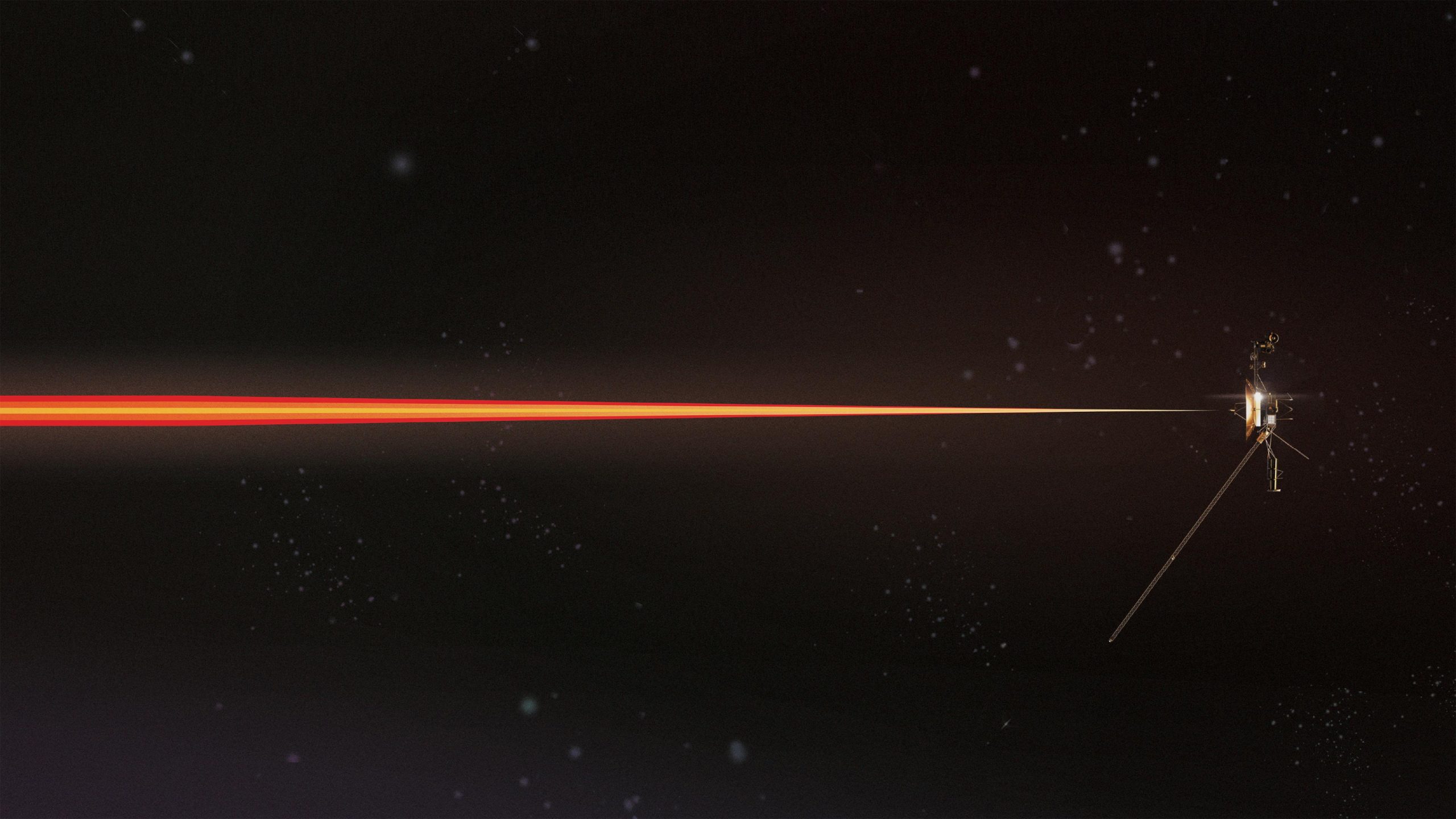
NASA’s Voyager 1 has made history after 49 years in space, reaching an astonishing 16.1 billion miles from Earth, where even light takes 24 hours to bring its signals home.
NASA’s Voyager 1 has reached a remarkable new milestone, becoming the first spacecraft to travel one light-day from Earth. After more than 49 years in space, humanity’s most distant spacecraft is now so far away that even light takes a full 24 hours to reach it.
A light-day is the distance light travels in one day, approximately 16.1 billion miles (25.9 billion kilometers). Voyager 1 officially reached that distance at 2:16 a.m. PST (5:16 a.m. EST) on November 18.
The extraordinary distance means that communicating with the spacecraft now requires immense patience. Scientists at NASA’s Jet Propulsion Laboratory (JPL) in Southern California, which is managed by Caltech, received a radio signal from Voyager 1 early Thursday, exactly 24 hours after the spacecraft reached the milestone. Although the signal traveled at the speed of light, it still needed an entire day to cross the enormous distance separating the probe from Earth.
“Traveling a light-day is a singular feat for a spacecraft, but Voyager is so much more than a distant traveler. The Voyager mission would be remarkable just for what it contributed to planetary science with the Grand Tour of the outer planets,” said Joe Westlake, director, Heliophysics Division at NASA Headquarters in Washington. “But it went on to become central to NASA’s fleet of heliophysics missions offering insights into the star that we all revolve around, the Sun.”
Putting Voyager 1’s Incredible Distance Into Perspective
Because distances in space are so enormous, astronomers often measure them using the time it takes light to travel between locations. In a vacuum, light moves at approximately 186,000 miles (299,000 kilometers) per second, making it the fastest known way for information to travel.
Consider a beam of sunlight passing Earth. It would reach the Moon in approximately 1.3 seconds and take about four hours to arrive at Neptune. From Neptune, that same beam would need another 20 hours to reach Voyager 1.
For an even larger comparison, a light-year, the distance light travels over an entire year, measures approximately 5.88 trillion miles (9.46 trillion kilometers).
Despite the historic achievement, Voyager 1 is currently experiencing a technical problem. NASA engineers have not received science or engineering data from the spacecraft since November 14. However, the probe continues to transmit a carrier signal, the radio signal normally used to send that information back to Earth. By detecting this signal and combining it with calculations of Voyager 1’s trajectory, engineers were able to verify that the spacecraft had reached the one light-day mark. They are continuing to investigate why the expected data are not arriving.
Nearly 50 Years of Unprecedented Space Exploration
Voyager 1 and its companion, Voyager 2, began their extraordinary journeys in 1977. NASA launched the twin spacecraft during a rare alignment of the outer planets that made it possible to explore multiple worlds on a single mission.
Operated by JPL, the Voyagers became the third and fourth spacecraft to visit Jupiter and Saturn. They also delivered the first high-resolution images of these planets, revealing extraordinary new details about the giant worlds and their moons.
Voyager 2 continued farther along its unique route, becoming the first spacecraft to closely examine Uranus and Neptune, the two distant planets known as ice giants. Today, both probes are traveling through interstellar space, making them the only human spacecraft to have ventured beyond the Sun’s protective bubble. Their instruments continue monitoring magnetic fields and other conditions influenced by the Sun at extraordinary distances.
“Voyager 1 crossing the light-day threshold is yet another historic feat on an extraordinary voyage of discovery,” said Dave Gallagher, JPL director. “Above all, this milestone stands as a testament to the exceptional teams who built, programmed, and fly these spacecraft today, and who have overcome countless challenges to keep them connected to Earth across the vastness of space. As NASA pushes toward new frontiers in human and robotic exploration, Voyager and the people behind its success continue to inspire us to reach farther and dream bigger.”
The spacecraft are carrying more than instruments designed to explore the cosmos. Each Voyager also holds a Golden Record, a gold-plated copper phonograph record containing images and sounds representing life on Earth. The records were created as messages for any advanced civilization that might encounter the probes in the distant future.
“Nearly half a century after leaving Earth, the Voyager mission continues to push the boundaries of human exploration. Its epic journey reflects the vision of Ed Stone, the Caltech physicist and JPL director who guided the mission for decades, and the curiosity and tenacity of generations of scientists and engineers who have carried that vision forward,” said Ray Jayawardhana, president, Caltech. “Beyond its immense contributions to science, Voyager also captures something profound about the human spirit. We may never know where its journey will ultimately lead, but it will venture on, an enduring affirmation that humanity was here and we yearned to explore.”
Voyager 1 Is Exploring the Mysterious Space Beyond the Sun
Voyager 1 is currently traveling at roughly 38,000 mph (61,155 kph). In 2012, it became the first spacecraft to cross the boundary of the heliosphere, the enormous region surrounding the Sun that is filled with particles and magnetic fields generated by our star.
This protective region helps shield the solar system from cosmic radiation arriving from elsewhere in the galaxy. Beyond its outer boundary lies interstellar space, an environment that scientists had never directly explored with a spacecraft before Voyager 1 arrived. Voyager 2 crossed the same boundary in 2018, following a different path.
Although both spacecraft are now beyond the heliosphere, the Sun’s effects extend much farther than scientists once understood. By measuring conditions in this distant environment, the Voyagers are helping researchers investigate how far the Sun’s influence extends into the space between stars.
“The Voyagers are revolutionizing our understanding of interstellar space, a previously unexplored region outside the heliosphere,” said Linda Spilker, Voyager project scientist at JPL. “One big surprise is the extent to which our Sun continues to affect interstellar space, all the way out to Voyager 1. Where does the Sun’s influence end and pristine interstellar space begin? Perhaps Voyager may endure long enough to answer that question.”
How NASA Is Keeping Its Aging Voyager Spacecraft Alive
Maintaining spacecraft that have operated for nearly half a century presents enormous engineering challenges. Over the years, the Voyager team has developed inventive solutions to problems involving aging components, including clogged thrusters and a malfunctioning computer.
One of the greatest challenges is the spacecraft’s steadily shrinking supply of electrical power.
Earlier in 2026, engineers took a calculated risk by shutting down three devices aboard Voyager 1 and replacing their functions with three alternatives that require less energy. This approach is helping the spacecraft conserve its remaining power and extend the useful life of its nearly 50-year-old radioisotope thermal generator.
The generator works much like a nuclear battery. Rather than relying on sunlight, which is extremely weak at Voyager’s distance, it produces electricity using heat released as plutonium undergoes radioactive decay.
As that process continues, the amount of available electrical power gradually decreases. Both Voyager spacecraft lose approximately 4 watts of power each year, forcing engineers to make increasingly careful decisions about which systems can remain active.
NASA expects the latest power conservation measures to allow both probes to operate their current collections of scientific instruments until at least the summer of 2027, when they will celebrate the 50th anniversaries of their launches.
A 48-Hour Conversation Across Interstellar Space
Even after nearly five decades, NASA maintains regular contact with Voyager 1. Communication is handled by the agency’s Deep Space Network, a worldwide system of powerful radio antennas at three facilities that supports missions exploring the Moon and more distant regions of space.
The immense separation between Earth and Voyager 1 now makes even a simple exchange of messages a lengthy process. A command sent from Earth requires approximately 24 hours to reach the spacecraft. If Voyager 1 immediately sends a response, that signal takes another 24 hours to return.
In other words, a complete exchange of signals now requires about 48 hours, even though those signals travel at the speed of light.
“We listen to Voyager 1 every day and send commands to the spacecraft weekly. It just takes a little longer to communicate than it used to,” said Suzanne Dodd, Voyager project manager at JPL. “Even traveling at the speed of light, signals now take 24 hours to reach the spacecraft and 24 hours to reach us. One day in the future, when it can no longer communicate with Earth, Voyager 1 will become humanity’s silent ambassador to the stars.”
Never miss a breakthrough: Join the SciTechDaily newsletter.
Follow us on Google and Google News.