
Close Menu
    Facebook X (Twitter) Instagram
    SciTechDaily
    • Biology
    • Chemistry
    • Earth
    • Health
    • Physics
    • Science
    • Space
    • Technology
    Facebook X (Twitter) Pinterest YouTube RSS
    SciTechDaily
    Home»Space»“This Star System Should Not Exist”: Astronomers Discover a Cosmic Mystery Just 28 Light-Years Away
    Space

    “This Star System Should Not Exist”: Astronomers Discover a Cosmic Mystery Just 28 Light-Years Away

    By University of MontrealNovember 24, 2026No Comments5 Mins Read
    Facebook Twitter Pinterest Telegram LinkedIn WhatsApp Email Reddit
    Share
    Facebook Twitter LinkedIn Pinterest Telegram Email Reddit
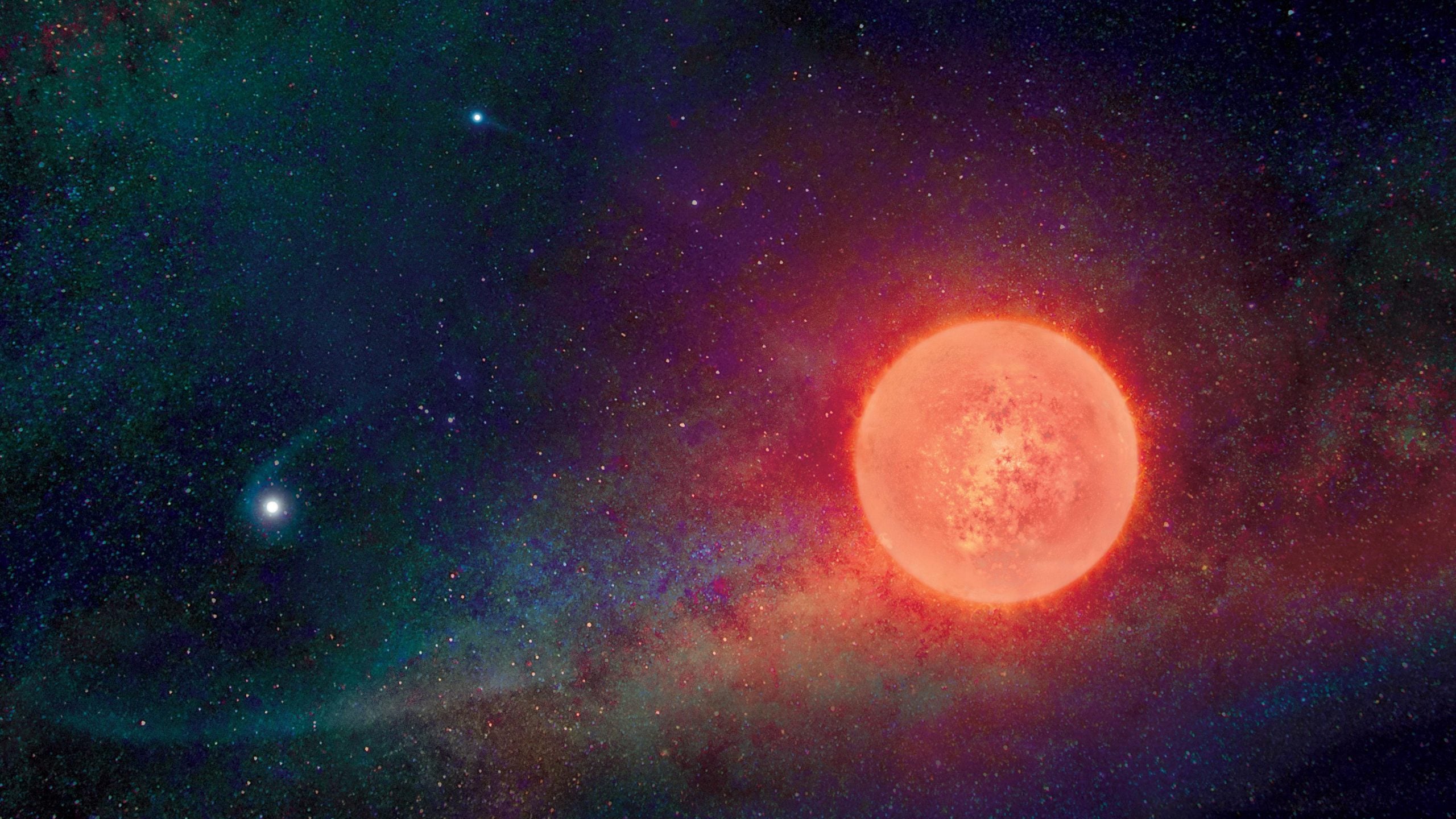
    Artistic Illustration of the Welopōʻai Triple Star System
    Artistic illustration of the Welopōʻai triple-star system, located just 28 light-years from Earth. The system consists of a red dwarf star (right) and a closely orbiting white dwarf (left), with a second white dwarf (upper) orbiting the pair at a much greater distance. Welopōʻai is the closest known triple-star system containing two white dwarfs. Note: this illustration is not to scale. Credit: Benoit Gougeon, University of Montreal

    A red dwarf still circles the burned-out core of a star that could once have swallowed it, and their orbit is wider than astronomers expected.

    A planet too faint to see can still give itself away by making the star it orbits wobble. Astronomers looking for planets around a dim red star 28 light-years from Earth measured a wobble more than a thousand times larger than they expected. Following that motion revealed a family of three stars, two of which had already run out of fuel.

    “We were actually looking for planets,” said lead author Étienne Artigau, a researcher at Université de Montréal’s Trottier Institute for Research on Exoplanets (IREx). “Instead, we found something much more surprising.”

    Patrick Dufour
    Étienne Artigau, researcher at IREx. Credit: iREx

    A strong pull from a faint companion

    The star they were watching was a red dwarf, a star much dimmer than the Sun. At the Canada-France-Hawaii Telescope on Maunakea, Hawaiʻi, a planet-hunting instrument called SPIRou (SPectropolarimètre InfraROUge) picked up a change of nearly 16 kilometers (10 miles) per second in the star’s speed. After several years of follow-up observations, the team knew that whatever was tugging on the red dwarf had more than half the Sun’s mass.

    “The unusual combination of high mass and very low brightness left only one plausible explanation: it was the remnant of a dead star,” said Charles-Antoine Parent, an undergraduate student at Université Laval and co-author of the study. “The most likely explanation was a white dwarf, although a neutron star or even a black hole couldn’t be ruled out.”
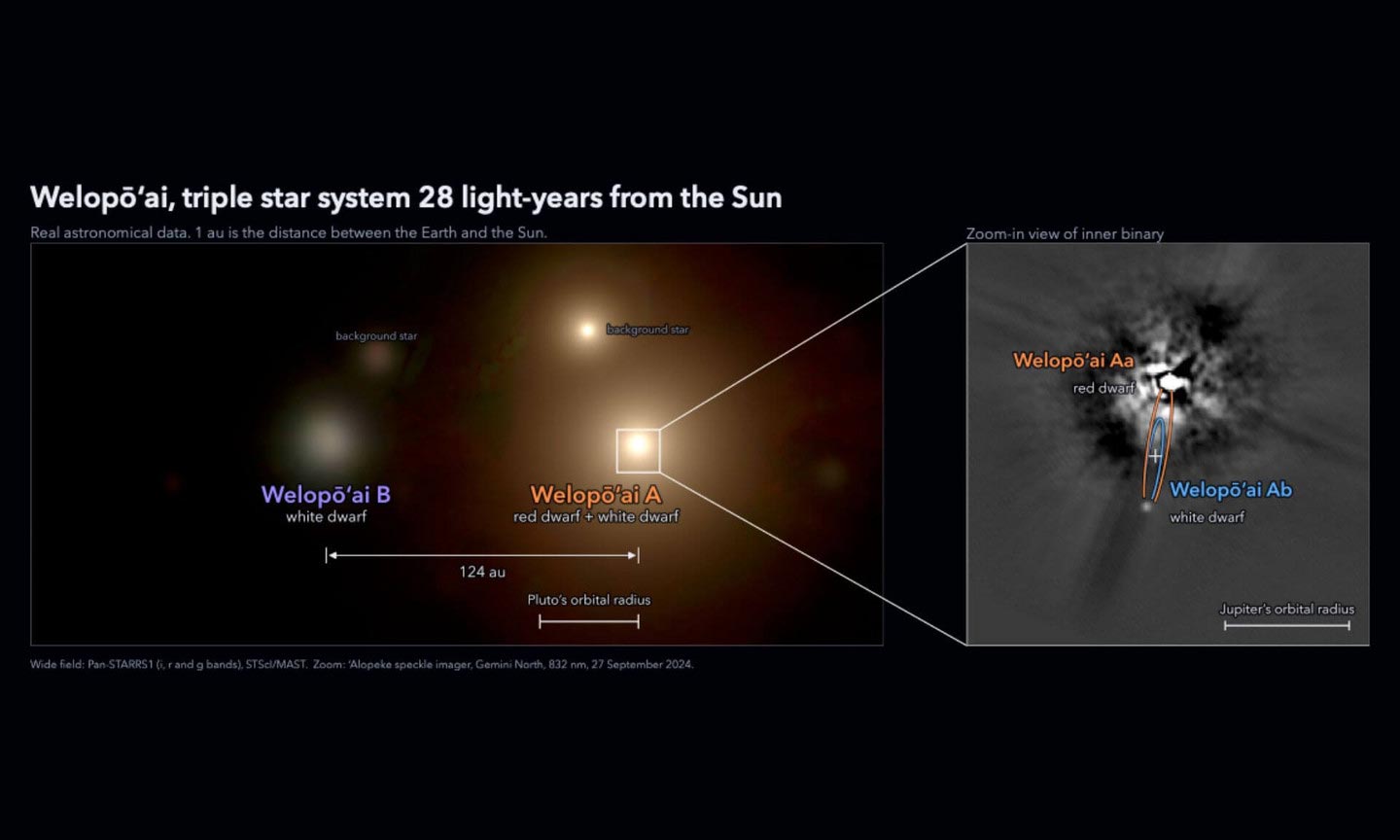
    Observations of Welopōʻai Triple Star System
    Observations of the Welopōʻai triple-star system, located 28 light-years from Earth. The image on the left shows the two components of the system: Welopōʻai A, a closely orbiting red dwarf and white dwarf pair, and Welopōʻai B, a second white dwarf located much farther away. The image on the right provides a close-up view of the inner pair, revealing the faint white dwarf companion (Ab) detected using the Gemini North telescope’s ‘Alopeke instrument. The overlaid curves illustrate the stars’ orbital paths. Credit: Pan-STARRS1/STScI/MAST (left); International Gemini Observatory/NSF NOIRLab (right). Graphic compilation: Étienne Artigau and Heidi White (UdeM/IREx)

    The team finally saw the faint companion with Gemini North, another telescope on Maunakea. High-resolution images from its ʻAlopeke instrument showed a white dwarf orbiting the red dwarf. A white dwarf is the extremely dense core a star leaves behind after it runs out of fuel. Most stars, including the Sun, will end their lives this way.

    Astronomers already knew about a white dwarf much farther out. That outer star circles both the red dwarf and its newly spotted companion. No other trio like this one, named Welopōʻai, is known within 100 light-years of Earth.

    Étienne Artigau
    Patrick Dufour, professor in the Department of Physics at Université de Montréal. Credit: iREx

    The red dwarf’s unexpectedly wide orbit

    Before it became a white dwarf, the red dwarf’s closer neighbor was about 40 percent more massive than the Sun. As it aged, it swelled into a giant several hundred times its original size. The red dwarf would have been close enough for the expanding giant to affect it. In similar systems, a giant can swallow its companion, and the two stars can even merge. Welopōʻai’s red dwarf appears to have survived. It now circles the remnant in a stable orbit, farther away than astronomers would expect given how close the two once were.

    “This system should not exist,” said Patrick Dufour, a professor at Université de Montréal who studies white dwarfs and co-authored the paper. “We have no clean explanation for how it got here. That is the question driving our next observations.”

    The team wants to find out whether the pull of all three stars on one another could explain the inner pair’s orbit. The researchers also measured the inner white dwarf’s mass with an uncertainty of less than 1 percent. Astronomers rarely get such a precise mass for a white dwarf, and it gives them a way to test predictions about how stars age and how matter behaves when packed so tightly together. The international team, led by IREx, reported its in Astronomy & Astrophysics.


    The simulation illustrates how gravitational interactions between its three stars could influence their orbits over time. The sonification translates the stars’ orbital motions into sound, so you can hear the system’s changing rhythms. Credit: Heidi White (UMONTREAL/IREx). Simulation data: Alexandre Correia, University of Coimbra

    Family and orbit in one Hawaiian name

    Welopōʻai got its name through A Hua He Inoa (“To Call Forth a Name”), a program of the ʻImiloa Astronomy Center of Hawaiʻi. The name joins welo, an inherited or family trait, with pōʻai, an orbit or circular path. Together they evoke a “path of family traits.”

    “Discoveries like this remind us that our own cosmic neighborhood still contains remarkable surprises,” Artigau said. “Even when we’re searching for planets, our Universe often has something completely unexpected waiting for us.”

    Reference: “Welopō‘ai: A peculiar triple system 8 pc from the Sun” by Étienne Artigau, Charles-Antoine Parent, Atanas K. Stefanov, Érika Le Bourdais, Souleymane Ouedraogo, Alexandrine L’Heureux, Patrick Dufour, René Doyon, Neil J. Cook, Charles Cadieux, Clémence Fontanive, Luc Arnold, Jean-François Donati, Matthias R. Schreiber, Ryan Cloutier, Xavier Delfosse, Céline Reylé, Thierry Forveille, Tianqi Cang, Claire Moutou and Alexandre C. M. Correia, 19 November 2026, Astronomy & Astrophysics.
    DOI: 10.1051/0004-6361/202661214

    Never miss a breakthrough: Join the SciTechDaily newsletter.
    Follow us on Google and Google News.

    Astronomy Astrophysics Stars Triple Star System University of Montreal
    Share. Facebook Twitter Pinterest LinkedIn Email Reddit

    Related Articles

    Distant Colliding Galaxy Dying Out As It Loses the Ability to Form Stars – Ejecting 10,000 Suns-Worth of Gas a Year

    Massive Rotating Stars in the Pleiades Cluster

    All 468 Stars in Milky Way Stellar Stream Theia 456 Are Related – “It’s Like Finding a Needle in a Haystack”

    A ‘Super-Puff’ Planet Like No Other – As Big as Jupiter but 10 Times Lighter

    A Star Dying Soon After the Beginning of the Universe Could Be Disrupting Mobile Phone Reception Today

    “This Galaxy Is Witnessing a Truly Extreme Event” – Galaxy Mergers Could Limit Star Formation

    Cosmic Neon Lights: Strange New Type of Star Revealed in X-ray Light

    Striped or Spotted? Planetary Scientists Solve a Brown Dwarf Mystery

    Chandra Studies Extraordinary Magnetar: Fastest Spinning and Possibly the Youngest Magnetar Known

    Leave A Reply Cancel Reply

    • Facebook
    • Twitter
    • Pinterest
    • YouTube

    Don't Miss a Discovery

    Subscribe for the Latest in Science & Tech!

    Trending News

    On the Brink of Extinction, These Giant Sea Turtles Are Doing Something Unexpected

    Coffee May Be Changing Your Gut in Ways Scientists Are Only Beginning To Understand

    Scientists Uncover Why a Common Nutrient Can Be Dangerous for Blood Vessels

    Mysterious Radio Signals From 5,000 Light-Years Away Lead Scientists to a Surprising Discovery

    New FDA-Approved Pill Lowers High Blood Pressure and May Slow Kidney Disease

    Scientists Just Challenged a Decades-Old Belief About How Cells Work

    Scientists Uncover a Natural Molecule That Makes Muscles Stronger and More Resistant to Fatigue

    Scientists Find That Mice, Not Deer, Hold a Major Clue to Lyme Disease Risk

    Follow SciTechDaily
    • Facebook
    • Twitter
    • YouTube
    • Pinterest
    • Newsletter
    • RSS
    SciTech News
    • Biology News
    • Chemistry News
    • Earth News
    • Health News
    • Physics News
    • Science News
    • Space News
    • Technology News
    Recent Posts
    • “This Star System Should Not Exist”: Astronomers Discover a Cosmic Mystery Just 28 Light-Years Away
    • A Newly Discovered Group of Immune Cells May Be Working Against You
    • Scientists Discover an Ancient Herbal Remedy May Help Curb Binge Drinking
    • Scientists Discover the Human Ear May Work Very Differently Than We Thought
    • Researchers Have Discovered a Previously Unknown Crystal Form of Silver
    Copyright © 1998 - 2026 SciTechDaily. All Rights Reserved.
    • Science News
    • About
    • Contact
    • Editorial Board
    • Privacy Policy
    • Terms of Use

    Type above and press Enter to search. Press Esc to cancel.