
Close Menu
    Facebook X (Twitter) Instagram
    SciTechDaily
    • Biology
    • Chemistry
    • Earth
    • Health
    • Physics
    • Science
    • Space
    • Technology
    Facebook X (Twitter) Pinterest YouTube RSS
    SciTechDaily
    Home»Space»Martian Rocks May Harbor Signs of Life From 4 Billion Years Ago
    Space

    Martian Rocks May Harbor Signs of Life From 4 Billion Years Ago

    By Corin Campbell, University Of EdinburghMay 25, 2018No Comments3 Mins Read
    Facebook Twitter Pinterest Telegram LinkedIn WhatsApp Email Reddit
    Share
    Facebook Twitter LinkedIn Pinterest Telegram Email Reddit
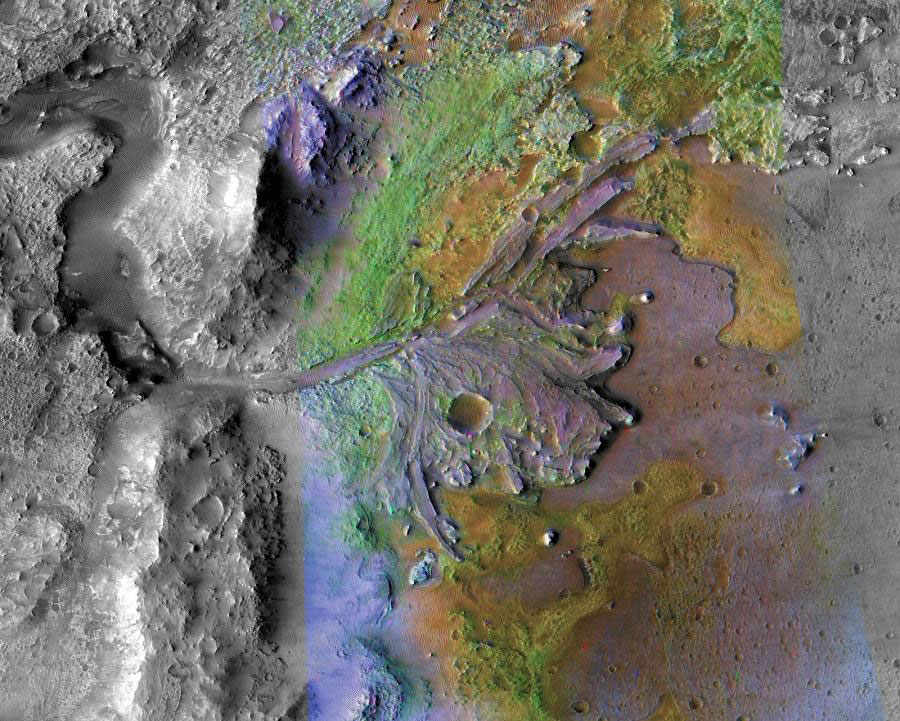
    Mars Rocks May Harbour Signs of Life
    The Jezero Crater delta, a well-preserved ancient river delta on Mars (credit: NASA/JPL-Caltech/MSSS/JHU-APL)

    Iron-rich rocks near ancient lake sites on Mars could hold vital clues that show life once existed there, research suggests.

    These rocks – which formed in lake beds – are the best place to seek fossil evidence of life from billions of years ago, researchers say.

    A new study that sheds light on where fossils might be preserved could aid the search for traces of tiny creatures – known as microbes – on Mars, which it is thought may have supported primitive life forms around four billion years ago.

    Ancient rocks

    A team led by an Edinburgh researcher has determined that sedimentary rocks made of compacted mud or clay are the most likely to contain fossils. These rocks are rich in iron and a mineral called silica, which helps preserve fossils.

    They formed during the Noachian and Hesperian Periods of Martian history between three and four billion years ago. At that time, the planet’s surface was abundant in water, which could have supported life.

    The rocks are much better preserved than those of the same age on Earth, researchers say. This is because Mars is not subject to plate tectonics – the movement of huge rocky slabs that form the crust of some planets – which over time can destroy rocks and fossils inside them.

    Mars missions

    The team reviewed studies of fossils on Earth and assessed the results of lab experiments replicating Martian conditions to identify the most promising sites on the planet to explore for traces of ancient life.

    Their findings could help inform NASA’s next rover mission to the Red Planet, which will focus on searching for evidence of past life. The US space agency’s Mars 2020 rover will collect rock samples to be returned to Earth for analysis by a future mission.

    A similar mission led by the European Space Agency is also planned in the coming years.

    The latest study could aid in the selection of landing sites for both missions, and help identify the best places to gather rock samples.

    The study, published in Journal of Geophysical Research, also involved researchers at NASA’s Jet Propulsion Laboratory, Brown University, California Institute of Technology, Massachusetts Institute of Technology, and Yale University in the US.

    Dr. Sean McMahon, a Marie Sklodowska-Curie fellow in the University of Edinburgh’s School of Physics and Astronomy, said: “There are many interesting rock and mineral outcrops on Mars where we would like to search for fossils, but since we can’t send rovers to all of them we have tried to prioritize the most promising deposits based on the best available information.”

    Reference: “A Field Guide to Finding Fossils on Mars” by S. McMahon, T. Bosak, J. P. Grotzinger, R. E. Milliken, R. E. Summons, M. Daye, S. A. Newman, A. Fraeman, K. H. Williford and D. E. G. Briggs, 2 May 2018, Journal of Geophysical Research.
    DOI: 10.1029/2017JE005478

    Never miss a breakthrough: Join the SciTechDaily newsletter.
    Follow us on Google and Google News.

    Astronomy Mars Planetary Science University of Edinburgh
    Share. Facebook Twitter Pinterest LinkedIn Email Reddit

    Related Articles

    Researchers Found a Surprisingly Realistic Way To Mine Asteroids for Mars

    An Unexpected Planetary Neighbor May Play a Surprising Role in Earth’s Climate Cycles

    New Clues Suggest Mars Once Had a Vast Northern Ocean

    Mystery Ozone Surge Discovered in Mars’s Winter Darkness

    Perseverance Rover Captures Elusive Martian Aurora for a Second Time

    NASA’s Curiosity Readies for First Drive on Mars

    Color HiRISE Image of Curiosity Rover on Mars

    First 360-Degree Color Panorama From NASA’s Curiosity Mars Rover

    A Connection Between Volatiles in the Subsurface of Mars and the Impact Process

    Leave A Reply Cancel Reply

    • Facebook
    • Twitter
    • Pinterest
    • YouTube

    Don't Miss a Discovery

    Subscribe for the Latest in Science & Tech!

    Trending News

    Scientists Built a Programmable Chip That Can Slow Light on Command

    The Backyard “Silly Sprinkler” That Cracked One of Physics’ Biggest Puzzles

    This Common Sleep Habit Could Be Making You Gain Weight

    Mathematician Offers New Solution to a Fundamental Cosmic Paradox

    Scientists Turn Plastic Waste Into Clean Hydrogen Fuel

    Long COVID Brain Scans Reveal Damage to Dopamine Neurons

    Scientists Warn a Silent Oxygen Crisis Is Spreading Through Earth’s Waters

    James Webb Telescope Discovers Hidden Giant Planet in Famous Star System

    Follow SciTechDaily
    • Facebook
    • Twitter
    • YouTube
    • Pinterest
    • Newsletter
    • RSS
    SciTech News
    • Biology News
    • Chemistry News
    • Earth News
    • Health News
    • Physics News
    • Science News
    • Space News
    • Technology News
    Recent Posts
    • Singapore Has the World’s Longest, Healthiest Lives – but It Comes With a Hidden Cost
    • Scientists Discover the First Contagious Cancer in a Freshwater Animal
    • NASA Astronaut Comes Home After 3,856 Orbits of Earth
    • A Rare and Deadly Cancer May Have an Unexpected New Vulnerability
    • Sleep Disorders Don’t Just Exhaust You. New Research Shows They Change Your Brain
    Copyright © 1998 - 2026 SciTechDaily. All Rights Reserved.
    • Science News
    • About
    • Contact
    • Editorial Board
    • Privacy Policy
    • Terms of Use

    Type above and press Enter to search. Press Esc to cancel.