
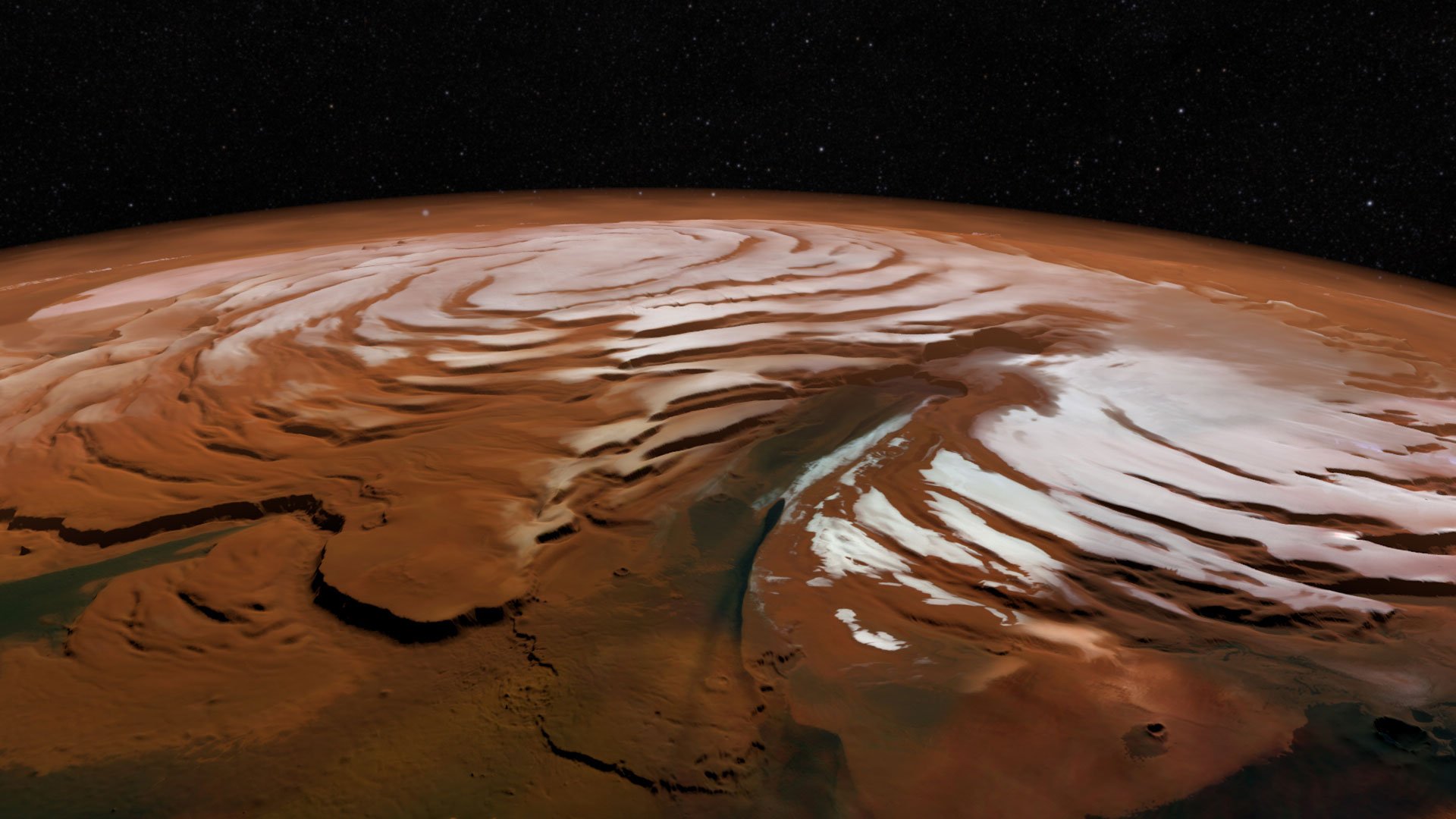
Scientists have captured rare insights into Mars’s north polar vortex, where temperatures plunge far below those outside its boundaries and darkness triggers an unusual surge in ozone.
New observations of Mars’s north polar vortex during winter reveal that conditions inside it are far more extreme than those outside. The lack of sunlight at the planet’s northern pole not only creates intense cold but also allows ozone levels in the atmosphere to rise.
“The atmosphere inside the polar vortex, from near the surface to about 30 kilometers high, is characterized by extreme cold temperatures, about 40 degrees Celsius colder than outside the vortex,” said Dr. Kevin Olsen of the University of Oxford, who presented the results at the EPSC-DPS2025 Joint Meeting in Helsinki last week.
In these freezing conditions, the small amount of water vapor in the Martian atmosphere condenses and settles on the ice cap. This shift has a major effect on atmospheric chemistry. Normally, ozone is broken down when molecules formed by ultraviolet sunlight interact with water vapor. When the water vapor disappears, that destructive process cannot take place, and ozone builds up inside the vortex instead.
“Ozone is a very important gas on Mars – it’s a very reactive form of oxygen and tells us how fast chemistry is happening in the atmosphere,” said Olsen. “By understanding how much ozone there is and how variable it is, we know more about how the atmosphere changed over time, and even whether Mars once had a protective ozone layer like on Earth.”
The European Space Agency plans to launch the ExoMars Rosalind Franklin rover in 2028, with the mission focused on searching for signs of ancient life on Mars. If the planet once possessed an ozone layer that shielded its surface from harmful ultraviolet radiation, the likelihood that life could have persisted there billions of years ago would be significantly higher.
How Mars’s Polar Vortex Forms
The polar vortex is a consequence of Mars’s seasons, which occur because the Red Planet’s axis is tilted at an angle of 25.2 degrees. Just like on Earth, the end of northern summer sees an atmospheric vortex develop over Mars’s north pole and last through to the spring.
On Earth, the polar vortex can sometimes become unstable, lose its shape, and descend southwards, bringing colder weather to the mid-latitudes. The same can happen to Mars’s polar vortex, and in doing so, it provides an opportunity to probe its interior.
“Because winters at Mars’s north pole experience total darkness, like on Earth, they are very hard to study,” says Olsen. “By being able to measure the vortex and determine whether our observations are inside or outside of the dark vortex, we can really tell what is going on.”
Probing the Vortex
Olsen works with ESA’s ExoMars Trace Gas Orbiter that is in orbit around Mars. In particular, the spacecraft’s Atmospheric Chemistry Suite (ACS) studies Mars’s atmosphere by gazing at the Red Planet’s limb when the Sun is on the other side of the planet and is shining through the atmosphere. The wavelengths at which the sunlight is absorbed give away which molecules are present in the atmosphere and how high above the surface they are.
However, this technique doesn’t work during the total darkness of Martian winter when the Sun doesn’t rise over the north pole. The only opportunities to glimpse inside the vortex are when it loses its circular shape but, to know exactly when and where this is happening, requires additional data.
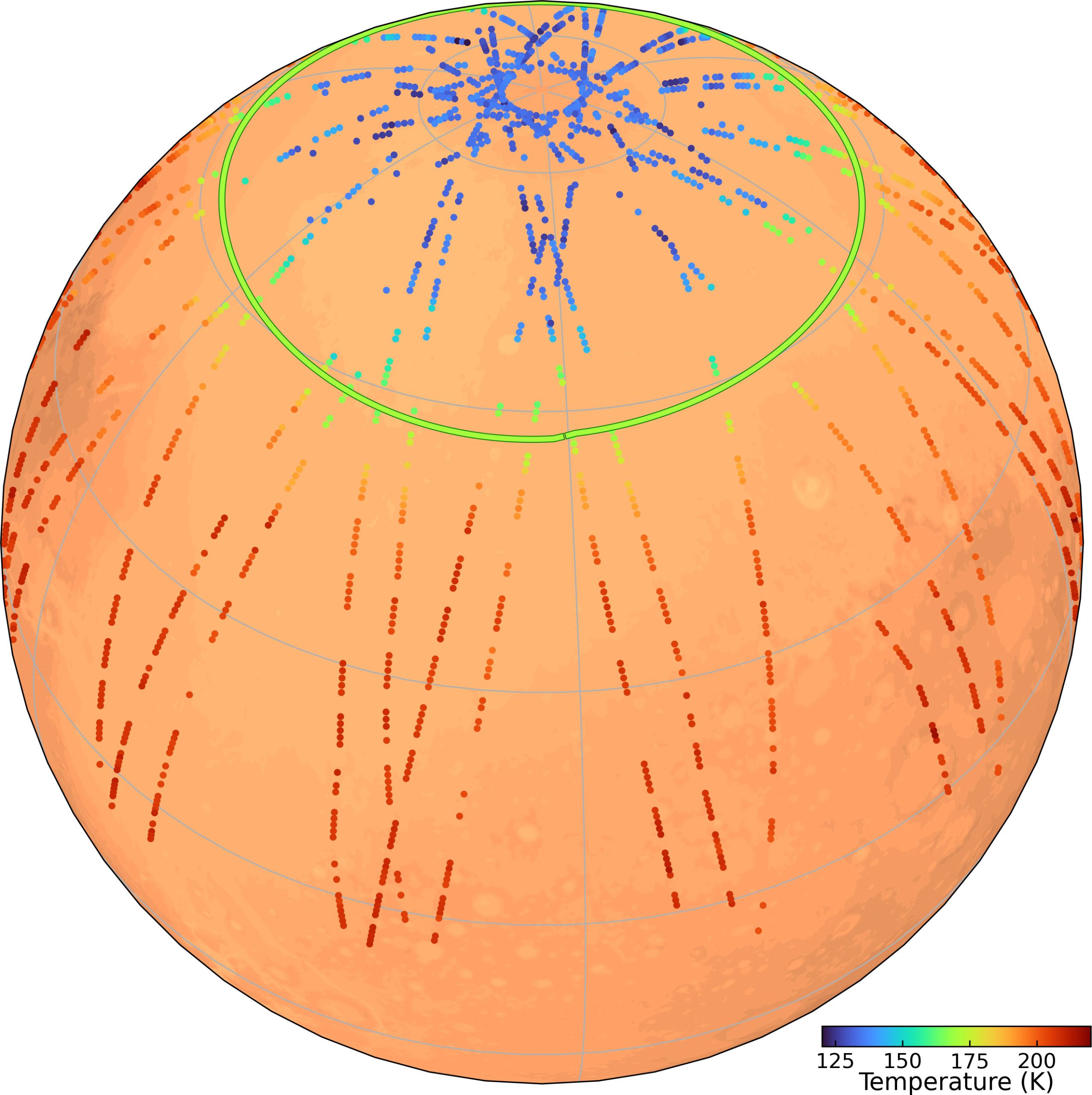
For this, Olsen turned to the Mars Climate Sounder instrument on NASA’s Mars Reconnaissance Orbiter to measure the extent of the vortex via temperature measurements.
“We looked for a sudden drop in temperature – a sure sign of being inside the vortex,” said Olsen. “Comparing the ACS observations with the results from the Mars Climate Sounder shows clear differences in the atmosphere inside the vortex compared to outside. This is a fascinating opportunity to learn more about Martian atmosphere chemistry and how conditions change during the polar night to allow ozone to build up.”
Reference: “What goes on inside the Mars north polar vortex?” by Kevin Olsen, Bethan Gregory, Franck Montmessin, Lucio Baggio, Franck Lefèvre, Oleg Korablev, Alexander Trokhimovsky, Anna Fedorova, Denis Belyaev, Juan Alday and Armin Kleinböhl, 8 July 2025, EPSC-DPS2025.
DOI: 10.5194/epsc-dps2025-1438
Never miss a breakthrough: Join the SciTechDaily newsletter.
Follow us on Google and Google News.
1 Comment
This is an interesting and puzzling claim. On Earth, at stratospheric pressures and temperatures, ozone appears to be metastable, meaning that it has a relatively short half-life and needs to be replenished continually by the Brewer-Dobson circulation. The Winter circumpolar vortex prevents migration of ozone produced in the tropics from replenishing the ozone that reverts to oxygen; the half-life gets even shorter during the Spring, when photocatalytic destruction takes place. Inasmuch as the Martian night is much longer than six-months (almost twice), there should be significant loss of ozone. I think that something is being missed here, either by me or the researchers.