
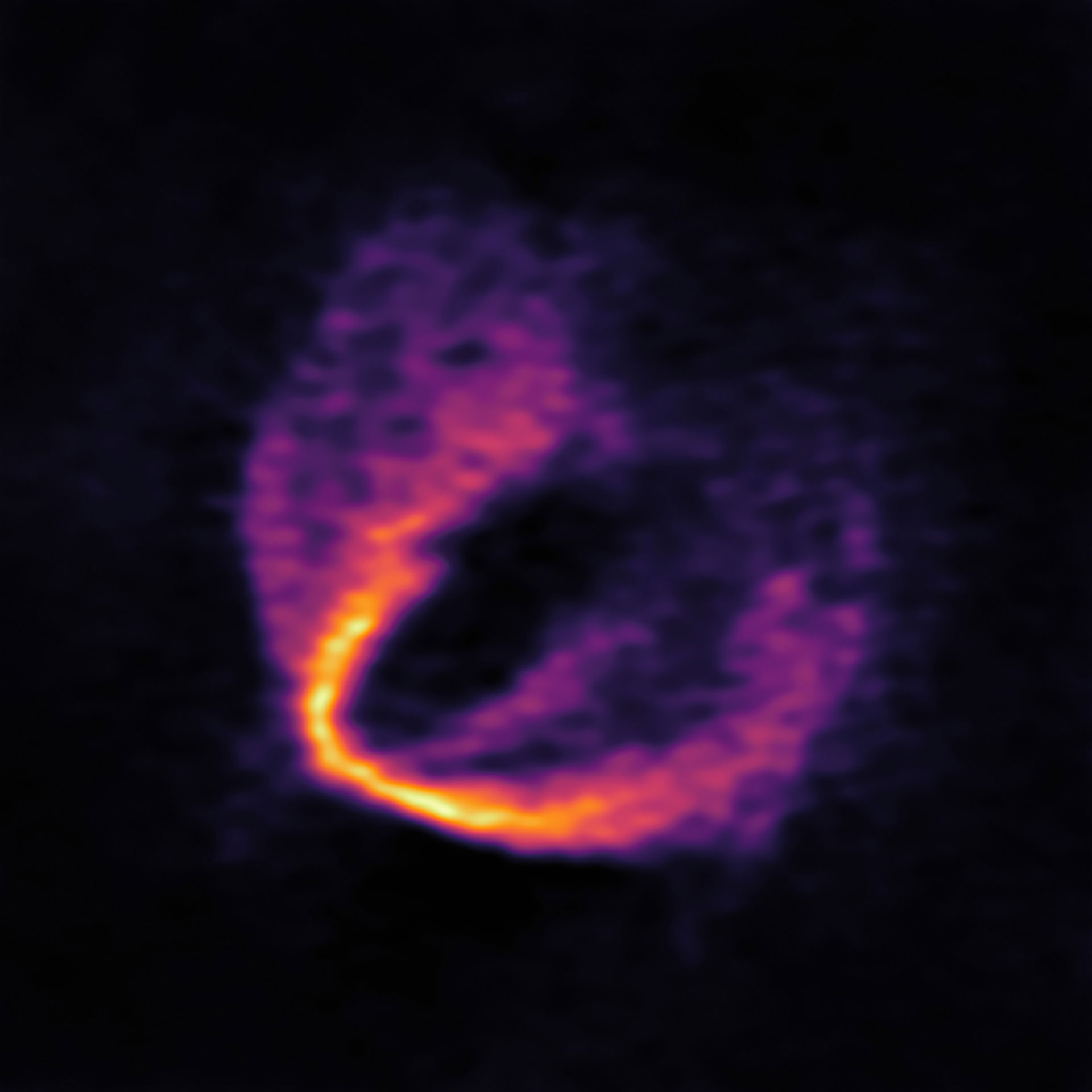
Two independent teams of astronomers have used ALMA to uncover convincing evidence that three young planets are in orbit around the infant star HD 163296. Using a novel planet-finding technique, the astronomers identified three disturbances in the gas-filled disc around the young star: the strongest evidence yet that newly formed planets are in orbit there. These are considered the first planets to be discovered with ALMA.
The Atacama Large Millimeter/submillimeter Array (ALMA) has transformed our understanding of protoplanetary discs — the gas- and dust-filled planet factories that encircle young stars. The rings and gaps in these discs provide intriguing circumstantial evidence for the presence of protoplanets. Other phenomena, however, could also account for these tantalizing features.
But now, using a novel planet-hunting technique that identifies unusual patterns in the flow of gas within a planet-forming disc around a young star, two teams of astronomers have each confirmed distinct, telltale hallmarks of newly formed planets orbiting an infant star.
“Measuring the flow of gas within a protoplanetary disc gives us much more certainty that planets are present around a young star,” said Christophe Pinte of Monash University in Australia and Institut de Planétologie et d’Astrophysique de Grenoble (Université de Grenoble-Alpes/CNRS) in France, and lead author on one of the two papers. “This technique offers a promising new direction to understand how planetary systems form.”
To make their respective discoveries, each team analyzed ALMA observations of HD 163296, a young star about 330 light-years from Earth in the constellation of Sagittarius (The Archer). This star is about twice the mass of the Sun but is just four million years old — just a thousandth of the age of the Sun.
“We looked at the localized, small-scale motion of gas in the star’s protoplanetary disc. This entirely new approach could uncover some of the youngest planets in our galaxy, all thanks to the high-resolution images from ALMA,” said Richard Teague, an astronomer at the University of Michigan and principal author on the other paper.
ESOcast 164 Light: ALMA Discovers Trio of Infant Planets (4K UHD)
Rather than focusing on the dust within the disc, which was clearly imaged in earlier ALMA observations, the astronomers instead studied carbon monoxide (CO) gas spread throughout the disc. Molecules of CO emit a very distinctive millimeter-wavelength light that ALMA can observe in great detail. Subtle changes in the wavelength of this light due to the Doppler effect reveal the motions of the gas in the disc.
The team led by Teague identified two planets located approximately 12 billion and 21 billion kilometers from the star. The other team, led by Pinte, identified a planet at about 39 billion kilometers from the star.
The two teams used variations on the same technique, which looks for anomalies in the flow of gas — as evidenced by the shifting wavelengths of the CO emission — that indicate the gas is interacting with a massive object.
The technique used by Teague, which derived averaged variations in the flow of the gas as small as a few percent, revealed the impact of multiple planets on the gas motions nearer to the star. The technique used by Pinte, which more directly measured the flow of the gas, is better suited to studying the outer portion of the disc. It allowed the authors to more accurately locate the third planet, but is restricted to larger deviations of the flow, greater than about 10%.
This sequence takes the viewer from a broad view of the spectacular central regions of the Milky Way and in towards the rich constellation of Sagittarius (The Archer). Here we find an unremarkable-looking star, HD 163296, which has about twice the mass of the Sun, but is only four million years old. The final image from ALMA reveals the disc around the star where planets are forming. Credit: ESO. Music: Astral Electronic.
In both cases, the researchers identified areas where the flow of the gas did not match its surroundings — a bit like eddies around a rock in a river. By carefully analyzing this motion, they could clearly see the influence of planetary bodies similar in mass to Jupiter.
This new technique allows astronomers to more precisely estimate protoplanetary masses and is less likely to produce false positives. “We are now bringing ALMA front and center into the realm of planet detection,” said coauthor Ted Bergin of the University of Michigan.
Both teams will continue refining this method and will apply it to other discs, where they hope to better understand how atmospheres are formed and which elements and molecules are delivered to a planet at its birth.
Papers:
- Research paper Pinte et al. in Astrophysical Journal Letters
- Research paper Teague et al. in Astrophysical Journal Letters
Never miss a breakthrough: Join the SciTechDaily newsletter.
Follow us on Google and Google News.