
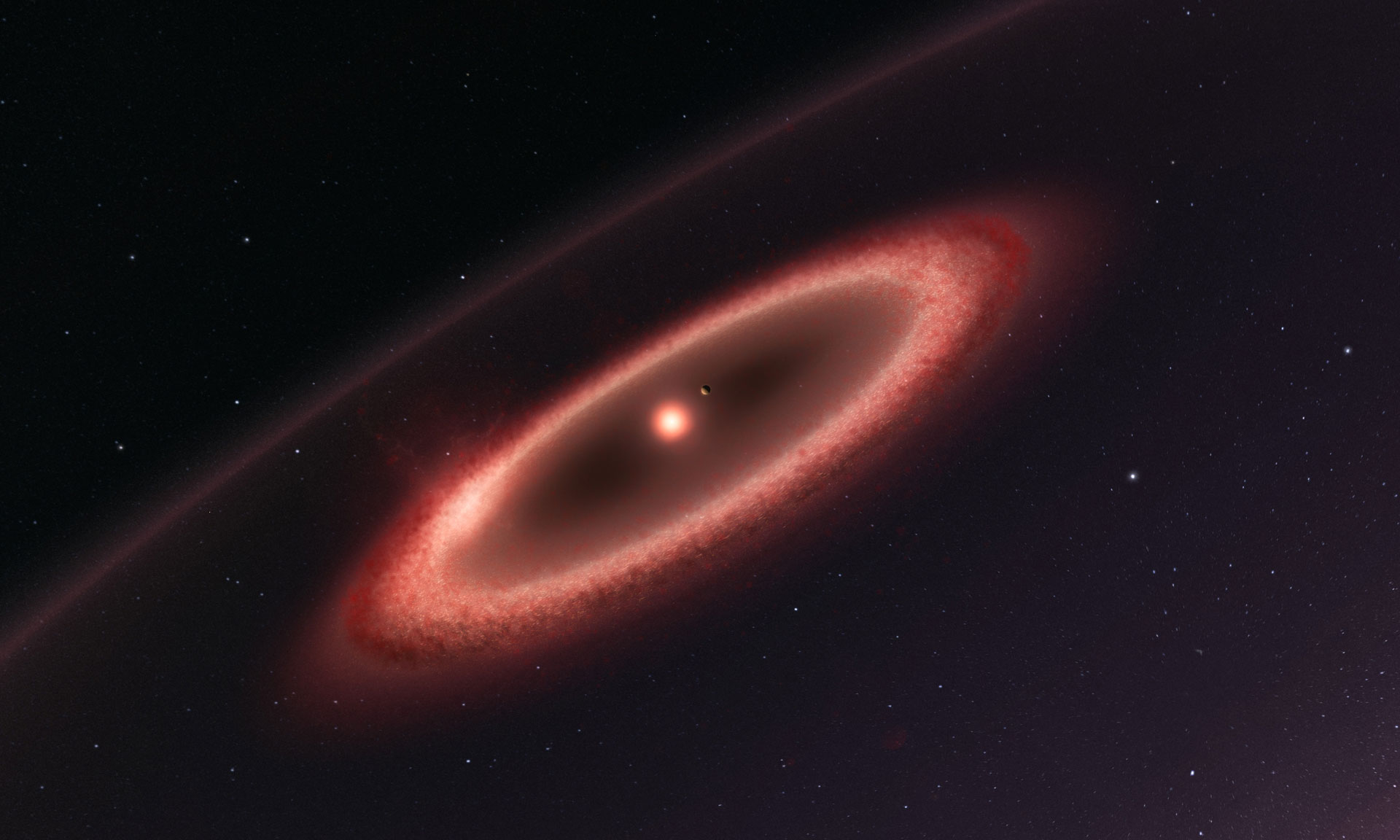
The Atacama Large Millimeter/submillimeter Array (ALMA) has discovered dust around the closest star to the Solar System, Proxima Centauri. These new observations reveal the glow coming from cold dust in a region between one to four times as far from Proxima Centauri as the Earth is from the Sun. The data also hint at the presence of an even cooler outer dust belt and may indicate the presence of an elaborate planetary system. These structures are similar to the much larger belts in the Solar System and are also expected to be made from particles of rock and ice that failed to form planets.
Proxima Centauri is the closest star to the Sun. It is a faint red dwarf lying just four light-years away in the southern constellation of Centaurus (The Centaur). It is orbited by the Earth-sized temperate world Proxima b, discovered in 2016 and the closest planet to the Solar System. But there is more to this system than just a single planet. The new ALMA observations reveal emission from clouds of cold cosmic dust surrounding the star.
The lead author of the new study, Guillem Anglada, from the Instituto de Astrofísica de Andalucía (CSIC), Granada, Spain, explains the significance of this find: “The dust around Proxima is important because, following the discovery of the terrestrial planet Proxima b, it’s the first indication of the presence of an elaborate planetary system, and not just a single planet, around the star closest to our Sun.”
Dust belts are the remains of material that did not form into larger bodies such as planets. The particles of rock and ice in these belts vary in size from the tiniest dust grain, smaller than a millimeter across, up to asteroid-like bodies many kilometers in diameter.
Dust appears to lie in a belt that extends a few hundred million kilometers from Proxima Centauri and has a total mass of about one hundredth of the Earth’s mass. This belt is estimated to have a temperature of about –230 degrees Celsius, as cold as that of the Kuiper Belt in the outer Solar System.
There are also hints in the ALMA data of another belt of even colder dust about ten times further out. If confirmed, the nature of an outer belt is intriguing, given its very cold environment far from a star that is cooler and fainter than the Sun. Both belts are much further from Proxima Centauri than the planet Proxima b, which orbits at just four million kilometers from its parent star.
Guillem Anglada explains the implications of the discovery: “This result suggests that Proxima Centauri may have a multiple planet system with a rich history of interactions that resulted in the formation of a dust belt. Further study may also provide information that might point to the locations of as yet unidentified additional planets.”
Proxima Centauri’s planetary system is also particularly interesting because there are plans — the Starshot project — for future direct exploration of the system with microprobes attached to laser-driven sails. Knowledge of the dust environment around the star is essential for planning such a mission.
Co-author Pedro Amado, also from the Instituto de Astrofísica de Andalucía, explains that this observation is just the start: “These first results show that ALMA can detect dust structures orbiting around Proxima. Further observations will give us a more detailed picture of Proxima’s planetary system. In combination with the study of protoplanetary discs around young stars, many of the details of the processes that led to the formation of the Earth and the Solar System about 4600 million years ago will be unveiled. What we are seeing now is just the appetizer compared to what is coming!”
Reference: “ALMA Discovery of Dust Belts Around Proxima Centauri” by Guillem Anglada, Pedro J. Amado, Jose L. Ortiz, José F. Gómez, Enrique Macías, Antxon Alberdi, Mayra Osorio, José L. Gómez, Itziar de Gregorio-Monsalvo, Miguel A. Pérez-Torres, Guillem Anglada-Escudé, Zaira M. Berdiñas, James S. Jenkins, Izaskun Jimenez-Serra, Luisa M. Lara, Maria J. López-González, Manuel López-Puertas, Nicolas Morales, Ignasi Ribas, Anita M. S. Richards, Cristina Rodríguez-López and Eloy Rodriguez, 15 November 2017, The Astrophysical Journal Letters.
DOI: 10.3847/2041-8213/aa978b
PDF
Never miss a breakthrough: Join the SciTechDaily newsletter.
Follow us on Google and Google News.