
Close Menu
    Facebook X (Twitter) Instagram
    SciTechDaily
    • Biology
    • Chemistry
    • Earth
    • Health
    • Physics
    • Science
    • Space
    • Technology
    Facebook X (Twitter) Pinterest YouTube RSS
    SciTechDaily
    Home»Space»Proxima Centauri C Experiences Earth-Like Conditions in Terms of Stellar Wind
    Space

    Proxima Centauri C Experiences Earth-Like Conditions in Terms of Stellar Wind

    By Harvard-Smithsonian Center for AstrophysicsDecember 13, 20201 Comment3 Mins Read
    Facebook Twitter Pinterest Telegram LinkedIn WhatsApp Email Reddit
    Share
    Facebook Twitter LinkedIn Pinterest Telegram Email Reddit
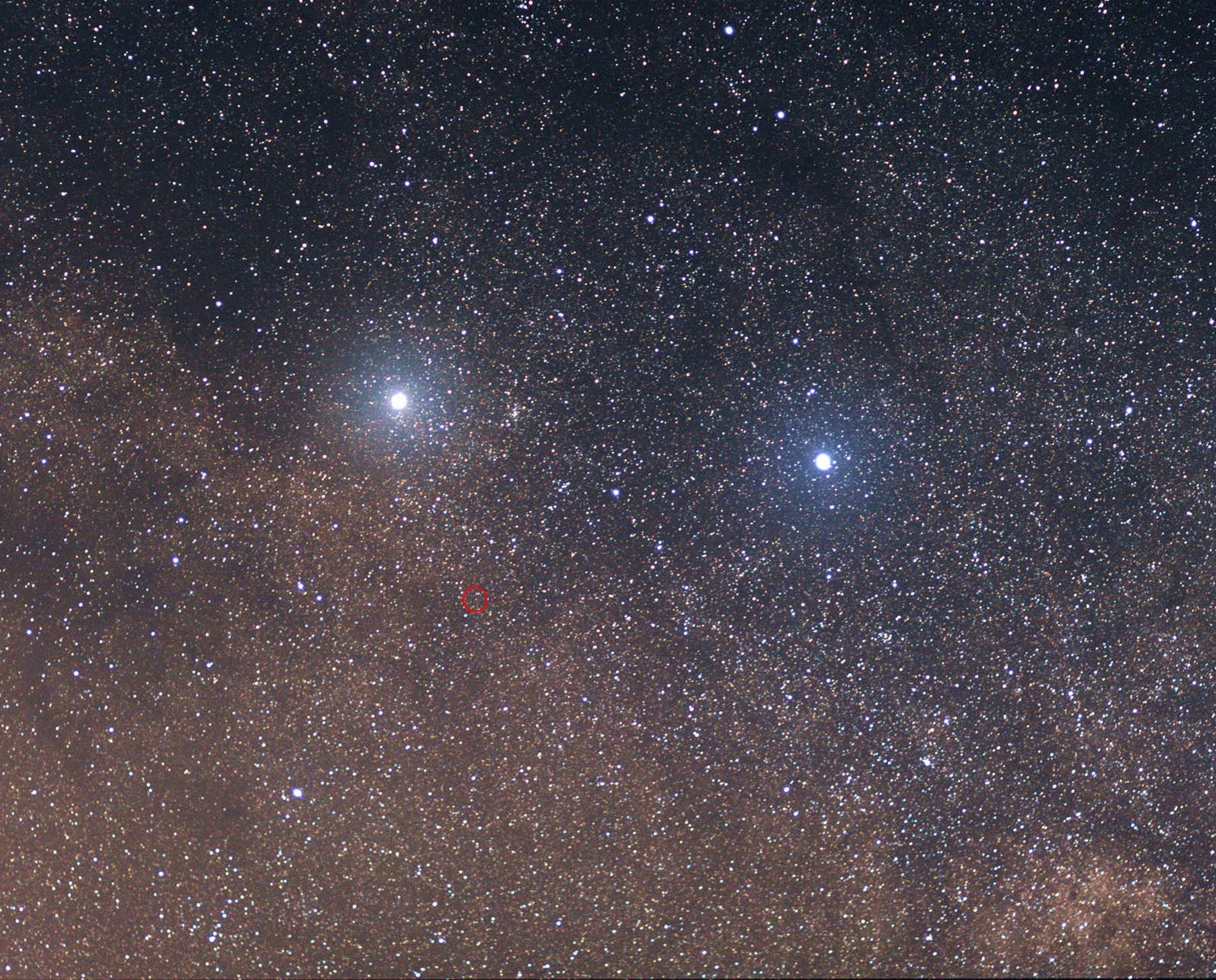
    Starfield Near Proxima Centauri
    An optical image of the starfield near Proxima Cen. The two bright stars are (left) Alpha and (right) Beta Centauri. Proxima Centauri, the closest star to the Sun, is the faint red dot inside the red circle. A second planet, Proxima c, was recently discovered orbiting Proxima Cen every 5.3 years. Astronomers calculating the likely effects of the star’s wind on the planet conclude that a possible atmosphere would experience Earth-like conditions. Credit: Skatebiker

    Proxima Centauri is the closest star to the Sun, and its planet, Proxima Cen b (“Proxima b”), lies in its habitable zone (the distance range within which surface water can be liquid), making the planet a prime target for exoplanet characterization.

    The star is an M- dwarf with a mass of only 0.12 solar-masses and an effective surface temperature of about 3000 kelvin. The comparatively low surface temperature means that its habitable zone lies very close to the star and Proxima b, with its mass of about 1.2 Earth-masses, lies about twenty times closer to the star than the Earth does to the Sun, orbiting in only 11.2 days.

    Being as close as it is to its star, Proxima b (like all habitable-zone exoplanets around M-dwarf stars) is susceptible to stellar flares, winds, X-rays, and other kinds of activity that could disrupt its atmosphere and possibilities for life. These activities are linked to the strong magnetic fields in M-dwarfs, and they remain active in dwarf stars over much longer timescales than in higher-mass stars like the Sun, so that the cumulative exposures are commensurately greater. All these issues have been investigated in some detail for Proxima b; one conclusion, for example, is that it is probably subject to wind pressures ten thousand times larger than those exerted by the Sun on the Earth.

    A new planet has recently been discovered in the Proxima Cen system, Proxima c, after astronomers spotted slight variations in the orbital velocity of Proxima b (because it does not transit the star, its discovery was made by monitoring its velocity, not the star’s lightcurve). Follow-up studies of Proxima c determined that it was a ~ six Earth-mass planet and orbited at 1.44 AU every 5.3 years – and is much farther away from the star than Proxima b. (There are even hints of the presence of a third planet). CfA astronomers Jeremy Drake and Cecilia Garraffo, and their colleagues, investigated the effects the star’s activity might have on Proxima c’s atmosphere.

    The scientists constructed the most comprehensive numerical simulation of the space environment of the Proxima Cen system that has been done to date including models for the stellar corona and realistic surface magnetic field configurations during the minimum and maximum activity states of the star. Their results indicate that Proxima c experiences Earth-like conditions, at least in terms of stellar wind effects. It is not known whether or not Proxima c actually has an atmosphere, but the new models indicate the conditions are not unduly corrosive and are favorable for the persistence of any atmosphere that does exist.

    Reference: “An Earth-like Stellar Wind Environment for Proxima Centauri c” by Julián D. Alvarado-Gómez, Jeremy J. Drake, Cecilia Garraffo, Ofer Cohen, Katja Poppenhaeger, Rakesh K. Yadav and Sofia P. Moschou, 7 October 2020, The Astrophysical Journal Letters.
    DOI: 10.3847/2041-8213/abb885

    Never miss a breakthrough: Join the SciTechDaily newsletter.
    Follow us on Google and Google News.

    Astronomy Astrophysics Harvard-Smithsonian Center for Astrophysics Space Weather
    Share. Facebook Twitter Pinterest LinkedIn Email Reddit

    Related Articles

    New Research Helps Explain Why the Sun’s Magnetic Field Reverses Every Eleven Years

    New Model Advances the Understanding of How Solar Wind Works

    Scientists Report Details of the Gravity Probe-B Mission

    Two Planets Separated by Less Than 5 Earth Moon Distances

    Study Challenges Prevailing Ideas About How Supermassive Black Holes Grow

    Calculations Show the Ideal Time to Study the Cosmos

    Using Infrared Images from Hubble & Spitzer, Scientists Discover 25 Distant Galaxies

    Supernova Shock Wave Breaks Through a Cocoon of Gas

    Origins of Type Ia Supernovae

    1 Comment

    1. Geoff Houtman on February 5, 2021 4:58 pm

      Great article. Two questions-

      Any news on Prox d?

      Do we have to wait for the James Webb telescope to launch before we can find out any more about this system?

      Cheers Geoff

      Reply
    Leave A Reply Cancel Reply

    • Facebook
    • Twitter
    • Pinterest
    • YouTube

    Don't Miss a Discovery

    Subscribe for the Latest in Science & Tech!

    Trending News

    Scientists Break 50-Year-Old Bottleneck To Supercharge Cancer Drug Production

    Popular Weight-Loss Drug Wegovy Linked to Sudden Vision Loss

    Extraordinary Fossil Reveals Fatal Duel Between Ocean Titans 80 Million Years Ago

    “Super Bizarre” – Neuroscientists Discover That Adult Brain Is Filled With Millions of “Silent Synapses”

    Simple Brain Training Cuts Dementia Risk Decades Later, Study Finds

    A Simple Injection Could Help the Heart Heal Itself After a Heart Attack

    Scientists Just Discovered a Hidden Freshwater World Beneath the Great Salt Lake

    Why Your Daily Shower Could Be Worsening the Water Crisis

    Follow SciTechDaily
    • Facebook
    • Twitter
    • YouTube
    • Pinterest
    • Newsletter
    • RSS
    SciTech News
    • Biology News
    • Chemistry News
    • Earth News
    • Health News
    • Physics News
    • Science News
    • Space News
    • Technology News
    Recent Posts
    • This Surprising Daily Habit Could Cut Dementia Risk by 35%
    • Just 10 Minutes a Day: Scientists Say This Ancient Chinese Practice Shows Powerful Blood Pressure Benefits
    • This Alga Rewrites the Rules of Photosynthesis To Survive in the Dark
    • Are Humans Naturally Violent? Scientists Challenge Long-Held Assumptions
    • Scientists Say This Popular Food Could Help Your Body Get Rid of Microplastics
    Copyright © 1998 - 2026 SciTechDaily. All Rights Reserved.
    • Science News
    • About
    • Contact
    • Editorial Board
    • Privacy Policy
    • Terms of Use

    Type above and press Enter to search. Press Esc to cancel.