
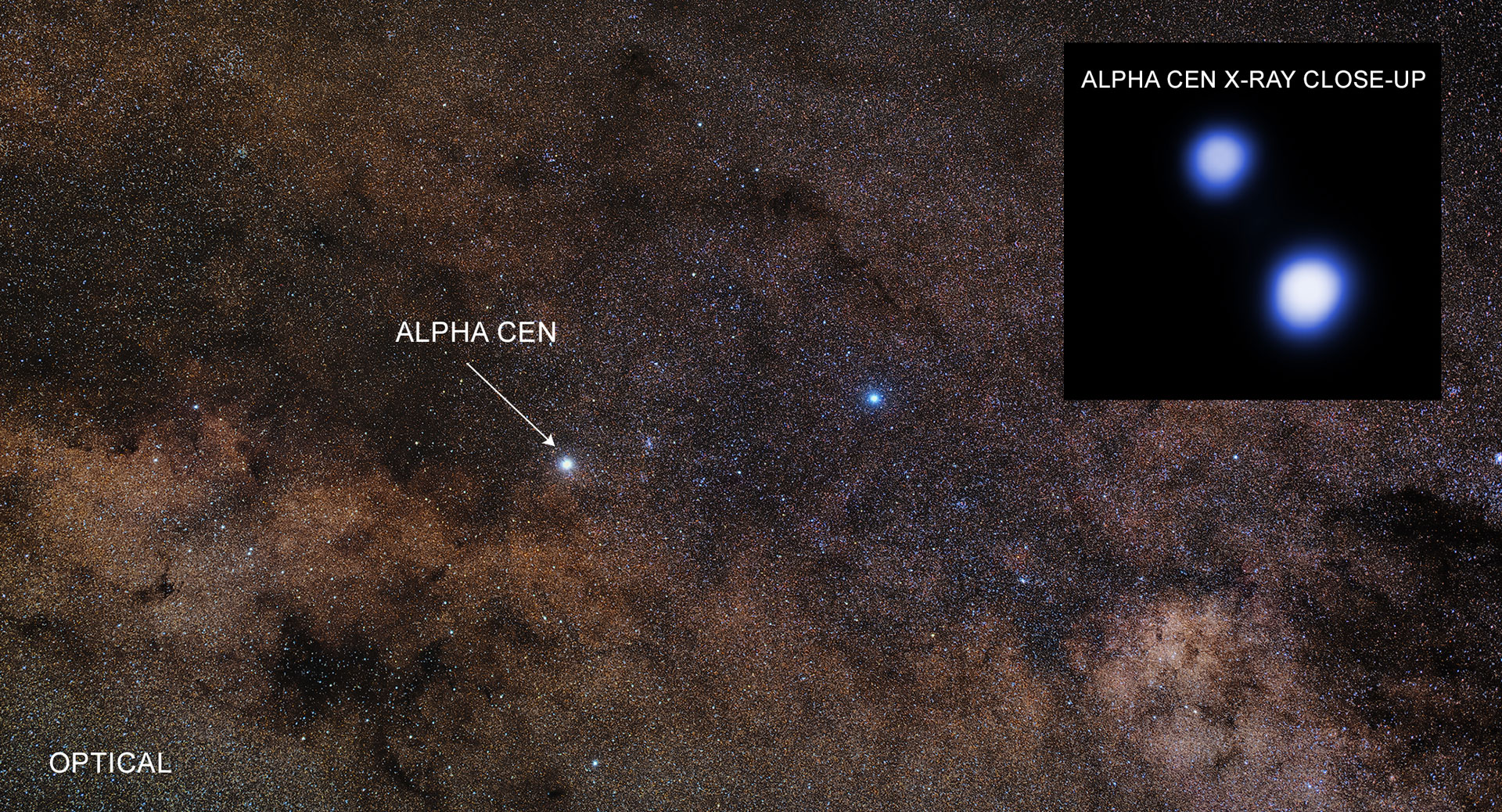
- Chandra observations indicate the two brightest stars in Alpha Centauri are not pummeling any orbiting planets with large amounts of X-rays.
- Alpha Centauri is a triple star system that is only about 25 trillion miles from Earth, and contains the closest star to our Sun.
- Two of the three stars in Alpha Centauri closely resemble the Sun, making it a prime target in the search for life-hosting exoplanets.
- Chandra has monitored the Alpha Centauri system every six months for over a decade, providing valuable information about its stars.
In humanity’s search for life outside our Solar System, one of the best places scientists have considered is Alpha Centauri, a system containing the three nearest stars beyond our Sun.
A new study that has involved monitoring of Alpha Centauri for more than a decade by NASA’s Chandra X-ray Observatory provides encouraging news about one key aspect of planetary habitability. It indicates that any planets orbiting the two brightest stars in the Alpha Cen system are likely not being pummeled by large amounts of X-ray radiation from their host stars. X-rays and related Space Weather effects are bad for unprotected life, directly through high radiation doses and indirectly through stripping away planetary atmospheres (a fate thought to have been suffered by Mars in our own Solar System).
Alpha Centauri is a triple star system located just over four light years, or about 25 trillion miles, from Earth. While this is a large distance in terrestrial terms, it is much closer than the next nearest Sun-like stars.
“Because it is relatively close, the Alpha Centauri system is seen by many as the best candidate to explore for signs of life,” said Tom Ayres of the University of Colorado Boulder. “The question is, will we find planets in an environment conducive to life as we know it?”
The stars in the Alpha Centauri system include a pair called “A” and “B,” (AB for short) which orbit relatively close to each other. Alpha Cen A is a near twin of our Sun in almost every way, including age, while Alpha Cen B is somewhat smaller and dimmer but still quite similar to the Sun. The third member, Alpha Cen C (also known as Proxima), is a much smaller red dwarf star that travels around the AB pair in a much larger orbit that takes it more than 10 thousand times farther from the AB pair than the Earth-Sun distance. Proxima currently holds the title of the nearest star to Earth, although AB is a very close second.
This movie shows Chandra observations of Alpha Centauri A and B taken about every 6 months between 2005 and 2018. Alpha Cen A is the star to the upper left. The motion of the pair from left to right is their “proper motion,” showing the movement of the pair in our galaxy with respect to the solar system. The change in relative positions of the pair shows the motion in their 80 year long orbit and the wobbles show the small apparent motion (called parallax) caused by the year long orbit of the Earth around the Sun. The Chandra images are shown in black and white. To place these semi-annual images in context, the two colored circles show the expected motion of Alpha Cen A (yellow) and Alpha Cen B (orange) when taking account of proper motion, orbital motion and parallax. The size of the circles is proportional to the X-ray brightness of the source.
The Chandra data reveal that the prospects for life in terms of current X-ray bombardment are actually better around Alpha Cen A than for the Sun, and Alpha Cen B fares only slightly worse. Proxima, on the other hand, is a type of active red dwarf star known to frequently send out dangerous flares of X-ray radiation, and is likely hostile to life.
“This is very good news for Alpha Cen AB in terms of the ability of possible life on any of their planets to survive radiation bouts from the stars,” said Ayres. “Chandra shows us that life should have a fighting chance on planets around either of these stars.”
While one remarkable Earth-size planet has been discovered around Proxima, astronomers continue to search, without success, for exoplanets around Alpha Cen A and B. Planet-hunting around these stars has proved more difficult recently due to the orbit of the pair, which has drawn the two bright stars close together on the sky over the past decade.
To help determine whether Alpha Cen’s stars are hospitable to life, astronomers have run a long-term campaign in which Chandra has observed the system’s two main stars about every six months since 2005. Chandra is the only X-ray observatory capable of resolving AB during its current close orbital approach, to determine which star is doing what.
These long-term measurements have captured the complete ups and downs of the X-ray activity of AB, analogous to the Sun’s 11-year sunspot cycle. They show that any planets in the habitable zone for A would receive a lower dose of X-rays, on average, than similar planets around the Sun. For companion B the X-ray dose for habitable zone planets is higher than for the Sun, but only by a factor of about five.
In comparison planets in the habitable zone around Proxima receive an average dose of X-rays about 500 times larger than the Earth, and 50,000 times larger during a big flare.
Besides illuminating the possible habitability of Alpha Cen’s planets, Chandra’s X-ray history of AB plays into theoretical explorations of our own Sun’s cyclical X-ray activity. Understanding this is a key to cosmic hazards such as Space Weather, which can impact the technology-laden civilization right here on our home world.
At a distance of only 25 trillion miles, the Alpha Centauri star system is a prime target in humanity’s search for life outside our Solar System.
Tom Ayres presented these results at the 232nd meeting of the American Astronomical Society meeting in Denver, Colorado, and some of these results were published in January 2018 in the Research Notes of the American Astronomical Society. NASA’s Marshall Space Flight Center in Huntsville, Alabama, manages the Chandra program for NASA’s Science Mission Directorate in Washington. The Smithsonian Astrophysical Observatory in Cambridge, Massachusetts, controls Chandra’s science and flight operations.
Publication: ,”Alpha Centauri Beyond the Crossroads” T. R. Ayres, AAS, January 2018;
doi:10.3847/2515-5172/aaa88f
Never miss a breakthrough: Join the SciTechDaily newsletter.
Follow us on Google and Google News.