
Close Menu
    Facebook X (Twitter) Instagram
    SciTechDaily
    • Biology
    • Chemistry
    • Earth
    • Health
    • Physics
    • Science
    • Space
    • Technology
    Facebook X (Twitter) Pinterest YouTube RSS
    SciTechDaily
    Home»Space»Updated Juno Mission Allows for More Exploration of the Jovian Magnetosphere
    Space

    Updated Juno Mission Allows for More Exploration of the Jovian Magnetosphere

    By DC Agle, Jet Propulsion LaboratoryJune 8, 2018No Comments3 Mins Read
    Facebook Twitter Pinterest Telegram LinkedIn WhatsApp Email Reddit
    Share
    Facebook Twitter LinkedIn Pinterest Telegram Email Reddit
    NASA Re plans Juno’s Jupiter Mission
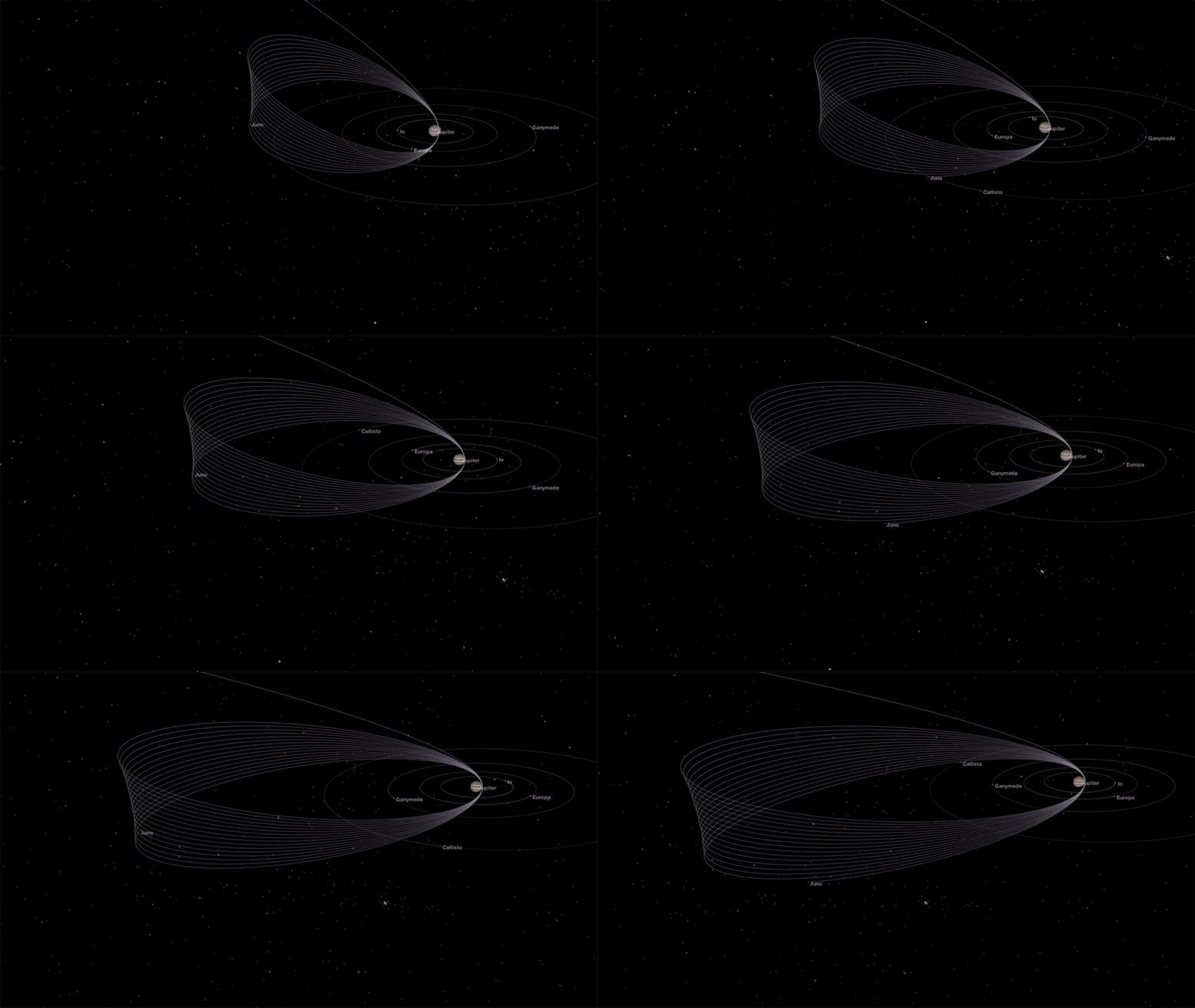
    During its continued mission, NASA’s Juno spacecraft will maintain its 53-day polar orbit around Jupiter. At its closest, Juno passes within 3,000 miles (5,000 kilometers) of Jupiter’s cloud tops once during each 53-day orbit. At the high end of each orbit, Juno is about 5 million miles (8 million kilometers) from the planet – which is just beyond the orbit of the Jovian moon Themisto. Credit: NASA/JPL-Caltech

    NASA has approved an update to Juno’s science operations until July 2021. This provides for an additional 41 months in orbit around Jupiter and will enable Juno to achieve its primary science objectives. Juno is in 53-day orbits rather than 14-day orbits as initially planned because of a concern about valves on the spacecraft’s fuel system. This longer orbit means that it will take more time to collect the needed science data.

    An independent panel of experts confirmed in April that Juno is on track to achieve its science objectives and is already returning spectacular results. The Juno spacecraft and all instruments are healthy and operating nominally.

    NASA has now funded Juno through FY 2022. The end of prime operations is now expected in July 2021, with data analysis and mission close-out activities continuing into 2022.

    “With these funds, not only can the Juno team continue to answer long-standing questions about Jupiter that first fueled this exciting mission, but they’ll also investigate new scientific puzzles motivated by their discoveries thus far,” said Thomas Zurbuchen, associate administrator for NASA’s Science Mission Directorate in Washington. “With every additional orbit, both scientists and citizen scientists will help unveil new surprises about this distant world.”

    “This is great news for planetary exploration as well as for the Juno team,” said Scott Bolton, principal investigator of Juno, from the Southwest Research Institute in San Antonio. “These updated plans for Juno will allow it to complete its primary science goals. As a bonus, the larger orbits allow us to further explore the far reaches of the Jovian magnetosphere — the region of space dominated by Jupiter’s magnetic field — including the far magnetotail, the southern magnetosphere, and the magnetospheric boundary region called the magnetopause. We have also found Jupiter’s radiation environment in this orbit to be less extreme than expected, which has been beneficial to not only our spacecraft, but our instruments and the continued quality of science data collected.”

    Juno will make its 13th science flyby over Jupiter’s mysterious cloud tops on July 16.

    NASA’s Jet Propulsion Laboratory, Pasadena, California, manages the Juno mission for the principal investigator, Scott Bolton, of the Southwest Research Institute in San Antonio. Juno is part of NASA’s New Frontiers Program, which is managed at NASA’s Marshall Space Flight Center in Huntsville, Alabama, for NASA’s Science Mission Directorate. The Italian Space Agency (ASI), contributed two instruments, a Ka-band frequency translator (KaT) and the Jovian Infrared Auroral Mapper (JIRAM). Lockheed Martin Space, Denver, built the spacecraft.

    Never miss a breakthrough: Join the SciTechDaily newsletter.
    Follow us on Google and Google News.

    Juno Spacecraft Jupiter Planetary Science
    Share. Facebook Twitter Pinterest LinkedIn Email Reddit

    Related Articles

    Juno Images Provide an Unprecedented View of Jupiter

    A Billion or More Jupiter-Like Worlds Could Be Orbiting Stars in the Milky Way

    First In-orbit View from NASA’s Juno Spacecraft

    Juno Spacecraft in Orbit Around Jupiter

    Hubble Telescope Views Vivid Auroras in Jupiter’s Atmosphere

    Astronomers Prepare for the Arrival of Juno at Jupiter

    NASA Juno Mission Trailer – Jupiter: Into the Unknown

    ScienceCasts Video: Close Encounters with Jupiter

    NASA’s Juno Spacecraft Adjusts Flight Path for Jupiter

    Leave A Reply Cancel Reply

    • Facebook
    • Twitter
    • Pinterest
    • YouTube

    Don't Miss a Discovery

    Subscribe for the Latest in Science & Tech!

    Trending News

    Scientists Discover Cheap, Natural Remedy for High Blood Pressure

    Earth’s Upper Atmosphere Is Cooling Fast and Scientists Finally Know Why

    32,000 Olympic Pools of Magma Nearly Erupted Beneath Atlantic Island

    Exercise Changes the Heart in a Way Researchers Never Expected

    Too Much Sleep May Age Your Body Faster, New Study Warns

    Scientists Uncover Promising New Strategy To Stop Parkinson’s in Its Tracks

    Experts Reveal the Surprising Cancer Link Behind a Common Vitamin

    This Strange “Golden Orb” Found 2 Miles Deep Stumped Scientists for Years

    Follow SciTechDaily
    • Facebook
    • Twitter
    • YouTube
    • Pinterest
    • Newsletter
    • RSS
    SciTech News
    • Biology News
    • Chemistry News
    • Earth News
    • Health News
    • Physics News
    • Science News
    • Space News
    • Technology News
    Recent Posts
    • The Type of Alcohol You Drink Could Affect How Long You Live
    • 19-Year Study Reveals the Surprising Truth About Sitting and Dementia
    • This Common Vitamin May Help Stop Prediabetes From Turning Into Diabetes
    • Canada’s Billion-Year-Old Rocks Could Hold the Future of Clean Energy
    • Climate Change Is Quietly Choking Rivers Across the Planet
    Copyright © 1998 - 2026 SciTechDaily. All Rights Reserved.
    • Science News
    • About
    • Contact
    • Editorial Board
    • Privacy Policy
    • Terms of Use

    Type above and press Enter to search. Press Esc to cancel.