
Close Menu
    Facebook X (Twitter) Instagram
    SciTechDaily
    • Biology
    • Chemistry
    • Earth
    • Health
    • Physics
    • Science
    • Space
    • Technology
    Facebook X (Twitter) Pinterest YouTube RSS
    SciTechDaily
    Home»Biology»Light-Switched Anesthetics Allow Researchers to turn Pain Nerves On and Off
    Biology

    Light-Switched Anesthetics Allow Researchers to turn Pain Nerves On and Off

    By SciTechDailyFebruary 28, 2012No Comments2 Mins Read
    Facebook Twitter Pinterest Telegram LinkedIn WhatsApp Email Reddit
    Share
    Facebook Twitter LinkedIn Pinterest Telegram Email Reddit
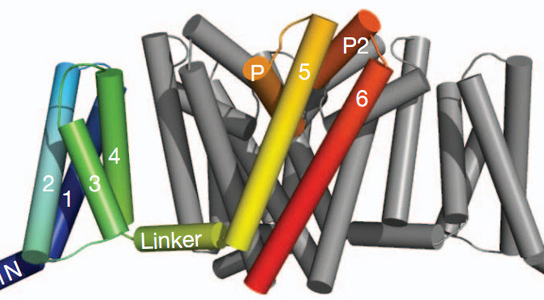
    sodium-channel-cell
    A new local anesthetic can be activated and deactivated using various light wavelengths, offering precise control over which nerves are blocked.

    A new study published in the journal Nature Methods, shows that a novel local anesthetic developed by a group of researchers at UC Berkeley, University of Münich, and the Université de Boardeaux, can be switched on and off using different wavelengths of light, allowing a much finer control of which nerves are blocked.

    Local anesthetics, which work by blocking the flow of sodium ions across neuronal cell membranes, have been in use for well over a century. Cocaine was the first drug used in this fashion, but it was superseded by a variety of synthetic alternatives.
    lidocaine-formula

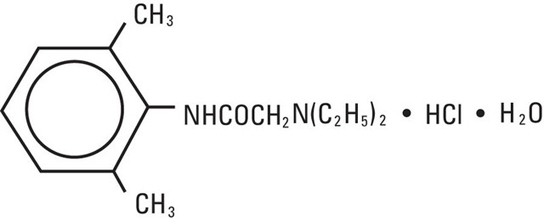
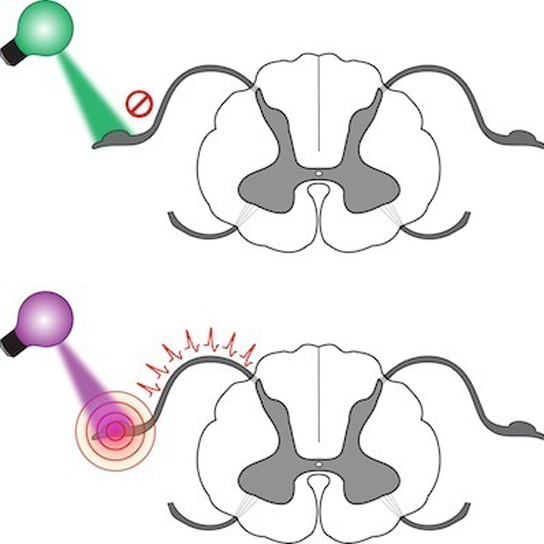
    The new molecule, called quaternary ammonium-azobenzene-quaternary ammonium (QAQ), resembles lidocaine, but it comes in two forms, cis and trans. The trans form can be converted to the cis form by a 380 nm light. In the dark, QAQ slowly reverts back to the trans form. This can be achieved rapidly by using a 500 nm light.

    Once inside a cell, the trans form of QAQ blocks many different ion channels while the cis version remains inactive.
    QAQ-in-action

    However, QAQ is a fairly large molecule which usually doesn’t cross cell membranes. This could allow QAQ to be a very selective local anesthetic. Pain-sensing neurons (nocieptive) contain many ion channels, which are activated by stimuli. One of the main channels is called TRPV1, which is activated by capsaicin, heat, and other inflammatory mediators.

    When activated for a prolonged period, TRPV1 receptors dilate, and the pores become large enough for bigger molecules, such as QAQ, to pass through the cell membranes. This means that the anesthetic could actively target the pain receptors that sense pain, where it can be turned on and off by different wavelengths of light.

    Reference: “Rapid optical control of nociception with an ion-channel photoswitch” by Alexandre Mourot, Timm Fehrentz, Yves Le Feuvre, Caleb M Smith, Christian Herold, Deniz Dalkara, Frédéric Nagy, Dirk Trauner and Richard H Kramer, 19 February 2012, Nature Methods.
    DOI: 10.1038/nmeth.1897

    Never miss a breakthrough: Join the SciTechDaily newsletter.
    Follow us on Google and Google News.

    Anaesthetics Anesthesiology Light Medicine
    Share. Facebook Twitter Pinterest LinkedIn Email Reddit

    Related Articles

    Cancer-Causing Mutations Disrupt Cells’ Ability to Differentiate

    Stem Cells Help Re-grow Healthy Heart Muscle After Heart Attack

    Researchers Suggest Halofuginone (HF) May Treat Autoimmune Disorders

    Researchers Use Body’s Immune System to Fight Cancer

    Scientists Find Cure for Neurocysticercosis, a Major Cause of Seizures

    Neuroscientists Create Model to Study Burst Suppression and Brain States

    Massages Change Gene Expression and Reduce Inflammation

    Visual Science’s Ebolavirus 3D Model is 10 Times More Complex Than Their HIV Model

    Controversial Proposal Wants Sugar to be Regulated as a Toxic Substance

    Leave A Reply Cancel Reply

    • Facebook
    • Twitter
    • Pinterest
    • YouTube

    Don't Miss a Discovery

    Subscribe for the Latest in Science & Tech!

    Trending News

    JWST Finds a “Star” 100 Billion Times Brighter Than Any Star Should Be

    Scientists Find a Hidden Biological Link Across Different Forms of Autism

    Astronomers Discover a Ghostly River of Stars That Could Reveal Dark Matter

    Why Is Colorectal Cancer Rising in People Under 50? New Clues Point to the Environment

    Quantum Fluctuations Break a Crystal’s Symmetry Rules

    Why Does an Irregular Heartbeat Strike 40 Years Early in Some People?

    Scientists Reveal How ADHD Could Fuel Creative Thinking

    Scientists Find Just 3 Minutes of Sprinting Can Transform Blood Chemistry

    Follow SciTechDaily
    • Facebook
    • Twitter
    • YouTube
    • Pinterest
    • Newsletter
    • RSS
    SciTech News
    • Biology News
    • Chemistry News
    • Earth News
    • Health News
    • Physics News
    • Science News
    • Space News
    • Technology News
    Recent Posts
    • 1 in 3 Middle-Aged Americans Struggle With Basic, “Everyday” Health Tasks
    • Just 4 Minutes of Daily Strength Training Can Quadruple Fitness in Older Adults
    • Almost All Plant-Based Meat Alternatives Contain Mycotoxins, Study Finds
    • Strange Quantum Oscillations Reveal New Physics in an Exotic Material
    • Quantum Experiment Breaks a Long-Standing X-Ray Energy Limit
    Copyright © 1998 - 2026 SciTechDaily. All Rights Reserved.
    • Science News
    • About
    • Contact
    • Editorial Board
    • Privacy Policy
    • Terms of Use

    Type above and press Enter to search. Press Esc to cancel.