

NASA’s newest planet hunter, the Transiting Exoplanet Survey Satellite (TESS), has discovered three new worlds — one slightly larger than Earth and two of a type not found in our solar system — orbiting a nearby star. The planets straddle an observed gap in the sizes of known planets and promise to be among the most curious targets for future studies.
TESS Object of Interest (TOI) 270 is a faint, cool star more commonly identified by its catalog name: UCAC4 191-004642. The M-type dwarf star is about 40% smaller than the Sun in both size and mass, and it has a surface temperature about one-third cooler than the Sun’s. The planetary system lies about 73 light-years away in the southern constellation of Pictor.
“This system is exactly what TESS was designed to find — small, temperate planets that pass, or transit, in front of an inactive host star, one lacking excessive stellar activity, such as flares,” said lead researcher Maximilian Günther, a Torres Postdoctoral Fellow at the Massachusetts Institute of Technology’s (MIT) Kavli Institute for Astrophysics and Space Research in Cambridge. “This star is quiet and very close to us, and therefore much brighter than the host stars of comparable systems. With extended follow-up observations, we’ll soon be able to determine the make-up of these worlds, establish if atmospheres are present and what gases they contain, and more.”
A paper describing the system was published in the journal Nature Astronomy and is now available online.
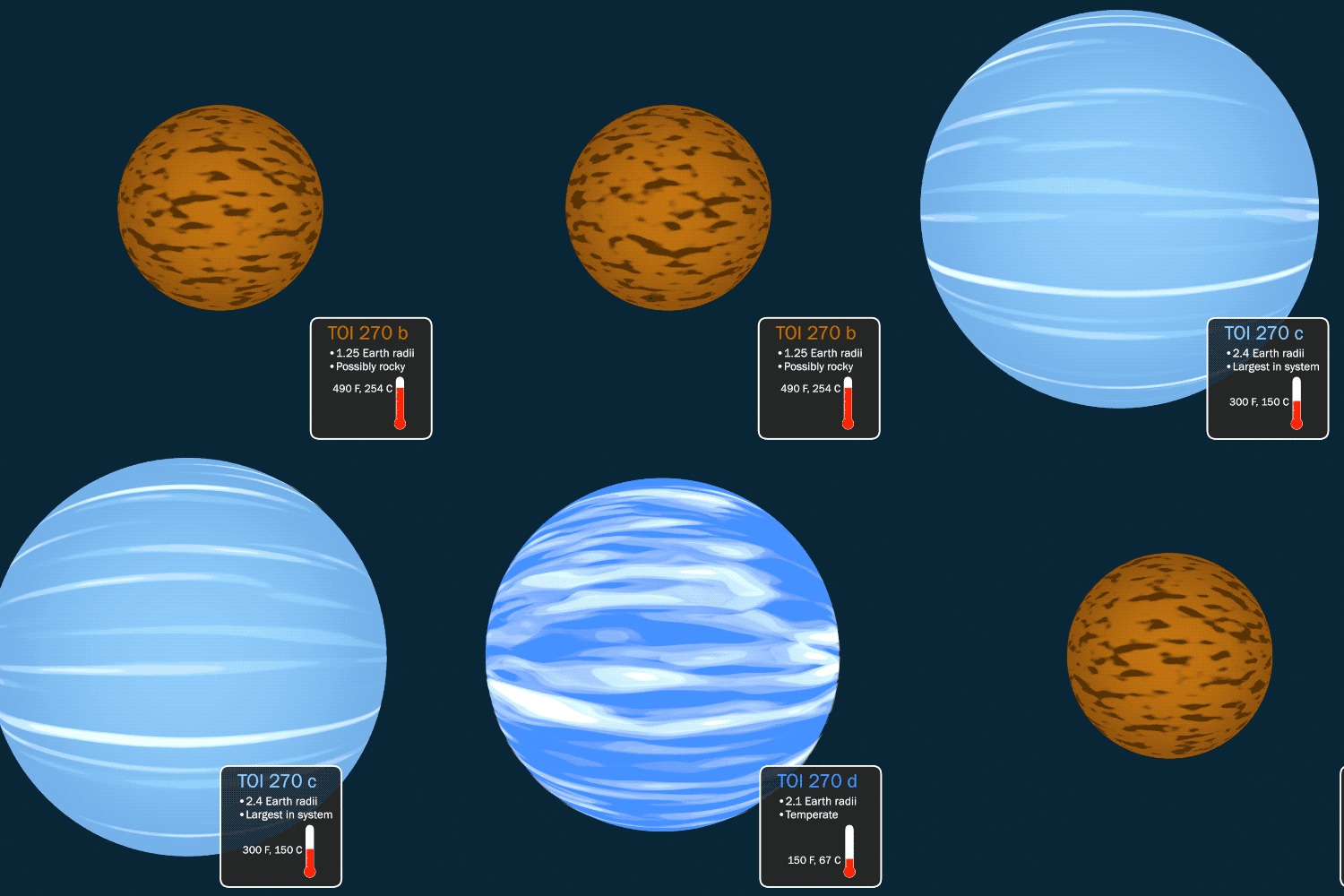
The innermost planet, TOI 270 b, is likely a rocky world about 25% larger than Earth. It orbits the star every 3.4 days at a distance about 13 times closer than Mercury orbits the Sun. Based on statistical studies of known exoplanets of similar size, the science team estimates TOI 270 b has a mass around 1.9 times greater than Earth’s.
Due to its proximity to the star, planet b is an oven-hot world. Its equilibrium temperature — that is, the temperature based only on the energy it receives from the star, which ignores additional warming effects from a possible atmosphere — is around 490 degrees Fahrenheit (254 degrees Celsius).
The other two planets, TOI 270 c and d, are, respectively, 2.4 and 2.1 times larger than Earth and orbit the star every 5.7 and 11.4 days. Although only about half its size, both may be similar to Neptune in our solar system, with compositions dominated by gases rather than rock, and they likely weigh around 7 and 5 times Earth’s mass, respectively.
All of the planets are expected to be tidally locked to the star, which means they only rotate once every orbit and keep the same side facing the star at all times, just as the Moon does in its orbit around Earth.
Planet c and d might best be described as mini-Neptunes, a type of planet not seen in our own solar system. The researchers hope a further exploration of TOI 270 may help explain how two of these mini-Neptunes formed alongside a nearly Earth-size world.

“An interesting aspect of this system is that its planets straddle a well-established gap in known planetary sizes,” said co-author Fran Pozuelos, a postdoctoral researcher at the University of Liège in Belgium. “It is uncommon for planets to have sizes between 1.5 and two times that of Earth for reasons likely related to the way planets form, but this is still a highly controversial topic. TOI 270 is an excellent laboratory for studying the margins of this gap and will help us better understand how planetary systems form and evolve.”
Günther’s team is particularly interested in the outermost planet, TOI 270 d. The team estimates the planet’s equilibrium temperature to be about 150 degrees Fahrenheit (66 degrees C). This makes it the most temperate world in the system — and as such, a rarity among known transiting planets.
“TOI 270 is perfectly situated in the sky for studying the atmospheres of its outer planets with NASA’s future James Webb Space Telescope,” said co-author Adina Feinstein, a doctoral student at the University of Chicago. “It will be observable by Webb for over half a year, which could allow for really interesting comparison studies between the atmospheres of TOI 270 c and d.”
The team hopes further research may reveal additional planets beyond the three now known. If planet d has a rocky core covered by a thick atmosphere, its surface would be too warm for the presence of liquid water, considered a key requirement for a potentially habitable world. But follow-up studies may discover additional rocky planets at slightly greater distances from the star, where cooler temperatures could allow liquid water to pool on their surfaces.
TESS is a NASA Astrophysics Explorer mission led and operated by MIT in Cambridge, Massachusetts, and managed by NASA’s Goddard Space Flight Center. Additional partners include Northrop Grumman, based in Falls Church, Virginia; NASA’s Ames Research Center in California’s Silicon Valley; the Harvard-Smithsonian Center for Astrophysics in Cambridge, Massachusetts; MIT’s Lincoln Laboratory; and the Space Telescope Science Institute in Baltimore. More than a dozen universities, research institutes and observatories worldwide are participants in the mission.
Reference: “A super-Earth and two sub-Neptunes transiting the nearby and quiet M dwarf TOI-270” by Maximilian N. Günther, Francisco J. Pozuelos, Jason A. Dittmann, Diana Dragomir, Stephen R. Kane, Tansu Daylan, Adina D. Feinstein, Chelsea X. Huang, Timothy D. Morton, Andrea Bonfanti, L. G. Bouma, Jennifer Burt, Karen A. Collins, Jack J. Lissauer, Elisabeth Matthews, Benjamin T. Montet, Andrew Vanderburg, Songhu Wang, Jennifer G. Winters, George R. Ricker, Roland K. Vanderspek, David W. Latham, Sara Seager, Joshua N. Winn, Jon M. Jenkins, James D. Armstrong, Khalid Barkaoui, Natalie Batalha, Jacob L. Bean, Douglas A. Caldwell, David R. Ciardi, Kevin I. Collins, Ian Crossfield, Michael Fausnaugh, Gabor Furesz, Tianjun Gan, Michaël Gillon, Natalia Guerrero, Keith Horne, Steve B. Howell, Michael Ireland, Giovanni Isopi, Emmanuël Jehin, John F. Kielkopf, Sebastien Lepine, Franco Mallia, Rachel A. Matson, Gordon Myers, Enric Palle, Samuel N. Quinn, Howard M. Relles, Bárbara Rojas-Ayala, Joshua Schlieder, Ramotholo Sefako, Avi Shporer, Juan C. Suárez, Thiam-Guan Tan, Eric B. Ting, Joseph D. Twicken and Ian A. Waite, 29 July 2019, Nature Astronomy.
DOI: 10.1038/s41550-019-0845-5
Never miss a breakthrough: Join the SciTechDaily newsletter.
Follow us on Google and Google News.
4 Comments
We needed more planets to prove they exist.
that is so cool i never knew that we had aliens
Very bad news boring updates
I really do wonder if their aliens out there and if their are planets in outside our solar system that humans can inhabitant on is their such planets that do exist if so I would to find out.