
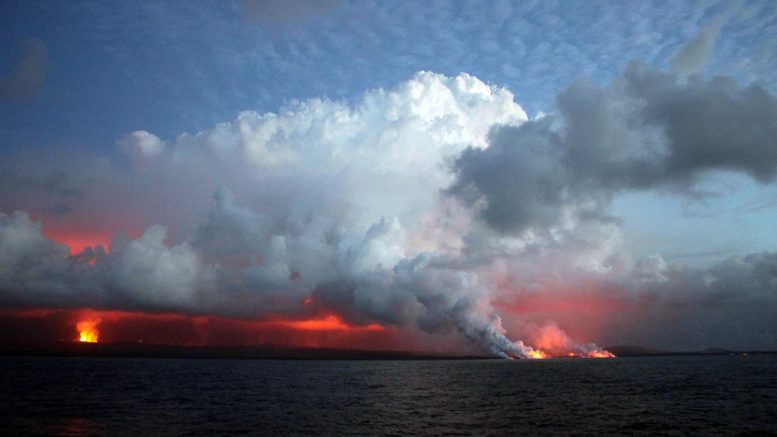
When Kīlauea Volcano erupted in 2018, it injected millions of cubic feet of molten lava into the nutrient-poor waters off Hawaiʻi Island. The lava-impacted seawater contained high concentrations of nutrients that stimulated phytoplankton growth, resulting in an extensive plume of microbes that were detectable by satellite.
Now a study led by researchers at the University of Hawaiʻi at Mānoa and University of Southern California (USC) revealed that this biological response hinged on unexpectedly high concentrations of nitrate, despite the negligible amount of nitrogen in basaltic lava. The research team determined that nitrate was brought to the surface of the ocean when heat from the substantial input of lava into the ocean warmed nutrient-rich deep waters and caused them to rise up, supplying the sunlit layer with nutrients.
“UH has a strong tradition of not only volcanic research, but also looking at its impacts on the surrounding environment such as the ocean, groundwater, and atmosphere,” said co-lead author Sam Wilson in the UH Mānoa Center for Microbial Oceanography: Research and Education (C-MORE). “This latest piece of research improves our understanding of lava-seawater interactions within the much broader context of land-ocean connections.”
Rapid Response Expedition
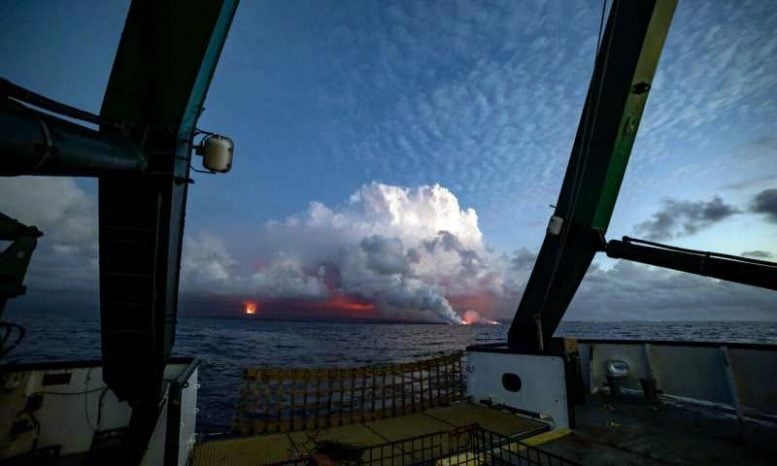
After observing the phytoplankton bloom in satellite images, C-MORE organized a rapid response oceanographic expedition on the UH research vessel Kaʻimikai-O-Kanaloa from July 13–17, 2018—during the thick of Kīlauea’s activity. The team conducted round-the-clock operations in the vicinity of the lava entry region to test water chemistry and the biological response to the dramatic event.
C-MORE’s Wilson and co-lead researcher Nick Hawco, a USC researcher who will be joining the UH Mānoa oceanography department in January 2020, tested the hypothesis that lava and volcanic dust would stimulate microorganisms that are limited by phosphate or iron, which are chemicals found in lava.
As it turned out, since there was so much lava in the water, the dissolved iron and phosphate combined into particles, making those nutrients unavailable for microbes. In addition, deep and heated seawater became buoyant, and brought up nitrate which caused other classes of phytoplankton to bloom.
Land-Ocean Connections
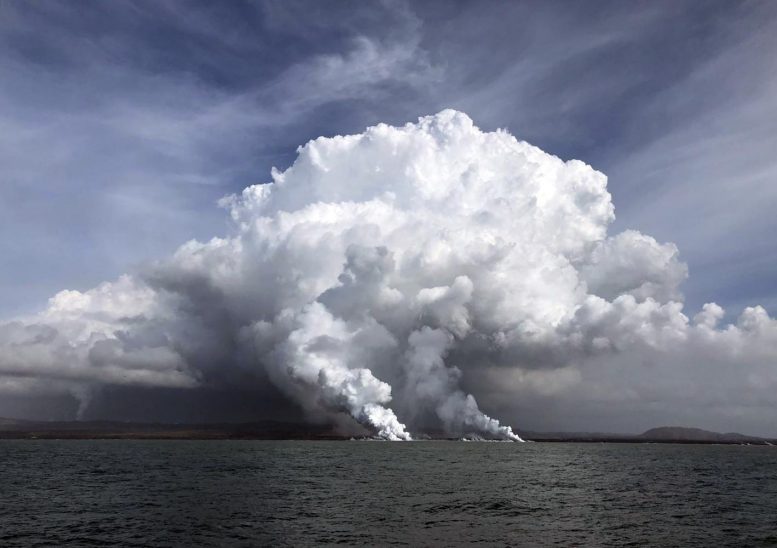
It is possible that this mechanism has led to similar ocean fertilization events in the past associated with the formation of the Hawaiian Islands and other significant volcanic eruptions, the authors suggest. Depending on their location, sustained eruption on this scale could also facilitate a large flux of nitrate from the deep ocean and perturb larger scale ocean circulation, biology, and chemistry.
“The expedition in July 2018 provided a unique opportunity to see first-hand how a massive input of external nutrients alters marine ecosystems that are finely attuned to low-nutrient conditions,” said Wilson. “Ecosystem responses to such a substantial addition of nutrients are rarely observed or sampled in real-time.”
Added Dave Karl, senior author and co-director of the UH Mānoa Simons Collaboration on Ocean Processes and Ecology (SCOPE), “Science is a team sport. SCOPE emphasizes collaboration, where scientists with complementary skills came together to complete this unique, interdisciplinary project.”
In the future, the team hopes to sample the newly-formed ponds at the bottom of the Halemaʻumaʻu crater and further investigate lava-seawater interactions in the laboratory.
Reference: “Kīlauea lava fuels phytoplankton bloom in the North Pacific Ocean” by Samuel T. Wilson, Nicholas J. Hawco, E. Virginia Armbrust, Benedetto Barone, Karin M. Björkman, Angela K. Boysen, Macarena Burgos, Timothy J. Burrell, John R. Casey, Edward F. DeLong, Mathilde Dugenne, Stephanie Dutkiewicz, Sonya T. Dyhrman, Sara Ferrón, Michael J. Follows, Rhea K. Foreman, Carolina P. Funkey, Matthew J. Harke, Britt A. Henke, Christopher N. Hill, Annette M. Hynes, Anitra E. Ingalls, Oliver Jahn, Rachel L. Kelly, Angela N. Knapp, Ricardo M. Letelier, Francois Ribalet, Eric M. Shimabukuro, Ryan K. S. Tabata, Kendra A. Turk-Kubo, Angelique E. White, Jonathan P. Zehr, Seth John and David M. Karl, 6 September 2019, Science.
DOI: 10.1126/science.aax4767
Never miss a breakthrough: Join the SciTechDaily newsletter.
Follow us on Google and Google News.