
Close Menu
    Facebook X (Twitter) Instagram
    SciTechDaily
    • Biology
    • Chemistry
    • Earth
    • Health
    • Physics
    • Science
    • Space
    • Technology
    Facebook X (Twitter) Pinterest YouTube RSS
    SciTechDaily
    Home»Science»Scientists Unlock 700,000-Year-Old Secrets Hidden Inside a Giant Elephant Tooth
    Science

    Scientists Unlock 700,000-Year-Old Secrets Hidden Inside a Giant Elephant Tooth

    By Tel-Hai University of Kiryat Shmona in the GalileeOctober 14, 2026No Comments4 Mins Read
    Facebook Twitter Pinterest Telegram LinkedIn WhatsApp Email Reddit
    Share
    Facebook Twitter LinkedIn Pinterest Telegram Email Reddit
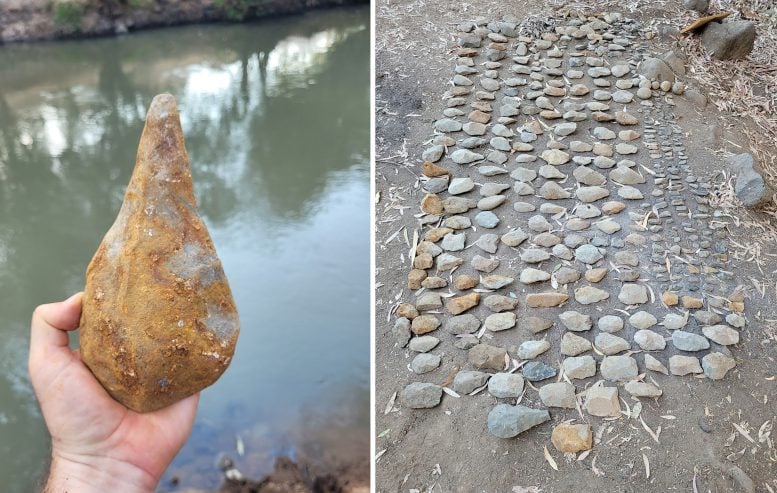
    Handaxes, Stone Tools Uncovered at the Acheulian Site North of Gesher Benot Ya’aqov
    The elephant remains were discovered alongside basalt handaxes and cleavers, hallmark tools of the Acheulian tradition, one of the earliest and most widespread stone-tool technologies in human history. Credit: Tel-Hai University of Kiryat Shmona in the Galilee and Hannah Farrell, University of Haifa

    A giant elephant’s tooth has preserved clues to the watery world that sustained early humans nearly 700,000 years ago.

    Researchers studying elephant remains from Gesher Benot Ya’aqov (GBY-NBA) in northern Israel have reconstructed a Pleistocene environment rich in water, vegetation, and wildlife. Published in Quaternary Science Reviews, the study reveals the landscape shared by enormous mammals and some of the region’s earliest human toolmakers.

    Led by Hannah Farrell (a PhD candidate at Haifa University), the research examined molar and tusk fragments excavated by Prof. Gonen Sharon of Tel-Hai University of Kiryat Shmona in the Galilee and his colleagues. The site, Gesher Benot Ya’aqov (Daughters of Jacob Bridge), sits in the Jordan Rift Valley, south of today’s Hula Valley.
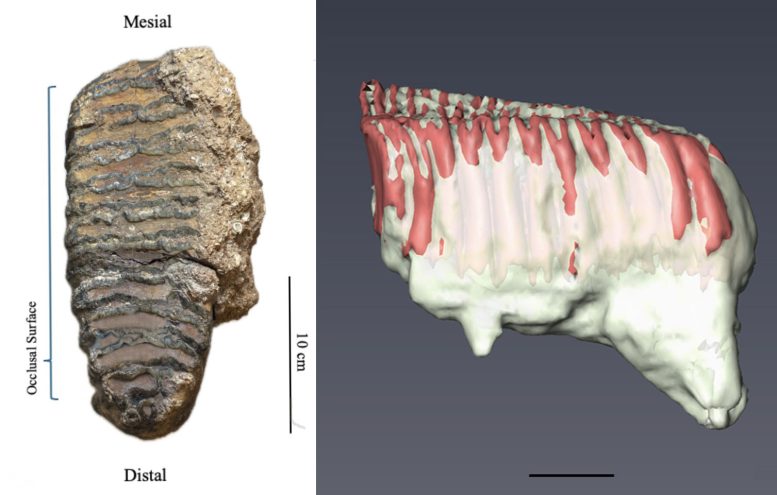
    Computer Generated Reconstruction of the Elephant Tooth
    Rather than studying the elephant alone, researchers used the tooth as a biological archive to reconstruct the broader ecosystem shared by large mammals and early human toolmakers. Credit: Tel-Hai University of Kiryat Shmona in the Galilee and Hannah Farrell, University of Haifa

    The fossils belonged to Palaeoloxodon antiquus, the straight-tusked elephant, one of the largest land mammals of the Pleistocene. Nearby basalt handaxes and cleavers place early humans in the same setting. These tools belong to the Acheulian tradition, among the earliest and most geographically widespread stone tool technologies in human history.

    An Elephant Tooth Holds Environmental Clues

    The tooth offered more than a way to identify the animal. Its structure, microscopic wear, and chemical composition provided different lines of evidence about its life and surroundings. The team combined CT scanning, 3D reconstruction, microscopic wear analysis, isotope geochemistry, and pollen studies to piece together the broader ecosystem.
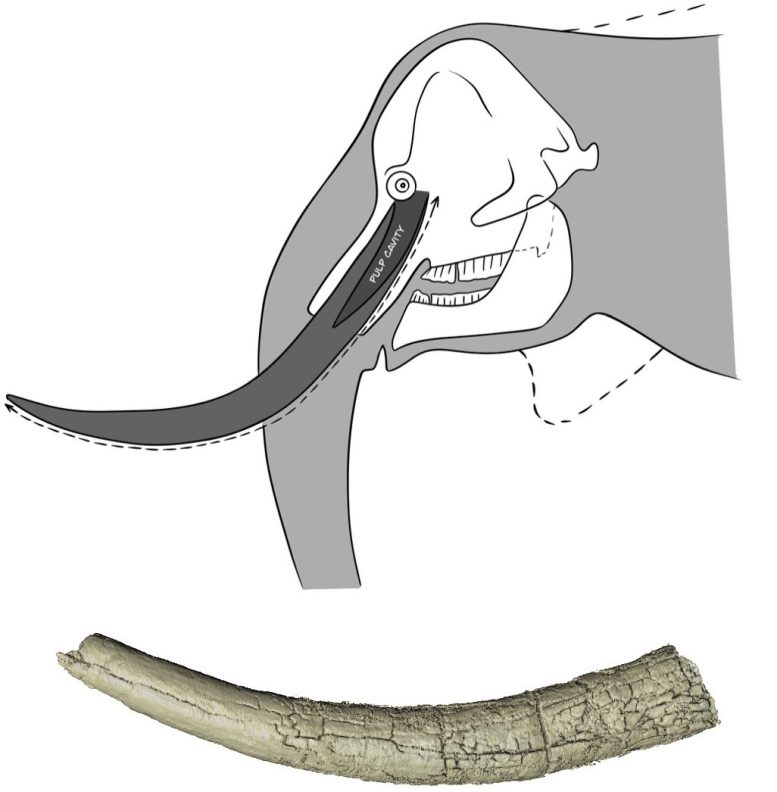
    The Elephant Tusk and Its Estimated Original Position
    The remains belong to Palaeoloxodon antiquus, the straight-tusked elephant, one of the largest land mammals of the Pleistocene. Credit: Tel-Hai University of Kiryat Shmona in the Galilee and Hannah Farrell, University of Haifa

    The results point to an enduring landscape of woodlands, grasslands, marshes, rivers, and shallow-water habitats. Carbon isotope values suggest that the elephant lived where water remained consistently available. Pollen recovered from sediments added detail to that picture, revealing reeds, sedges, willows, tamarisks, and aquatic plants.

    Together, the findings suggest that the Hula Valley region was a stable ecological refuge within the Levantine Corridor, the land bridge connecting Africa and Eurasia. Reliable water and biological resources likely made this landscape a valuable stopping point or habitat for wildlife and human groups moving through the region.
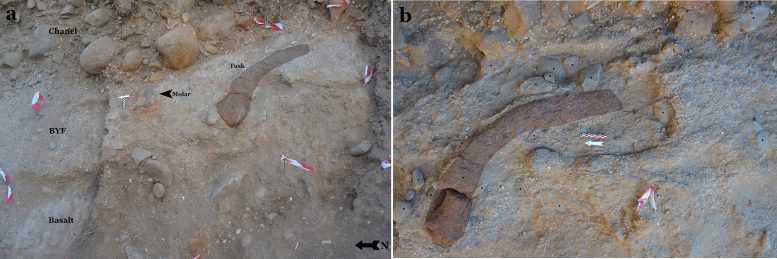
    The Elephant Tusk and Tools Found Within the Site’s Archaeological Layers
    The research focuses on a giant elephant molar and tusk fragments discovered alongside Acheulian stone tools at Gesher Benot Ya’aqov in northern Israel. The remains belonged to Palaeoloxodon antiquus, the straight-tusked elephant, one of the largest land mammals of the Pleistocene. Credit: Tel-Hai University of Kiryat Shmona in the Galilee and Hannah Farrell, University of Haifa

    According to Sharon, “understanding how humans and animals responded to environmental change hundreds of thousands of years ago helps us better understand the forces that shaped our species.”

    “The availability of water, vegetation, and animal resources shaped where humans and wildlife could survive,” Sharon says. “The wetlands, rivers, and woodlands of the Hula Valley helped sustain life along one of the world’s earliest migration corridors, offering a rare opportunity to understand the ecological conditions that supported both animals and human populations nearly 700,000 years ago.”

    Reference: “Elephant dental remains from the Acheulian site at North Bridge Acheulian–Gesher Benot Ya’aqov: hominin behavior and environmental implications” by Hannah Farrell, Gonen Sharon, Minji Jin, Dafna Langgut, Cheryl A. Makarewicz and Nimrod Marom, 14 September 2026, Quaternary Science Reviews.
    DOI: 10.1016/j.quascirev.2026.110277

    Never miss a breakthrough: Join the SciTechDaily newsletter.
    Follow us on Google and Google News.

    Anthropology Archaeology Ecosystems Evolution Paleontology
    Share. Facebook Twitter Pinterest LinkedIn Email Reddit

    Related Articles

    Rewriting Evolution: Study Shows Neanderthals and Humans Were Not the Same Species

    Becoming Human: What Ancient DNA Tells Us About Who We Are

    Early Human Evolution: Hominin Fossils in “Cradle of Humankind” May Be a Million Years Older Than Thought

    Human Ancestor Fossils in the “Cradle of Humankind” May Be More Than a Million Years Older Than Thought

    “Meat Made Us Human” Evolutionary Narrative Starts To Unravel

    First Tales of the Earliest Domesticated Goats Revealed by 10,000-Year-Old DNA

    Crystals Reveal Early Humans in the Kalahari 105,000 Years Ago Were As Innovative as Their Coastal Neighbors

    Earliest Interbreeding Between Ancient Human Populations Discovered – Evolutionary Puzzle Solved

    New Evidence Shows Humans Mastered Fire Earlier Than Thought

    Leave A Reply Cancel Reply

    • Facebook
    • Twitter
    • Pinterest
    • YouTube

    Don't Miss a Discovery

    Subscribe for the Latest in Science & Tech!

    Trending News

    Beyond Ozempic? New Weight Loss Drug Shows Stunning Results in Major Clinical Trial

    Scientists Create a Nuclear Clock So Precise It Barely Loses a Second in 30 Million Years

    Scientists Discover Groundbreaking Clues to Tissue Regrowth and “Immortality” in the Ocean

    A New Test Upends a Long-Held Assumption About Dark Matter

    Scientists Discover an Unexpected New Way To Fight Alzheimer’s Before It Starts

    Sleeping Less Than 5 Hours Was Linked to Higher Risk of 37 Diseases

    This 345-Million-Year-Old Fossil Fooled Scientists for Decades

    Scientists Restore Limited Vision in Blind Patients Using Gene Therapy and Special Goggles

    Follow SciTechDaily
    • Facebook
    • Twitter
    • YouTube
    • Pinterest
    • Newsletter
    • RSS
    SciTech News
    • Biology News
    • Chemistry News
    • Earth News
    • Health News
    • Physics News
    • Science News
    • Space News
    • Technology News
    Recent Posts
    • Scientists Unlock 700,000-Year-Old Secrets Hidden Inside a Giant Elephant Tooth
    • They Almost Vanished. Now 183,000 Giant Tortoises Rule This Remote Paradise
    • One of the World’s Rarest Animals Is Facing a Devastating Problem: It Can’t Find a Mate
    • A Quantum Breakthrough Inside a Diamond Could Help Solve One of Einstein’s Greatest Mysteries
    • Mars’s Strangest Cloud Just Got Even Stranger
    Copyright © 1998 - 2026 SciTechDaily. All Rights Reserved.
    • Science News
    • About
    • Contact
    • Editorial Board
    • Privacy Policy
    • Terms of Use

    Type above and press Enter to search. Press Esc to cancel.