
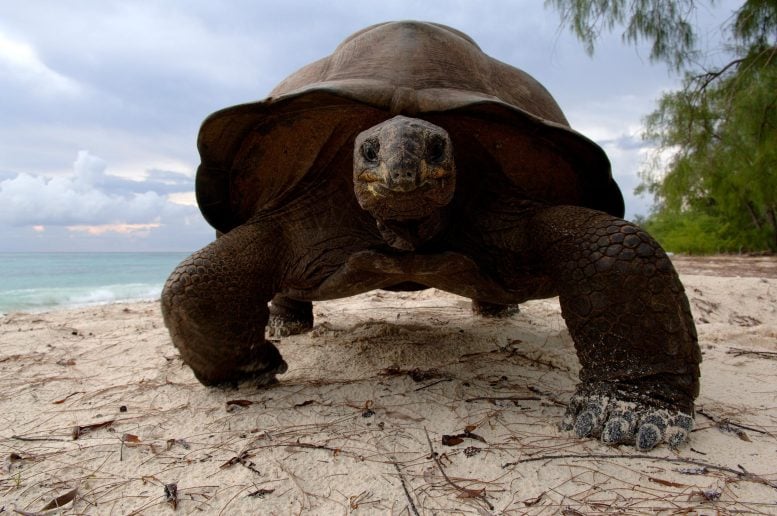
Once pushed to the brink, giant tortoises on a Seychelles atoll now outnumber the country’s people, with a new survey estimating nearly 183,000 animals.
Aldabra Atoll, home to the world’s largest free-roaming giant tortoise population, supports an estimated 180,000 animals, according to research led by the Seychelles Islands Foundation (SIF) and the University of Exeter. The highest estimate yet for the Aldabra giant tortoise (Aldabrachelys gigantea) reflects both a remarkable conservation recovery and a better way of counting animals that are difficult to see.
Published in Ecology and Evolution, the study analyzed monitoring records collected by SIF staff from 2018 through 2022. It delivers the first rigorous estimate covering the atoll and replaces the widely quoted figure of about 100,000 tortoises from the late 1990s.
A Recovery From The Brink
The team’s best estimate was almost 183,000 adult and subadult tortoises, more than the entire human population of the Seychelles. Their numbers appeared relatively stable during the study period.
That abundance would have been difficult to imagine in the 19th century, when heavy exploitation reduced Aldabra’s tortoises to fewer than 1,000. Their recovery has been supported by decades of protection, including the atoll’s designation as a strict nature reserve in 1981 and a UNESCO World Heritage Site in 1982.
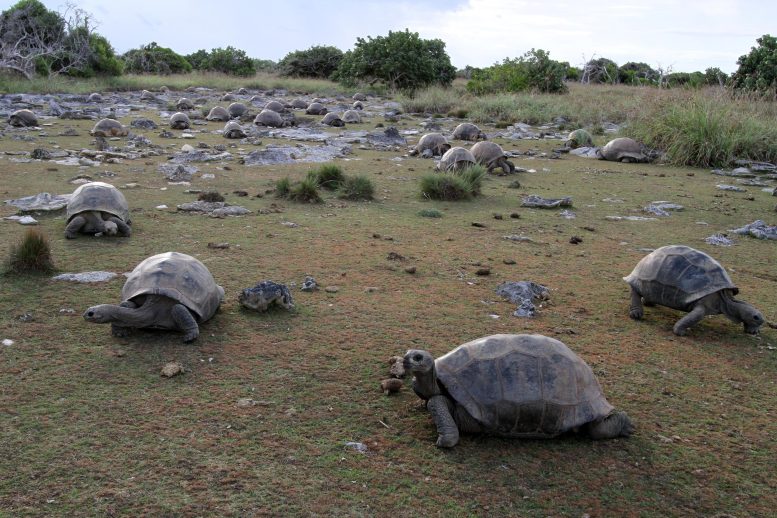
Today, Aldabra and the Galapagos are the two remaining strongholds of native wild giant tortoises, with far fewer animals in the Galapagos. The new findings strengthen Aldabra’s reputation as one of the Indian Ocean’s outstanding conservation successes.
“The monitoring data in this study were collected by SIF staff living and working on the atoll, year after year. More than 180,000 giant tortoises roaming freely on our atoll is proof of what long-term commitment to conservation can achieve. This is wonderful news for Seychelles, for the world, and for everyone who has worked to protect Aldabra,” said Dr. Frauke Fleischer-Dogley, CEO of SIF.
Counting The Tortoises Nobody Saw
The larger total comes with an important qualification: it does not mean the population has nearly doubled since 1999. A tortoise can be present without being visible, and earlier surveys did not adequately account for animals concealed in scrub or shade. Those estimates probably missed a substantial number.
To address that problem, the researchers used Bayesian hierarchical distance sampling. This statistical method accounts for animals that observers failed to detect and for differences in visibility across habitats. It produces an estimate of the population, rather than simply a tally of sightings.
“Aldabra’s giant tortoise monitoring program is one of the longest-running in the region, but the atoll’s dense vegetation makes counting tortoises genuinely difficult in places,” said study co-author Dr. Nancy Bunbury.
“By modeling what we didn’t see, as well as what we did, we’ve produced the most reliable baseline yet for this iconic Seychelles species, establishing a benchmark we can use to track the population for decades to come.”
Where Giant Tortoises Gather
The animals were most concentrated in Aldabra’s grasslands, known as “tortoise turf.” The next highest densities occurred on open exposed surfaces and in open mixed scrub.
Dense scrub, mangroves, and Pemphis vegetation made tortoises harder to detect. Correcting for those differences helps researchers distinguish places with fewer animals from places where animals are simply harder to spot.
Together, the findings describe a population that has recovered dramatically from historical exploitation and now appears healthy and stable. They also establish a more dependable starting point for measuring future changes, something direct comparisons with older estimates cannot provide.
Climate and Predators Still Pose Threats
Despite their recovery, Aldabra’s tortoises face growing environmental pressures. Droughts are projected to become longer and more frequent, reducing food and shade, while rising seas threaten the atoll’s low-lying habitats.
Feral goats, which devastated Aldabra’s vegetation, were eradicated in 2012. But feral cats and black rats remain and prey on tortoise eggs and hatchlings. The researchers say planned efforts to eliminate these mammals could allow more young tortoises to survive, support further population growth, and help the species withstand climate pressures.
“These results are great news for the tortoises and a testament to the fantastic work done in the field,” said Dr. Dave Hudson, a postdoctoral research associate at the University of Exeter in Cornwall who helped develop the statistical framework used to analyze the monitoring data.
“But it’s important to remember that the numbers provide a baseline, not an endpoint. Hopefully we have provided the conservation managers the evidence they need to track future change and act early as the tortoises face increasing pressures from climate change, drought, and invasive species.”
Reference: “Inferring the Abundance of an Island Megaherbivore From Semi-Structured Distance Sampling” by Lara B. Hillyard, Nancy Bunbury, Christopher N. Kaiser-Bunbury, Dave Hodgson, Luke A’Bear, Cheryl L. Sanchez, Christopher W. Jones, April Burt, Frauke Fleischer-Dogley and Dave W. Hudson, 4 September 2026, Ecology and Evolution.
DOI: 10.1002/ece3.74282
Never miss a breakthrough: Join the SciTechDaily newsletter.
Follow us on Google and Google News.