
Close Menu
    Facebook X (Twitter) Instagram
    SciTechDaily
    • Biology
    • Chemistry
    • Earth
    • Health
    • Physics
    • Science
    • Space
    • Technology
    Facebook X (Twitter) Pinterest YouTube RSS
    SciTechDaily
    Home»Earth»Forecasting Tool for Eruption Behavior of Hot, Flowing Lava
    Earth

    Forecasting Tool for Eruption Behavior of Hot, Flowing Lava

    By Jade Boyd, Rice UniversitySeptember 2, 20192 Comments3 Mins Read
    Facebook Twitter Pinterest Telegram LinkedIn WhatsApp Email Reddit
    Share
    Facebook Twitter LinkedIn Pinterest Telegram Email Reddit
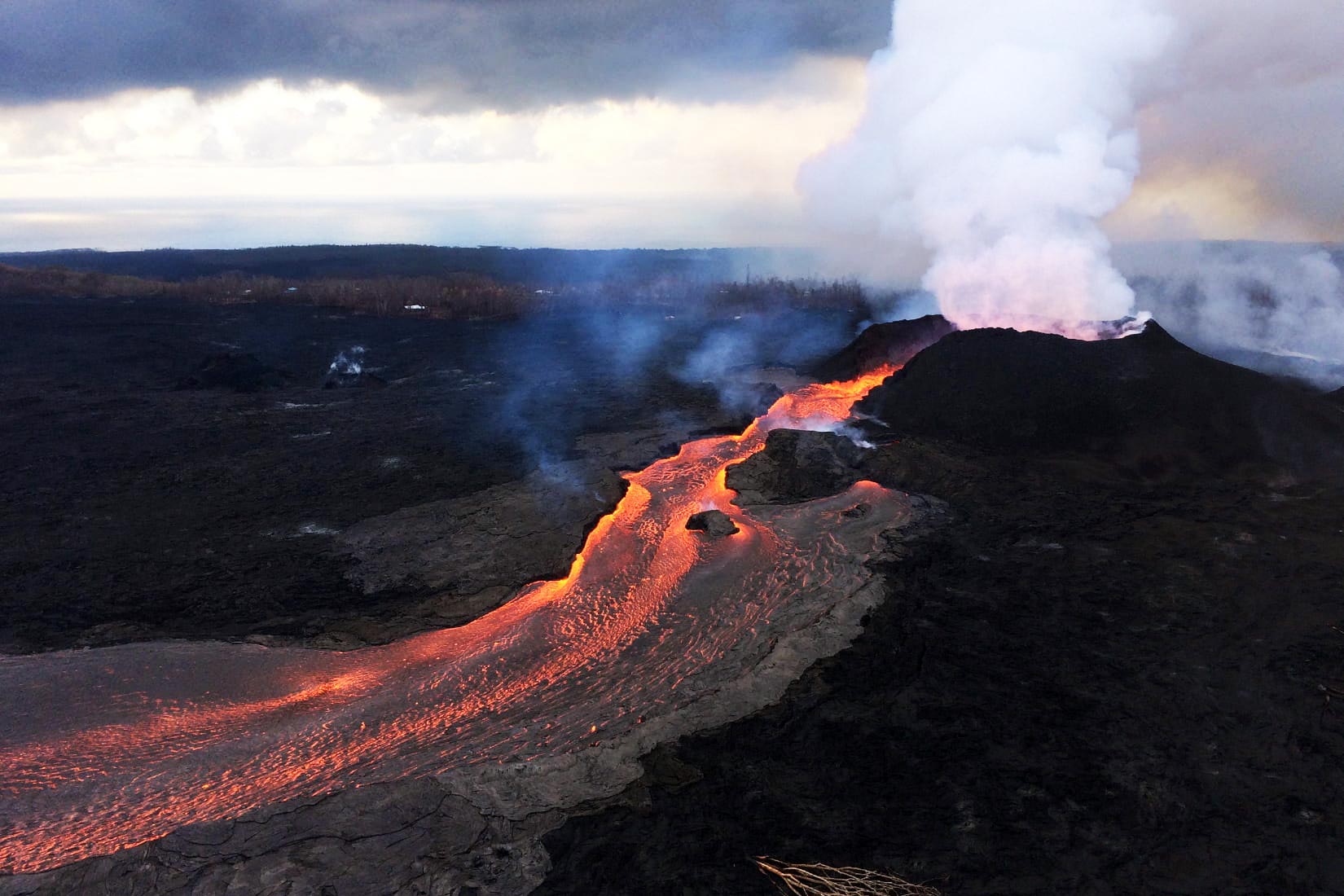
    Lava From a Fountain on Hawaii’s Kilauea Volcano
    Lava from a fountain on Hawaii’s Kilauea volcano flows over a spillway into an established channel in June 2018. (Image courtesy of U.S. Geological Survey)

    Tool lets scientists examine changing behavior of low-viscosity lava.

    Thomas Jones’ “universal break-up criterion” won’t help with meltdowns of the heart, but it will help volcanologists study changing lava conditions in common volcanic eruptions.

    Jones, of Rice University, studies the behavior of low-viscosity lava, the runny kind that’s found at most volcanoes. About two years ago, he began a series of lab experiments and field observations that provided the raw inputs for a new fluid dynamic model of lava break-up. The work is described in a paper in Nature Communications.

    Low-viscosity lava is the red-hot, flowing type one might see at Hawaii’s famed Kilauea volcano, and Jones said it usually behaves in one of two ways.

    “It can bubble or spew out, breaking into chunks that spatter about the vent, or it can flow smoothly, forming lava streams that can rapidly move downhill,” he said.
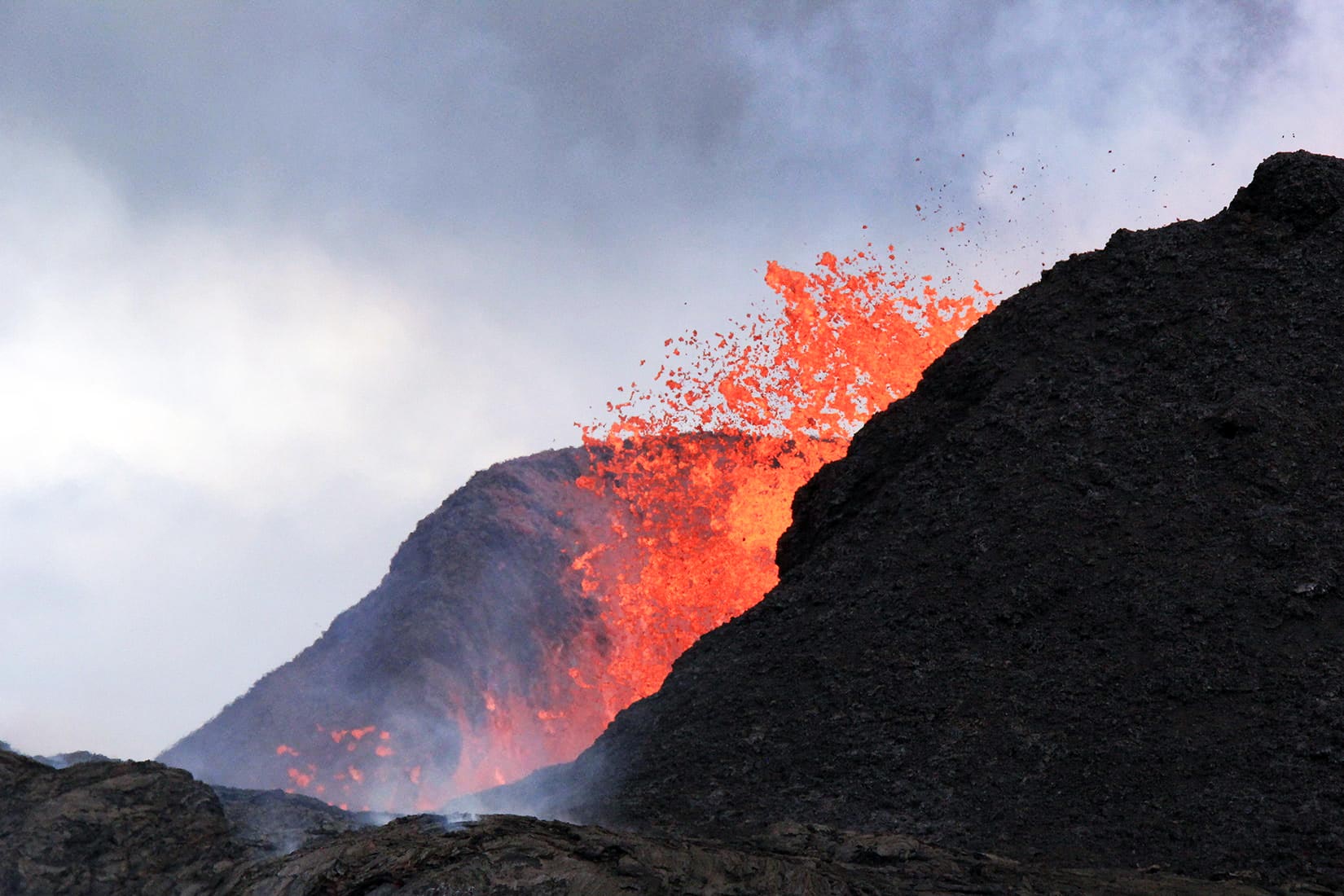
    Lava Fountains at Kilauea in Hawaii
    Lava fountains at Kilauea in Hawaii created a spatter cone, which was estimated to be 180 feet tall in this June 2018 photo. (Image courtesy of U.S. Geological Survey)

    But that behavior can sometimes change quickly during the course of an eruption, and so can the associated dangers: While spattering eruptions throw hot lava fragments into the air, lava flows can threaten to destroy whole neighborhoods and towns.

    Jones’ model, the first of its kind, allows scientists to calculate when an eruption will transition from a spattering spray to a flowing stream, based upon the liquid properties of the lava itself and the eruption conditions at the vent.

    Jones said additional work is needed to refine the tool, and he looks forward to doing some of it himself.

    Thomas Jones
    Thomas Jones is a Rice Academy Postdoctoral Fellow in Rice University’s Department of Earth, Environmental and Planetary Sciences. (Photo courtesy of T. Jones)

    “We will validate this by going to an active volcano, taking some high-speed videos and seeing when things break apart and under what conditions,” he said. “We also plan to look at the effect of adding bubbles and crystals, because real magmas aren’t as simple as the idealized liquid in our mathematical model. Real magmas can also have bubbles and crystals in them. I’m sure those will change things. We want to find out how.”

    Jones said pairing the new model with real-time information about a lava’s liquid properties and eruption conditions could allow emergency officials to predict when an eruption will change style and become a hazard to at-risk communities.

    “We want to use this as a forecasting tool for eruption behavior,” he said. “By developing a model of what’s happening in the subsurface we can then watch for indications that it’s about to cross the tipping point and change behavior.”

    ###

    Jones is a Rice Academy Postdoctoral Fellow in the Department of Earth, Environmental and Planetary Sciences and can be followed on Twitter @Thomas_JJones.

    The study was co-authored by C.D. Reynolds of the University of Birmingham in the United Kingdom and S.C. Boothroyd of Durham University, also in the UK. The research was supported by the UK’s National Environment Research Council and Rice University.

    Never miss a breakthrough: Join the SciTechDaily newsletter.
    Follow us on Google and Google News.

    Kilauea Lava Rice University Volcano
    Share. Facebook Twitter Pinterest LinkedIn Email Reddit

    Related Articles

    Extinct “Hotspot” Volcanoes Spill Secrets on Inner Workings of Volcanoes

    New Study Challenges Conventional Wisdom on the Origins of Large Magma Eruptions

    Volcanic Super-Eruptions Are Millions of Years in the Making

    Bringing Magma From Deep Underground Up to Our Feet – Just Add CO2

    A New Lake — Water Not Lava — On Kilauea Volcano in Hawaii

    Study Finds One Cause for Several Mysteries Linked to Breathable Oxygen 2.5 Billion Years Ago

    Phytoplankton Bloom off Hawaii Island Fueled by Kilauea Lava

    Cretaceous Volcanic Ash Linked with Shale Gas and Oil Fields

    Kilauea’s Halema’uma’u Lava Lake At Highest Level

    2 Comments

    1. gabriel on April 21, 2026 3:19 pm

      I comment.

      Reply
    2. gabriel on April 21, 2026 3:20 pm

      I comment for a lava fire

      Reply
    Leave A Reply Cancel Reply

    • Facebook
    • Twitter
    • Pinterest
    • YouTube

    Don't Miss a Discovery

    Subscribe for the Latest in Science & Tech!

    Trending News

    Stanford Scientists Discover a Remarkable Way To Rescue Dying Corals in Just Seven Weeks

    0 to 15 MPH in a Single Swipe: New Research Reveals How Ancient Giant Sea Monsters Ambushed Their Prey

    Late-Night Snacking Could Be Putting Your Liver at Risk

    40 Years of Superconductor Science Just Got Turned Upside Down by a Stunning Discovery

    A 50-Year-Old Mystery: Scientists Discover What May Have Killed Brazil’s Frogs

    Scientists Discover Exercise Changes the Body in Ways We Never Fully Understood

    Scientists Restore Memory in Mice With Alzheimer’s by Boosting a Single Brain Protein

    Scientists Create “Super Ice” That’s 10 Times Stronger and Rivals Concrete in Strength

    Follow SciTechDaily
    • Facebook
    • Twitter
    • YouTube
    • Pinterest
    • Newsletter
    • RSS
    SciTech News
    • Biology News
    • Chemistry News
    • Earth News
    • Health News
    • Physics News
    • Science News
    • Space News
    • Technology News
    Recent Posts
    • Scientists Find That Cats and Their Owners Share a Surprising Biological Connection
    • New Research Reveals Cows Have a Little-Known Ability To Recognize Humans
    • These Giant-Headed Ants Are Breaking a Fundamental Rule of Biology
    • Your Saliva Could Hold the Key to Detecting a Deadly Cancer
    • Scientists Discover a Hidden Cholesterol Switch That Could Change How We Treat Heart Disease
    Copyright © 1998 - 2026 SciTechDaily. All Rights Reserved.
    • Science News
    • About
    • Contact
    • Editorial Board
    • Privacy Policy
    • Terms of Use

    Type above and press Enter to search. Press Esc to cancel.