
Close Menu
    Facebook X (Twitter) Instagram
    SciTechDaily
    • Biology
    • Chemistry
    • Earth
    • Health
    • Physics
    • Science
    • Space
    • Technology
    Facebook X (Twitter) Pinterest YouTube RSS
    SciTechDaily
    Home»Space»Hubble Glimpses Faint Galaxy in Sea Monster Constellation
    Space

    Hubble Glimpses Faint Galaxy in Sea Monster Constellation

    By ESA (European Space Agency)September 15, 2019No Comments2 Mins Read
    Facebook Twitter Pinterest Telegram LinkedIn WhatsApp Email Reddit
    Share
    Facebook Twitter LinkedIn Pinterest Telegram Email Reddit
    UGC 695
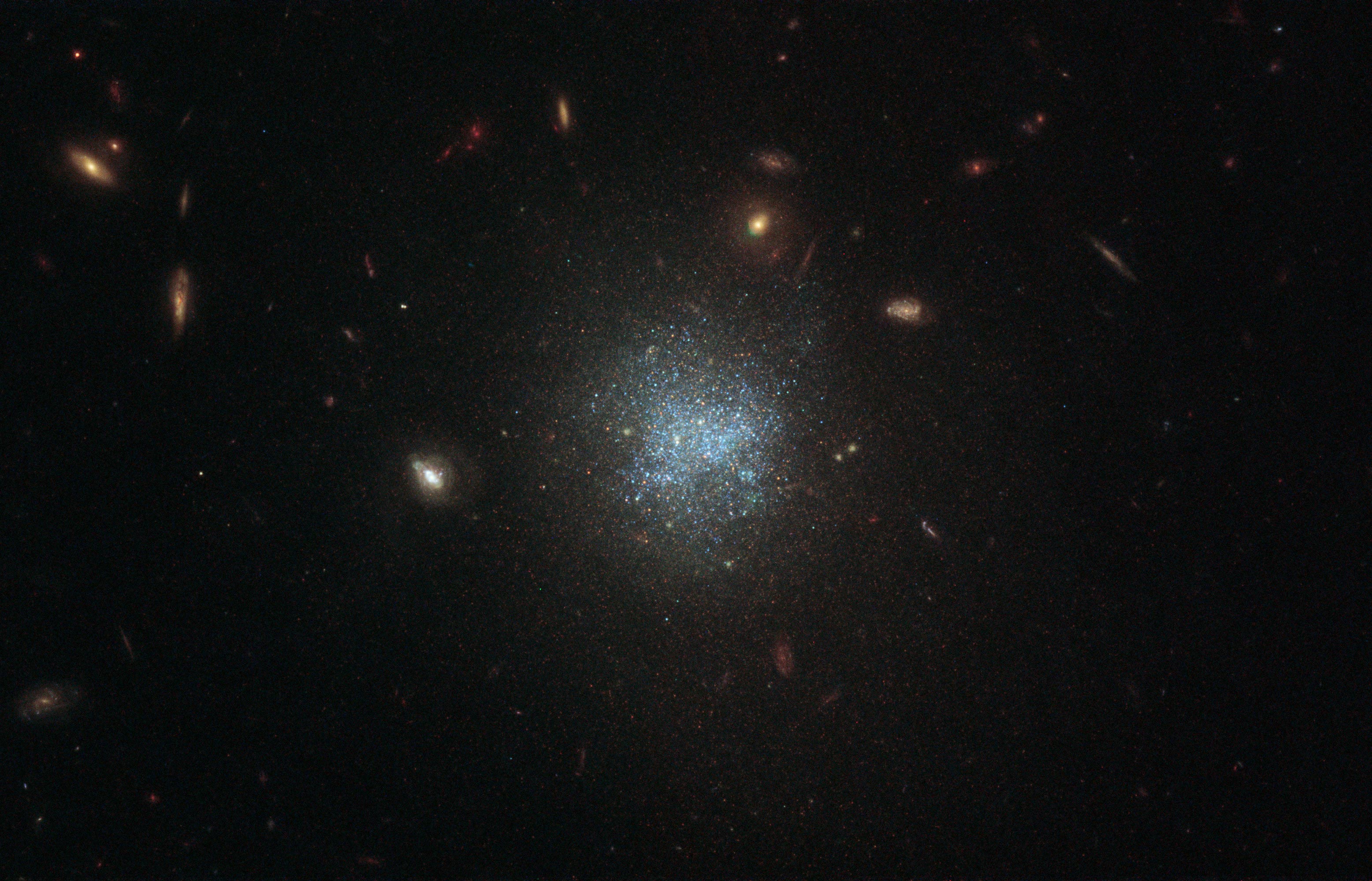
    UGC 695 is located 30 million light-years away within the constellation Cetus (the Sea Monster), also known as the Whale. UGC 695 is a low-surface-brightness (LSB) galaxy. These galaxies are so faint that their brightness is less than the background brightness of Earth’s atmosphere, which makes them tricky to observe. Image Credit: ESA/Hubble & NASA, D. Calzetti

    This image, taken with the NASA/ESA Hubble Space Telescope, focuses on an object named UGC 695, which is located 30 million light-years away within the constellation Cetus (the Sea Monster), also known as the Whale. A bounty of diverse background galaxies is also visible in this image.

    UGC 695 is a low-surface-brightness (LSB) galaxy. These galaxies are so faint that their brightness is less than the background brightness of Earth’s atmosphere, which makes them tricky to observe. This low brightness is the result of the relatively small number of stars within them — most of the normal, or “baryonic,” matter in these galaxies exists in the form of huge clouds of gas and dust. The stars are also distributed over a relatively large area.

    LSB galaxies, like dwarf galaxies, have a high fraction of dark matter relative to the number of stars they contain. Astronomers still debate about how LSB galaxies formed in the first place.

    Never miss a breakthrough: Join the SciTechDaily newsletter.
    Follow us on Google and Google News.

    European Space Agency Galaxy Hubble Space Telescope
    Share. Facebook Twitter Pinterest LinkedIn Email Reddit

    Related Articles

    Hubble Tracks a Galaxy Moving Toward Us at Over 543,000 Miles Per Hour

    Astronomers Have Seen Signs of “Life” at the Center of Messier 110

    Hubble Image of Peculiar Galaxy Pair Arp 116

    Hubble Helps Solve the Mystery of Why Ultra-Faint Dwarf Galaxies Contain Few Stars

    Hubble Captures Image of Compact Blue Dwarf Galaxy UGC 5497

    A Spiral Within a Spiral, Galaxy ESO 498-G5

    Hubble Captures Image of NGC 891 in the Constellation of Andromeda

    Hubble Captures New Image of Messier 9

    Researchers Discover First Intermediate-Mass Black Hole

    Leave A Reply Cancel Reply

    • Facebook
    • Twitter
    • Pinterest
    • YouTube

    Don't Miss a Discovery

    Subscribe for the Latest in Science & Tech!

    Trending News

    Scientists May Have Solved a Long-Standing Melanoma Treatment Mystery

    This Flesh-Eating Fly Is Back in the U.S. – Scientists Are Tracking Where It Could Strike Next

    Scientists Have Uncovered a Troubling New Pattern Hidden in America’s Rivers

    “Entirely Surprising” – Scientists Have Found a Martian Meteorite Unlike Any Known Before

    “Find of the Year” – Archaeologists Discover the Smallest Ice Age Figurines Ever Found

    New Research Challenges Common Exercise Advice for Bone Health

    Avoiding These 3 Health Risks in Midlife Linked to 13 More Years Without Dementia

    Where Were All the Tiny Dinosaurs? Scientists May Finally Have an Answer

    Follow SciTechDaily
    • Facebook
    • Twitter
    • YouTube
    • Pinterest
    • Newsletter
    • RSS
    SciTech News
    • Biology News
    • Chemistry News
    • Earth News
    • Health News
    • Physics News
    • Science News
    • Space News
    • Technology News
    Recent Posts
    • A 2-Billion-Year-Old Clue Challenges a Popular Earth Science Theory
    • Paleontologists Reconstruct 56-Million-Year-Old Forests – and Find a Chilling Warning for Today
    • Scientists Identify a Surprising 129-Day Limit for Predicting the Weather
    • The Ancient Mediterranean Diet Wasn’t What You Think
    • 11,000-Year-Old Grains Reveal a Surprise About the Origins of Agriculture
    Copyright © 1998 - 2026 SciTechDaily. All Rights Reserved.
    • Science News
    • About
    • Contact
    • Editorial Board
    • Privacy Policy
    • Terms of Use

    Type above and press Enter to search. Press Esc to cancel.