
Close Menu
    Facebook X (Twitter) Instagram
    SciTechDaily
    • Biology
    • Chemistry
    • Earth
    • Health
    • Physics
    • Science
    • Space
    • Technology
    Facebook X (Twitter) Pinterest YouTube RSS
    SciTechDaily
    Home»Physics»Precision Measurements of Gravity by Trapping Atoms in a Laser Beam – Could Test General Relativity and Fundamental Physics
    Physics

    Precision Measurements of Gravity by Trapping Atoms in a Laser Beam – Could Test General Relativity and Fundamental Physics

    By American Association for the Advancement of ScienceNovember 8, 2019No Comments2 Mins Read
    Facebook Twitter Pinterest Telegram LinkedIn WhatsApp Email Reddit
    Share
    Facebook Twitter LinkedIn Pinterest Telegram Email Reddit

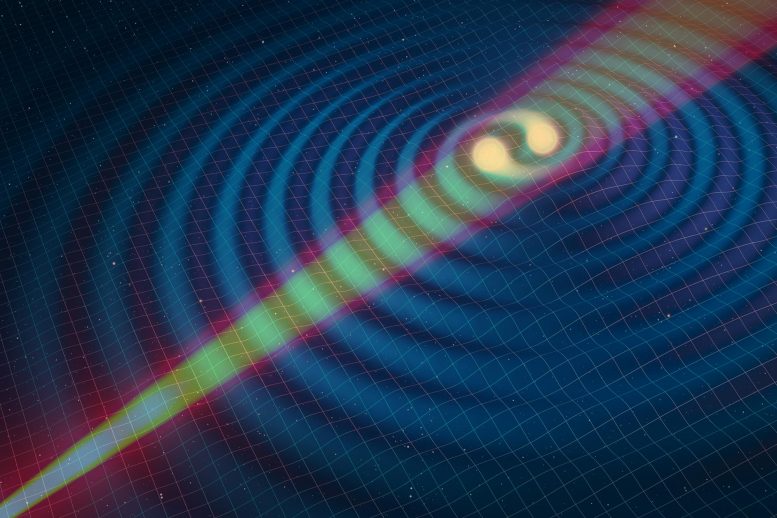
    Illustration Laser Atoms Gravity

    Trapped atoms, suspended aloft on a lattice of laser light for as long as 20 seconds, allow for highly sensitive measurements of gravity, according to a new study published today (November 8, 2019) in the journal Science, which describes a new approach to atom interferometers.

    The new design greatly enhances the sensitivity and precision of gravitational measurements over previous iterations and could be used in tests of general relativity or other investigations into fundamental physics.

    Atom interferometry is a powerful technique that uses the quantum properties of exceedingly cold atoms to precisely measure various aspects of physics, such as inertia or gravity, or to search for new physical or atomic phenomena. Like Galileo’s infamous experiment at the Leaning Tower of Pisa, gravimeters based on atom interferometry can detect slight variations in gravitational fields by observing the behavior of ‘dropped’ atoms. However, the sensitivity and precision of gravitational measurements are largely dependent on the length of time a freely falling atom can be interrogated and the distance it falls, which until now has been limited to only 2.3 seconds in a span of 10 meters (33 feet).

    Rather than dropping atoms like balls from a tower, Victoria Xu and colleagues describe a trapped atom interferometer capable of expanding the interrogation time to 20 seconds.

    Xu et al. use an optical lattice to control and suspend ultracold atoms in place, greatly increasing the ability to measure their behavior in a gravitational field and, by extension, the precision of the gravitational measurements. What’s more, the results show a more than 10,000-fold suppression in the vibrational noise common to even the most state-of-the-art atomic gravimeters, drastically improving the signal-to-noise ratio of measurements. The authors show that the new design allows for highly sensitive and precise yet compact atomic setups.

    Reference: “Probing gravity by holding atoms for 20 seconds” by Victoria Xu, Matt Jaffe, Cristian D. Panda, Sofus L. Kristensen, Logan W. Clark and Holger Müller, 8 November 2019, Science.
    DOI: 10.1126/science.aay6428

    Never miss a breakthrough: Join the SciTechDaily newsletter.
    Follow us on Google and Google News.

    American Association for the Advancement of Science Gravity
    Share. Facebook Twitter Pinterest LinkedIn Email Reddit

    Related Articles

    Defying Gravity With Every Twist: Hula Hooping’s Hidden Physics Revealed by NYU Mathematicians

    Physicists Electrify the Quantum World to Crack Quantum Gravity

    Scientists Use Food Dye to Peek Inside Living Mice

    Beyond Gravity: UC Berkeley’s Quantum Leap in Dark Energy Research

    Photons at the Edge of Physics Unlock Gravity’s Quantum Secrets

    Quantum Leap: How a New Experiment Could Solve Gravity’s Biggest Mystery

    Einstein Challenged: Exploring the “Cosmic Glitch” in Gravity

    From Theory to Reality: Graviton-like Particles Found in Quantum Experiments

    Quantum Gravity Unveiled – Scientists Crack the Cosmic Code That Baffled Einstein

    Leave A Reply Cancel Reply

    • Facebook
    • Twitter
    • Pinterest
    • YouTube

    Don't Miss a Discovery

    Subscribe for the Latest in Science & Tech!

    Trending News

    New Molecule Restores the Brain’s Natural Defenses Against Alzheimer’s

    Could Creatine Boost More Than Muscles? It May Also Help Depression

    Scientists Discover a Natural Molecule That Could Help Prevent Vision Loss

    Scientists Thought Royal Jelly Made Queen Bees. They Were Wrong

    One Tiny Change May Explain How Viruses Jump From Bats to Humans

    The Secret to Healthy Aging May Be More Protein and More Exercise

    These 567-Million-Year-Old Fossils Are Rewriting the Story of Life on Earth

    The Spider-Like Creatures Helping Scientists Decode the Origins of Fatherhood

    Follow SciTechDaily
    • Facebook
    • Twitter
    • YouTube
    • Pinterest
    • Newsletter
    • RSS
    SciTech News
    • Biology News
    • Chemistry News
    • Earth News
    • Health News
    • Physics News
    • Science News
    • Space News
    • Technology News
    Recent Posts
    • Rethinking Movement Disorders: Scientists Uncover a Surprising Disconnect Deep Inside the Brain
    • Groundbreaking Study Challenges 40 Years of Beliefs About Mad Cow Disease
    • One Sugar Tells Your Brain You’re Full. Another Barely Does
    • One of Arizona’s Largest Reservoirs Is Less Than 1% Full After Snowpack Collapse
    • Scientists Detect Hundreds of Iceberg Earthquakes at Antarctica’s Crumbling Doomsday Glacier
    Copyright © 1998 - 2026 SciTechDaily. All Rights Reserved.
    • Science News
    • About
    • Contact
    • Editorial Board
    • Privacy Policy
    • Terms of Use

    Type above and press Enter to search. Press Esc to cancel.