
Close Menu
    Facebook X (Twitter) Instagram
    SciTechDaily
    • Biology
    • Chemistry
    • Earth
    • Health
    • Physics
    • Science
    • Space
    • Technology
    Facebook X (Twitter) Pinterest YouTube RSS
    SciTechDaily
    Home»Physics»Scientists Use Food Dye to Peek Inside Living Mice
    Physics

    Scientists Use Food Dye to Peek Inside Living Mice

    By Becky Ham, American Association for the Advancement of Science (AAAS)September 18, 20241 Comment4 Mins Read
    Facebook Twitter Pinterest Telegram LinkedIn WhatsApp Email Reddit
    Share
    Facebook Twitter LinkedIn Pinterest Telegram Email Reddit
    Transparent Arm
    Illustration of a human hand as it might appear if the new tissue transparency effect proves effective in humans. Currently, the effect has only been tested with animals in a laboratory setting. Note that dyes may be harmful. Always exercise caution with dyes and do not consume directly, apply to people or animals, or otherwise misuse. Credit: Keyi “Onyx” Li/U.S. National Science Foundation

    Researchers have developed a method to turn the tissues of a live mouse transparent using a common food dye called tartrazine, which absorbs specific light wavelengths.

    This innovative technique modifies the refractive index of tissues, allowing enhanced visualization of internal structures such as blood vessels and muscle units without harming the animal. The transparency effect is temporary and reversible, offering exciting new possibilities for non-invasive medical imaging.

    Innovative Use of Food Dye in Research

    By topically applying a common food dye that strongly absorbs light to a live mouse, Zihao Ou and colleagues were able to turn its tissues transparent, allowing them a look into the blood vessels of the scalp, the movement of organs laying under the skin of the abdomen, and tiny contractile units of muscle at work.

    Achieving optical transparency in live animals depends on some interesting physics, where strongly absorbing dye molecules enhance light transmission through a medium usually characterized by substantial light scattering.
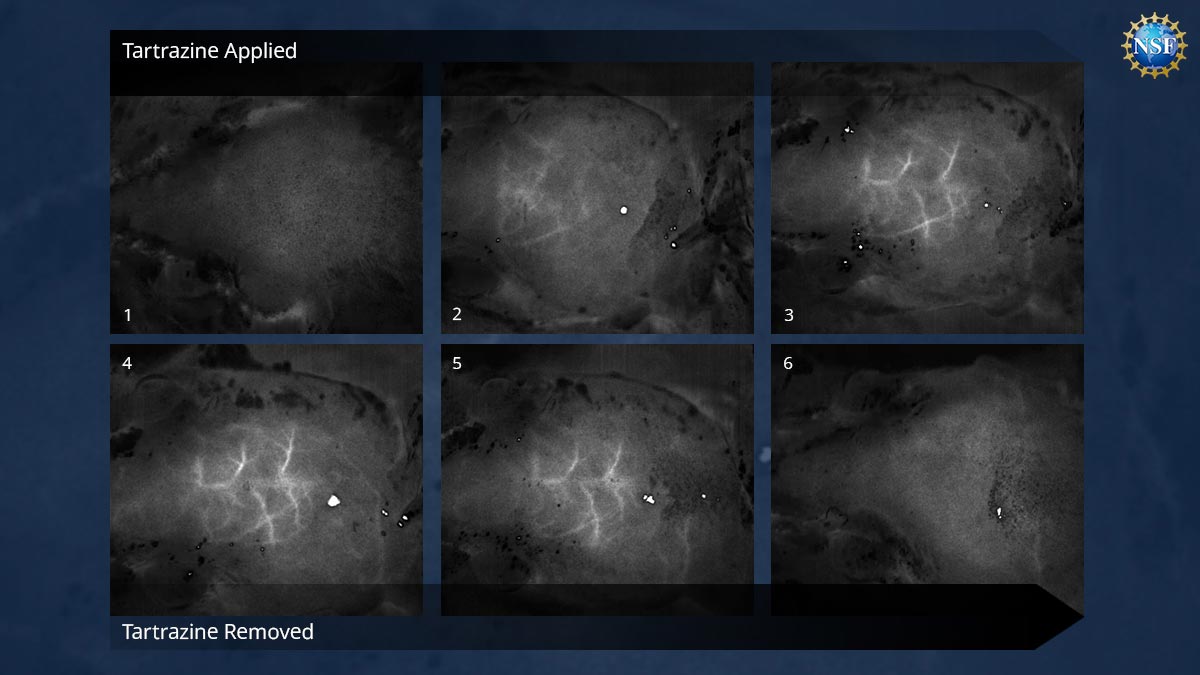
    Transparent Mouse Time Lapse Graphic
    Time-lapse images of blood vessels in the brain just beneath the skull of a sedated mouse, revealed without any surgery, incisions, or damaging the mouse’s bone or skin. By reversibly dyeing the tissues with FD & C Yellow 5 and using a technique called laser speckle contrast imaging, Stanford University researchers observed the blood flow within this living brain. Credit: Stanford University/Gail Rupert/NSF

    Achieving Transparency in Live Tissues

    This scattering is the result of a low refractive index in aqueous parts of tissue and a high refractive index of its protein and fat-based component. Typical methods of tissue clearing can involve processes such as clearing proteins and fats, which wouldn’t work in a live animal.


    Researchers at Stanford University have developed a way to make skin and other tissues transparent using a simple food dye, a reversible technique with potential for revolutionizing internal medicine. In this clip, thin slices of chicken breast become transparent on exposure to the dye FD & C Yellow 5. Credit: U.S. National Science Foundation

    The Role of Tartrazine in Tissue Transparency

    Ou et al. found that a common food dye called tartrazine (mixed with water, it’s called FD&C Yellow 5) topically applied can modify the refractive index of the aqueous parts of tissue by absorbing light in the near ultraviolet and blue regions of the spectrum, to better match the refractive index of nearby high-refractive materials.

    This allows the non-absorbing part of the spectrum, namely the red/orange part, to transmit deeper through the tissue.

    Yellow Dye White Background
    Close-up macro image of syringe injected a solution of yellow #5 dye into white container filled with water. Credit: Matthew Christiansen/U.S. National Science Foundation

    Implications for Medical Imaging

    The result is a temporary transparency effect that can be undone with a quick wash, and does not harm living animals, unlike other approaches used to enhance transparency.

    Christopher Rowlands and Jon Gorecki discuss the imaging possibilities of the technology in a related Perspective.


    Animation depicting the tissue transparency effect and how it might appear if tested with humans in the future. The latter part of the animation shows how photons interact with tissues at the cellular level, both with and without FD & C Yellow 5 saturation. Credit: Keyi “Onyx” Li/U.S. National Science Foundation

    For more on this research:

    • Researchers Make Skin Invisible With Common Food Dye
    • Stanford Scientists Use Food Dye to Make Skin Temporarily Invisible

    References:

    “Achieving optical transparency in live animals with absorbing molecules” by Zihao Ou, Yi-Shiou Duh, Nicholas J. Rommelfanger, Carl H. C. Keck, Shan Jiang, Kenneth BrinsonJr, Su Zhao, Elizabeth L. Schmidt, Xiang Wu, Fan Yang, Betty Cai, Han Cui, Wei Qi, Shifu Wu, Adarsh Tantry, Richard Roth, Jun Ding, Xiaoke Chen, Julia A. Kaltschmidt, Mark L. Brongersma and Guosong Hong, 6 September 2024, Science.
    DOI: 10.1126/science.adm6869

    “Turning tissues temporarily transparent” by Christopher J. Rowlands and Jon Gorecki, 5 September 2024, Science.
    DOI: 10.1126/science.adr7935

    Never miss a breakthrough: Join the SciTechDaily newsletter.
    Follow us on Google and Google News.

    American Association for the Advancement of Science Biophysics Physiology
    Share. Facebook Twitter Pinterest LinkedIn Email Reddit

    Related Articles

    Breaking the Brain-Muscle Barrier: Scientists Discover Hidden Neural Network-Like Abilities of Self-Assembling Molecules

    Penguins’ Survival Secrets – Scientists Uncover Bizarre 4-Second Sleep Strategy

    The Future of Biology: Decoding Cell and Tissue Mechanics in 3D With Active Matter Theory

    Microscopic Masterminds: The Structural Genius of Bacteria

    From Atoms to Organisms: “Assembly Theory” Unifies Physics and Biology To Explain Evolution and Complexity

    Cracking One of the Universe’s Biggest Mysteries: “The Most Precise Measurement Yet” of Electron’s Permanent Electric Dipole Moment

    Cold-Blooded Secret: Hammerhead Sharks Hold Their Breath To Stay Warm As They Hunt

    Knotty by Nature: Blackworms and the Secrets of Rapid Untangling

    Mathematics Behind Wiggly Worm Knots Could Inspire Shapeshifting Robotics

    1 Comment

    1. Bao-hua ZHANG on September 18, 2024 5:49 am

      VERY GOOD!
      However, it should be noted that any interaction may alter the previous form and function, and the issue should be viewed from a historical perspective.

      Scientific research guided by correct theories can help humanity avoid detours, failures, and pomposity. Please witness the exemplary collaboration between theoretical physicists and experimentalists ( https://scitechdaily.com/microscope-spacecrafts-most-precise-test-of-key-component-of-the-theory-of-general-relativity/#comment-854286 ).

      Reply
    Leave A Reply Cancel Reply

    • Facebook
    • Twitter
    • Pinterest
    • YouTube

    Don't Miss a Discovery

    Subscribe for the Latest in Science & Tech!

    Trending News

    Scientists Discover 132-Million-Year-Old Dinosaur Tracks on South Africa’s Coast

    Scientists Uncover the Secret Ingredient Behind the Spark That May Have Started Life on Earth

    Physicists Observe Matter in Two Places at Once in Mind-Bending Quantum Experiment

    Stanford Scientists Discover Hidden Brain Circuit That Fuels Chronic Pain

    New Study Reveals Why Ozempic Works Better for Some People Than Others

    Climate Change Is Altering a Key Greenhouse Gas in a Way Scientists Didn’t Expect

    New Study Suggests Gravitational Waves May Have Created Dark Matter

    Scientists Discover Why the Brain Gets Stuck in Schizophrenia

    Follow SciTechDaily
    • Facebook
    • Twitter
    • YouTube
    • Pinterest
    • Newsletter
    • RSS
    SciTech News
    • Biology News
    • Chemistry News
    • Earth News
    • Health News
    • Physics News
    • Science News
    • Space News
    • Technology News
    Recent Posts
    • The Ideal Temperature for Storing Mangoes Isn’t What You Think
    • Groundbreaking Enzyme Atlas Rewrites Decades of Biology Research
    • New “Nanozyme Hypothesis” Could Rewrite the Story of Life’s Origins
    • Anatomy Isn’t Finished: The Human Body Still Holds Secrets
    • Researchers Discover Long-Lost Words of Ancient Greek Philosopher After 2,000 Years
    Copyright © 1998 - 2026 SciTechDaily. All Rights Reserved.
    • Science News
    • About
    • Contact
    • Editorial Board
    • Privacy Policy
    • Terms of Use

    Type above and press Enter to search. Press Esc to cancel.