
Close Menu
    Facebook X (Twitter) Instagram
    SciTechDaily
    • Biology
    • Chemistry
    • Earth
    • Health
    • Physics
    • Science
    • Space
    • Technology
    Facebook X (Twitter) Pinterest YouTube RSS
    SciTechDaily
    Home»Space»Pulsars Observed for the First Time From South America
    Space

    Pulsars Observed for the First Time From South America

    By Rochester Institute of TechnologyDecember 17, 2019No Comments3 Mins Read
    Facebook Twitter Pinterest Telegram LinkedIn WhatsApp Email Reddit
    Share
    Facebook Twitter LinkedIn Pinterest Telegram Email Reddit
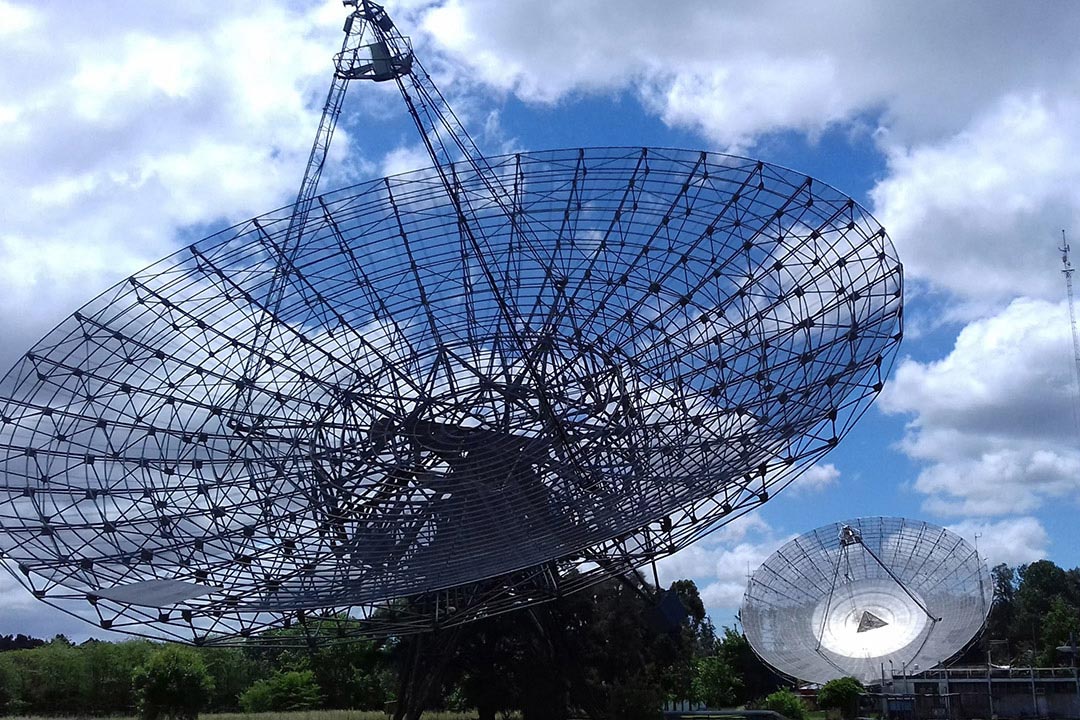
    Radio Telescopes Pereyra Iraola Provincial Park
    RIT and Insituto Argentino de Radioastronomía upgraded two radio telescopes in in the Pereyra Iraola provincial park near the city of La Plata, Buenos Aires, in order to study pulsars. Credit: Insituto Argentino de Radioastronomía

    Upgraded Radio Telescopes Enable Scientists to Study Pulsars From the Southern Hemisphere

    Rochester Institute of Technology and the Instituto Argentino de Radioastronomía (IAR) have collaborated to make the first pulsar observations from South America.

    A new paper published in Astronomy and Astrophysics outlines how the team upgraded two radio telescopes in Argentina that lay dormant for 15 years in order to study pulsars. Pulsars are rapidly rotating neutron stars with intense magnetic fields that emit notably in radio wavelengths. The pulses they emit carry information about the structure of neutron stars.

    Since getting the radio telescopes operational once again, the team has observed phenomena including a millisecond pulsar (J0437-4515), a magnetar (XTE J1810-197), and a glitch in the period of the Vela pulsar (J0835-4510). A glitch is a sudden change in the rotational period of the neutron star, due to a sort of quake leading to changes in the pulsar period. This is particularly noticeable in young pulsars, like Vela.

    “We have opened up the possibility to directly observe and study neutron stars in the deep southern sky from our lab in the northern hemisphere,” said Carlos Lousto, professor in RIT’s School of Mathematical Sciences and a member of the Center for Computational Relativity and Gravitation (CCRG). “Those stars are not directly accessible from radio telescopes in the north because the Earth lies in between our sight line. We have also implemented a visitor program to and from Argentina that increases the RIT interactions with Hispanic scientists and culture.”

    The two radio telescope antennae, each 30 meters (98 feet) in diameter, are located at the IAR observatory in the Pereyra Iraola provincial park near the city of La Plata, Argentina. Observations are performed remotely at RIT from the Pulsar Monitoring in Argentina Data Enabling Network (PuMA-DEN) lab by members of RIT’s CCRG.

    Three years of work culminated when Professor Manuela Campanelli, director of RIT’s CCRG, and Professor Gustavo Romero, director of IAR, signed an agreement to exchange visitors, scientific projects, and data. The early findings have the scientists involved encouraged about pursuing larger goals such as coordinated multi-wavelength observations with other observatories and studying transient phenomena such as magnetars, glitches, and fast radio burst sources.

    Several IAR students have already come to Rochester to contribute to research. Lousto said he hopes to engage more students from RIT’s programs in astrophysical sciences and technology, mathematical modeling, microelectronic engineering, computer science, and other disciplines involved in hands-on work both at RIT and in Argentina.

    Reference: “Upgraded antennas for pulsar observations in the Argentina Institute of Radio astronomy” by G. Gancio, C. O. Lousto, L. Combi, S. del Palacio, F. G. López Armengol, J. A. Combi, F. García, P. Kornecki, A. L. Müller, E. Gutiérrez, F. Hauscarriaga, and G. C. Mancuso, 2 December 2019, Astronomy and Astrophysics.
    DOI: 10.1051/0004-6361/201936525

    Never miss a breakthrough: Join the SciTechDaily newsletter.
    Follow us on Google and Google News.

    Astronomy Astrophysics Rochester Institute of Technology
    Share. Facebook Twitter Pinterest LinkedIn Email Reddit

    Related Articles

    Highly Eccentric Black Hole Merger Detected for the First Time

    Sending a Tiny Telescope Past Saturn Could Solve Some of the Biggest Mysteries of the Universe

    Dissecting the Anatomy of Planetary Nebulae Using the Hubble Space Telescope

    Massive, Spinning Black Holes Could Be the Result of ‘Pac-Man-Like’ Mergers

    Further Evidence That Outskirts of Spiral Galaxies Host Massive Black Holes

    New Simulation Provides First Hints of What Supermassive Black Hole Mergers Will Look Like

    New Research Pokes Holes in the Current Understanding of Galaxy Formation

    Simulations Re-Create the Complex Dynamics Near a Black Hole

    NASA Study Bridges the Gap Between Theory and Black Hole Observations

    Leave A Reply Cancel Reply

    • Facebook
    • Twitter
    • Pinterest
    • YouTube

    Don't Miss a Discovery

    Subscribe for the Latest in Science & Tech!

    Trending News

    This Experimental Drug Repaired the Gut and Reversed Severe Fatty Liver Disease

    Physicists Just Turned a Black Hole Energy Theory Into Reality

    Stanford Scientists Solve a 252-Million-Year-Old Mass Extinction Mystery

    The Ancient Survival Mechanism Making Weight Loss So Difficult

    Just 3,000 Steps a Day May Help Protect the Brain From Alzheimer’s

    “Weird Clams” Reveal a New Invasion Along the U.S. Northeast Coast

    Archaeologists Decapitated Tutankhamun and Glued His Body Back Together

    New Black Hole Theory Solves a 50-Year-Old Problem

    Follow SciTechDaily
    • Facebook
    • Twitter
    • YouTube
    • Pinterest
    • Newsletter
    • RSS
    SciTech News
    • Biology News
    • Chemistry News
    • Earth News
    • Health News
    • Physics News
    • Science News
    • Space News
    • Technology News
    Recent Posts
    • New Study Reveals Herpesvirus Infection May Accelerate Alzheimer’s Disease
    • Microplastics Found in 84% of Serious Heart Attack Patients
    • The Oldest Known Right-Handed Animal May Have Lived 550 Million Years Ago
    • MIT’s Tiny Flying Robot Just Learned To Move Like a Real Insect
    • Why Are Bees Struggling To Survive This Summer?
    Copyright © 1998 - 2026 SciTechDaily. All Rights Reserved.
    • Science News
    • About
    • Contact
    • Editorial Board
    • Privacy Policy
    • Terms of Use

    Type above and press Enter to search. Press Esc to cancel.