
Total collapse in the next 1,000 years unlikely.
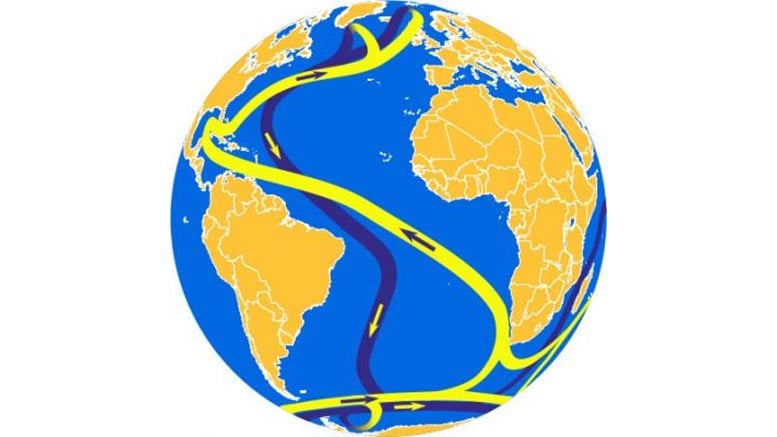
The North Atlantic Current transports warm water from the Gulf of Mexico toward Europe, providing much of north-western Europe with a relatively mild climate. However, scientists suspect that meltwater from Greenland and excessive rainfall could interfere with this ocean current. Simulations by scientists from the University of Groningen and Utrecht University showed that it is unlikely that the current will come to a complete stop, due to small and rapid changes in precipitation over the North Atlantic. However, there is a 15 percent likelihood that there will be a temporary change in the current in the next 100 years. The results were published on December 30, 2019, in the journal Scientific Reports.
‘The oceans store an immense amount of energy and the ocean currents have a strong effect on the Earth’s climate,’ says University of Groningen Associate Professor in Numerical Mathematics, Fred Wubs. Together with his colleague Henk Dijkstra from Utrecht University, he has studied ocean currents for some 20 years.
Box model
Ocean scientists have found that the Atlantic Ocean currents are sensitive to the amount of fresh water at the surface. Since the run-off of meltwater from Greenland has increased due to climate change, as has rainfall over the ocean, it has been suggested that this may slow down or even reverse the North Atlantic Current, blocking the transport of heat to Europe.
Simulations of the effects of freshwater on the currents have already been performed for some decades. ‘Both high-resolution models, based on the equations describing fluid flows, and highly simplified box models have been used,’ explains Wubs. ‘Our colleagues in Utrecht created a box model that describes present-day large-scale processes in the ocean rather well.’
Total collapse
The idea was to use this box model to estimate the likelihood of small fluctuations in freshwater input causing a temporary slowing down or a total collapse of the North Atlantic Current. The current shows non-linear behavior, which means that small changes can have large effects. The evolution of the physics described by the box model can only be obtained using simulations. ‘As the transitions we were looking for are expected to be rare events, you need a huge number of simulations to estimate the chance of them happening,’ says Wubs. However, the Dutch scientists found that a French scientist had devised a method to select the most promising simulations, reducing the number of full simulations required.
Sven Baars, a Ph.D. student of Wubs, implemented this method efficiently and linked it to the Utrecht box model. Daniele Castellana, a Ph.D. student of Dijkstra, performed the simulations. ‘These simulations showed that the chances of a total collapse of the North Atlantic Current within the next thousand years are negligible,’ says Wubs.
Interruption
A temporary interruption in the delivery of relatively warm water to north-western Europe is more likely: ‘In our simulations, the chances of this happening in the next 100 years are 15 percent.’ Such temporary transitions may cause cold spells in the North Atlantic, although this needs to be verified in further studies. Therefore, the current study is just a first step in determining the risk. The model does not take into account considerable changes in freshwater in the North Atlantic, which can be caused by the melting of the ice sheets. Wubs: ‘Confirming our results through simulation with a high-resolution climate model will be the next challenge.’
Reference: “Transition Probabilities of Noise-induced Transitions of the Atlantic Ocean Circulation” by Daniele Castellana, Sven Baars, Fred W. Wubs and Henk A. Dijkstra, 30 December 2019, Scientific Reports.
DOI: 10.1038/s41598-019-56435-6
Never miss a breakthrough: Join the SciTechDaily newsletter.
Follow us on Google and Google News.
1 Comment
A new frontier in city building soon being underwater. mmm.