
With outbreaks of infectious diseases making headlines around the world, scientists are under pressure to understand the drivers that influence the transmission of pathogens in order to better predict and control disease outbreaks.
A new research study led by Professor Kathleen Alexander of the College of Natural Resources and Environment explores the ways that landscapes can influence animal behavior, fostering dynamics that either encourage or limit the spread of infectious diseases.
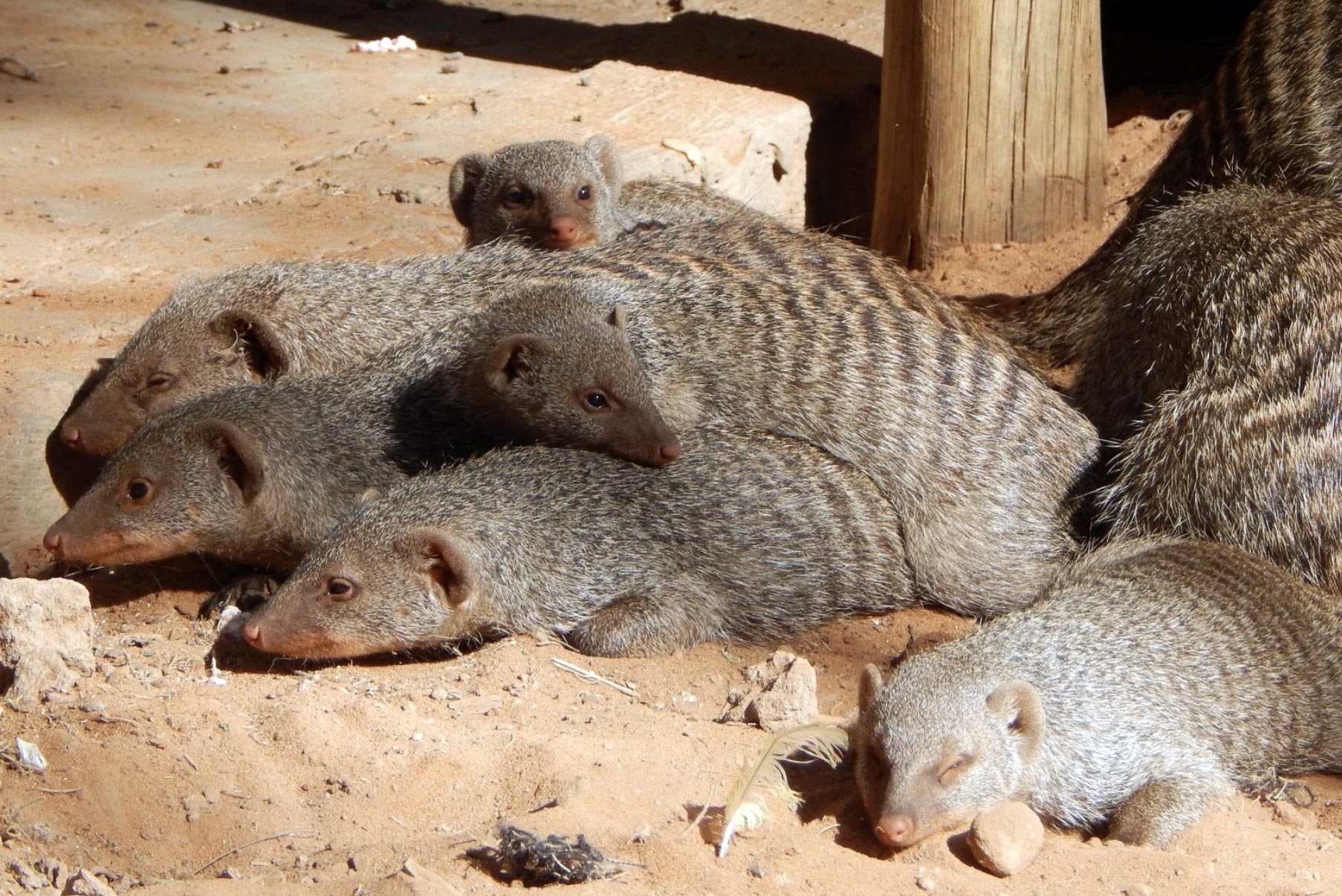
By observing banded mongoose populations across a range of environments in Botswana, researchers were able to gain insight into the manner in which land type and animal behavior interact to influence the spread of a novel tuberculosis pathogen that is transmitted through olfactory communication behaviors.
The study, published in the journal Frontiers in Ecology and Evolution, was funded with an award from the National Science Foundation’s Evolution and Ecology of Infectious Diseases program.
“Banded mongoose use scent marking to communicate information to other individuals, a central fitness behavior in this and many other species,” explained Alexander, faculty member in the Department of Fish and Wildlife Conservation and an affiliate of the Fralin Life Sciences Institute. “Scent marks are deposited into the environment and contain odor signals that convey information from one mongoose to another.”
“The novel tuberculosis pathogen we’ve discovered has essentially hijacked mongoose communication pathways: as they communicate information with other mongooses, they can also transmit the tuberculosis pathogen,” she continued.
Working through the Chobe Research Institute and Centre for the Conservation of African Resources: Animals, Communities, and Land Use (CARACAL) that she co-established in northern Botswana, Alexander, and former graduate student Carol Anne Nichols utilized radio collars and camera traps with remote sensors in den sites to monitor mongoose behaviors. In this way, the researchers could observe mongooses without influencing their behavior and were able to study them in protected park landscapes, urban environments, and other locations with varying characteristics. The result was a comprehensive data set of mongoose behavioral interactions across a range of landscape types.
“What we found is that land type significantly influences the interaction of vigilance — watching out for predators or competitors — with scent marking behavior,” Alexander said. “This has the potential to change pathogen transmission and, where scent marking is elevated, create superspreading landscapes.”
“When the mongooses were in Chobe National Park, for example, they had to be vigilant against predators,” explained Nichols, who earned her master’s in fisheries and wildlife sciences from Virginia Tech in 2018. “They were less likely to participate in scent marking or communicating with other mongooses. If you’re running from a predator, you’re not stopping to leave a message for other animals. You’re running for your life.”
But at tourism lodges, vigilance in mongoose was largely associated with the detection of other mongooses that might move in to take advantage of food and denning opportunities. Here, there was an increase in olfactory communication behaviors. In these environments, predators that might injure or kill mongoose were largely excluded.
Alexander notes that these insights demonstrate the importance of understanding complex land-behavior interactions when trying to predict disease distribution and transmission dynamics.
“Banded mongooses are social animals and live in territories, which is what makes this particular transmission method and these findings so interesting,” Alexander explained. “By utilizing olfactory communication behaviors, the pathogen can circumvent territorial boundaries because individuals from adjacent territories will come and smell the scent marks. But, as we found here, it matters where an animal lives and how it behaves in that environment.
“Infectious diseases will continue to emerge as we have seen again with the novel coronavirus,” she added. “Our results suggest an urgency in understanding how landscape types influence animal behavior and how these interactions might increase or decrease the potential for disease to be transmitted between animals and humans.”
Reference: “Behavior – Landscape Interactions May Create Super-Spreader Environments: Vigilance-Olfactory Interactions Across Land Type and Disease Transmission Potential in the Banded Mongoose” by Kathleen Anne Alexander and Carol Anne Nichols, 12, March 2020, Frontiers in Ecology and Evolution.
DOI: 10.3389/fevo.2020.00047
Never miss a breakthrough: Join the SciTechDaily newsletter.
Follow us on Google and Google News.