
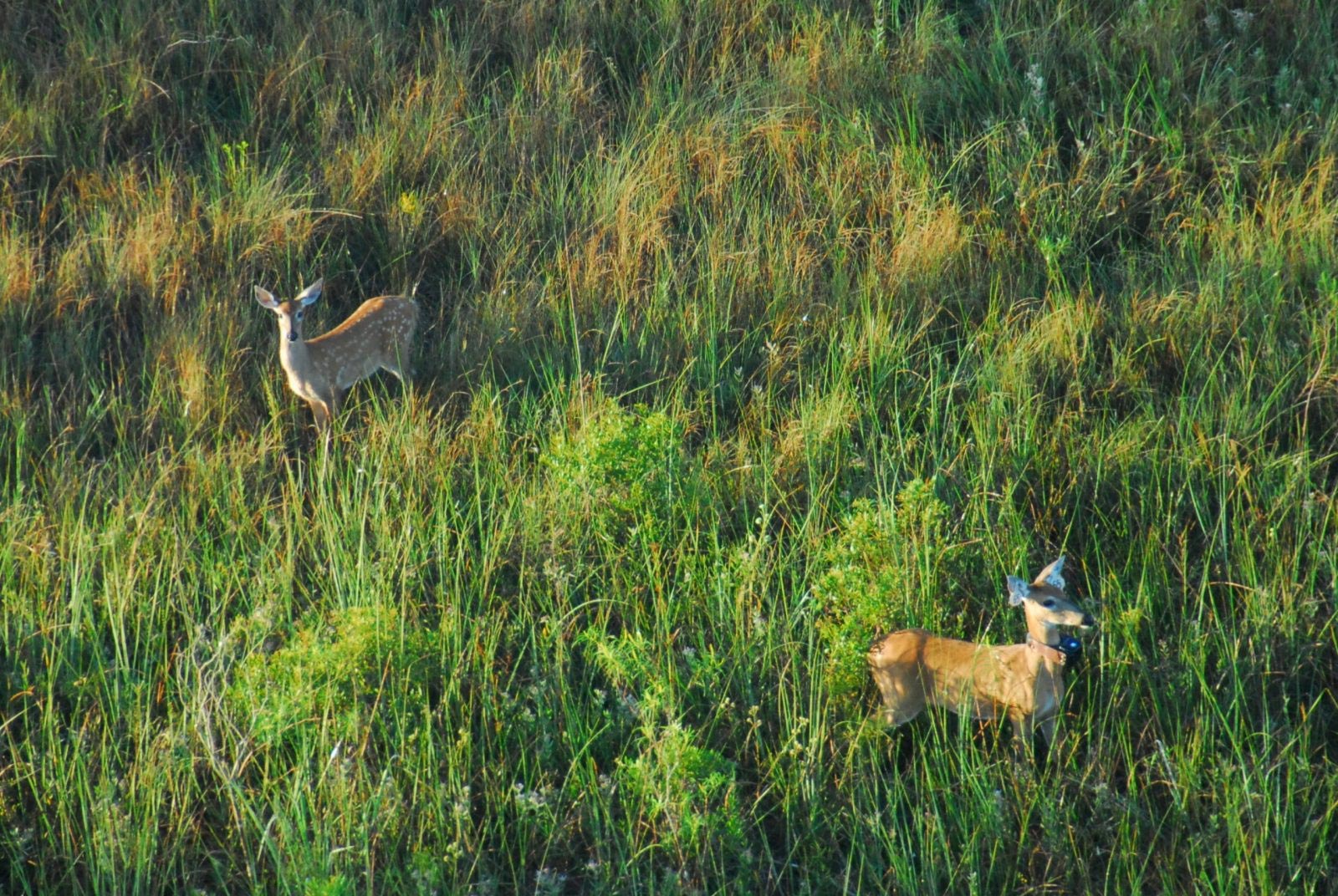
When Hurricane Irma made landfall in Florida in September 2017, the Category 5 storm offered a team of wildlife researchers a first-ever opportunity to observe behavioral responses of white-tailed deer to an extreme weather event in real time. The data collected are providing crucial new insights for scientists seeking to minimize the impacts of severe weather and climate change on wildlife.
Heather Abernathy, a doctoral student in the College of Natural Resources and Environment, detailed the group’s findings in a recent issue of Proceedings of the Royal Society B, a key biological research journal.
The paper is one outcome from a large, ongoing collaborative study of white-tailed deer population dynamics as well as interactions between white-tailed deer and Florida panther in southwestern Florida by Virginia Tech, the University of Georgia, and the Florida Fish and Wildlife Conservation Commission.
Since 2015, researchers have been monitoring white-tailed deer using GPS collars to track their movements through the Florida Panther National Wildlife Refuge and the northern management units of Big Cypress National Preserve. As Hurricane Irma made landfall, the team was able to track the movements of individual white-tailed deer in real time utilizing satellite data transmitted from the GPS collars every four hours.
Using the data collected during the hurricane, the researchers were able to estimate habitat use and movement rates. “We found that the deer, particularly the female deer, increased their movement rate substantially,” said Abernathy, who is in her third year as a student in the Department of Fish and Wildlife Conservation. “We also observed that the deer changed their habitat selection during the storm.”
“Typically, deer prefer prairie and marshland habitats during the wet season — those areas have the most prolific forage — and avoid forests because that is the habitat of their main predator: the Florida panther,” continued Abernathy, who has helped coordinate the project and was the lead author of the paper. “During the storm, we observed the inverse: deer avoided those areas, selecting the pine forests at higher elevations. More than half of the animals we tracked left their home range for higher terrain.”
These findings suggest that animals have the capacity to adapt their behaviors to survive extreme weather events. Since global climate change has the potential to contribute to an increase in flooding, drought, hurricanes, and tsunamis, this research has broad implications for wildlife behavioral mitigation strategies.
“In a lot of our climate change assessments, we make the assumption that animal behavior is static and that what we observe now is how the animals are going to respond in extreme events, such as hurricanes,” Abernathy explained. “What this research demonstrates is that animals have behavioral mechanisms that allow for survival, but those mechanisms aren’t going to be observed until the animals are undergoing a significant event.”
Abernathy’s research has local implications as well: because deer seek higher elevations of pine forests during heavy storms, it is essential that land managers and conservationists protect and manage these environments. They could mean the difference between life and death for this key prey species of the endangered Florida panther.
“Heather has masterfully handled the role as the point of contact for the cooperating agencies and numerous stakeholder groups affiliated with this project,” noted Assistant Professor Mike Cherry, Abernathy’s advisor. “Many of these groups have passionate opinions about our research, and Heather has interacted with these groups with grace and professionalism. I could not imagine a better spokesperson for our project.”
Reference: “Deer movement and resource selection during Hurricane Irma: implications for extreme climatic events and wildlife” by H. N. Abernathy, D. A. Crawford, E. P. Garrison, R. B. Chandler, M. L. Conner, K. V. Miller and M. J. Cherry, 27 November 2019, Proceedings of the Royal Society B.
DOI: 10.1098/rspb.2019.2230
Never miss a breakthrough: Join the SciTechDaily newsletter.
Follow us on Google and Google News.