

Harvard Scientists Uncover Link Between the Nervous System and Stem Cells That Regenerate Pigment
When Marie Antoinette was captured during the French Revolution, her hair reportedly turned white overnight. In more recent history, John McCain experienced severe injuries as a prisoner of war during the Vietnam War — and lost color in his hair.
For a long time, anecdotes have connected stressful experiences with the phenomenon of hair graying.
Now, for the first time, HSCI scientists have discovered exactly how the process plays out: stress activates nerves that are part of the fight-or-flight response, which in turn cause permanent damage to pigment-regenerating stem cells in hair follicles.
The study, published in Nature on January 22, 2020, advances scientists’ knowledge of how stress can impact the body.
“Everyone has an anecdote to share about how stress affects their body, particularly in their skin and hair — the only tissues we can see from the outside,” said senior author Ya-Chieh Hsu, the Alvin and Esta Star Associate Professor of Stem Cell and Regenerative Biology at Harvard and HSCI principal faculty member. “We wanted to understand if this connection is true, and if so, how stress leads to changes in diverse tissues. Hair pigmentation is such an accessible and tractable system to start with — and besides, we were genuinely curious to see if stress indeed leads to hair graying. ”
Narrowing down the culprit
Because stress affects the whole body, researchers first had to narrow down which body system was responsible for connecting stress to hair color. The team first hypothesized that stress causes an immune attack on pigment-producing cells. However, when mice lacking immune cells still showed hair graying, researchers turned to the hormone cortisol. But once more, it was a dead end.
“Stress always elevates levels of the hormone cortisol in the body, so we thought that cortisol might play a role,” Hsu said. “But surprisingly, when we removed the adrenal gland from the mice so that they couldn’t produce cortisol-like hormones, their hair still turned gray under stress.”
After systematically eliminating different possibilities, researchers honed in on the sympathetic nerve system, which is responsible for the body’s fight-or-flight response.
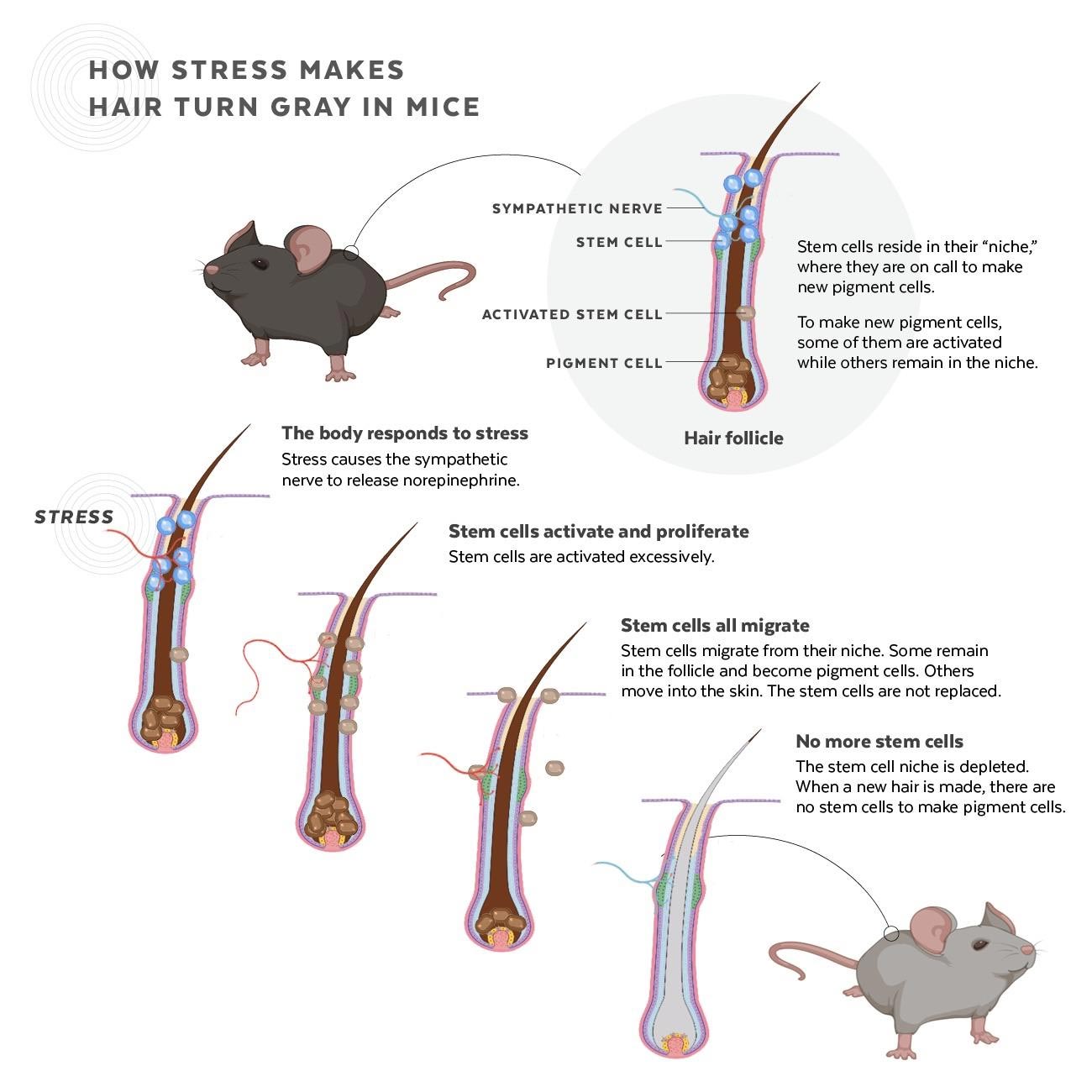
Sympathetic nerves branch out into each hair follicle on the skin. The researchers found that stress causes these nerves to release the chemical norepinephrine, which gets taken up by nearby pigment-regenerating stem cells.
Permanent damage
In the hair follicle, certain stem cells act as a reservoir of pigment-producing cells. When hair regenerates, some of the stem cells convert into pigment-producing cells that color the hair.
Researchers found that the norepinephrine from sympathetic nerves causes the stem cells to activate excessively. The stem cells all convert into pigment-producing cells, prematurely depleting the reservoir.
“When we started to study this, I expected that stress was bad for the body — but the detrimental impact of stress that we discovered was beyond what I imagined,” Hsu said. “After just a few days, all of the pigment-regenerating stem cells were lost. Once they’re gone, you can’t regenerate pigments anymore. The damage is permanent.”
The finding underscores the negative side effects of an otherwise protective evolutionary response, the researchers said.
“Acute stress, particularly the fight-or-flight response, has been traditionally viewed to be beneficial for an animal’s survival. But in this case, acute stress causes permanent depletion of stem cells,” said postdoctoral fellow Bing Zhang, the lead author of the study.
Answering a fundamental question
To connect stress with hair graying, the researchers started with a whole-body response and progressively zoomed into individual organ systems, cell-to-cell interaction and, eventually, all the way down to molecular dynamics. The process required a variety of research tools along the way, including methods to manipulate organs, nerves, and cell receptors.
“To go from the highest level to the smallest detail, we collaborated with many scientists across a wide range of disciplines, using a combination of different approaches to solve a very fundamental biological question,” Zhang said.
The collaborators included Isaac Chiu, assistant professor of immunology at Harvard Medical School who studies the interplay between nervous and immune systems.
“We know that peripheral neurons powerfully regulate organ function, blood vessels, and immunity, but less is known about how they regulate stem cells,” Chiu said.
“With this study, we now know that neurons can control stem cells and their function, and can explain how they interact at the cellular and molecular level to link stress with hair graying.”
The findings can help illuminate the broader effects of stress on various organs and tissues. This understanding will pave the way for new studies that seek to modify or block the damaging effects of stress. Harvard’s Office of Technology Development has filed a provisional patent application on the lab’s findings and is engaging prospective commercial partners who may be interested in clinical and cosmetic applications.
“By understanding precisely how stress affects stem cells that regenerate pigment, we’ve laid the groundwork for understanding how stress affects other tissues and organs in the body,” Hsu said. “Understanding how our tissues change under stress is the first critical step towards eventual treatment that can halt or revert the detrimental impact of stress. We still have a lot to learn in this area.”
Discover more
Reference: “Hyperactivation of sympathetic nerves drives depletion of melanocyte stem cells” by Bing Zhang, Sai Ma, Inbal Rachmin, Megan He, Pankaj Baral, Sekyu Choi, William A. Gonçalves, Yulia Shwartz, Eva M. Fast, Yiqun Su, Leonard I. Zon, Aviv Regev, Jason D. Buenrostro, Thiago M. Cunha, Isaac M. Chiu, David E. Fisher and Ya-Chieh Hsu, 22 January 2020, Nature.
DOI: 10.1038/s41586-020-1935-3
The study was supported by the Smith Family Foundation Odyssey Award, the Pew Charitable Trusts, Harvard Stem Cell Institute, Harvard/MIT Basic Neuroscience Grants Program, Harvard FAS and HMS Dean’s Award, American Cancer Society, NIH, the Charles A. King Trust Postdoctoral Fellowship Program, and an HSCI junior faculty grant.
Never miss a breakthrough: Join the SciTechDaily newsletter.
Follow us on Google and Google News.
3 Comments
Is it so with hair fall?
Lucky mice, get to be psychologically tortured just so we can find out about what makes hair grey.
@Timothy L. – yeah, and poor bacteria… they get murdered by the billions just so that we can discover some new antibiotics.