
Close Menu
    Facebook X (Twitter) Instagram
    SciTechDaily
    • Biology
    • Chemistry
    • Earth
    • Health
    • Physics
    • Science
    • Space
    • Technology
    Facebook X (Twitter) Pinterest YouTube RSS
    SciTechDaily
    Home»Technology»Graphene Center Laboratory is State of the Art “Nano-Factory”
    Technology

    Graphene Center Laboratory is State of the Art “Nano-Factory”

    By University of BathMay 2, 20121 Comment3 Mins Read
    Facebook Twitter Pinterest Telegram LinkedIn WhatsApp Email Reddit
    Share
    Facebook Twitter LinkedIn Pinterest Telegram Email Reddit
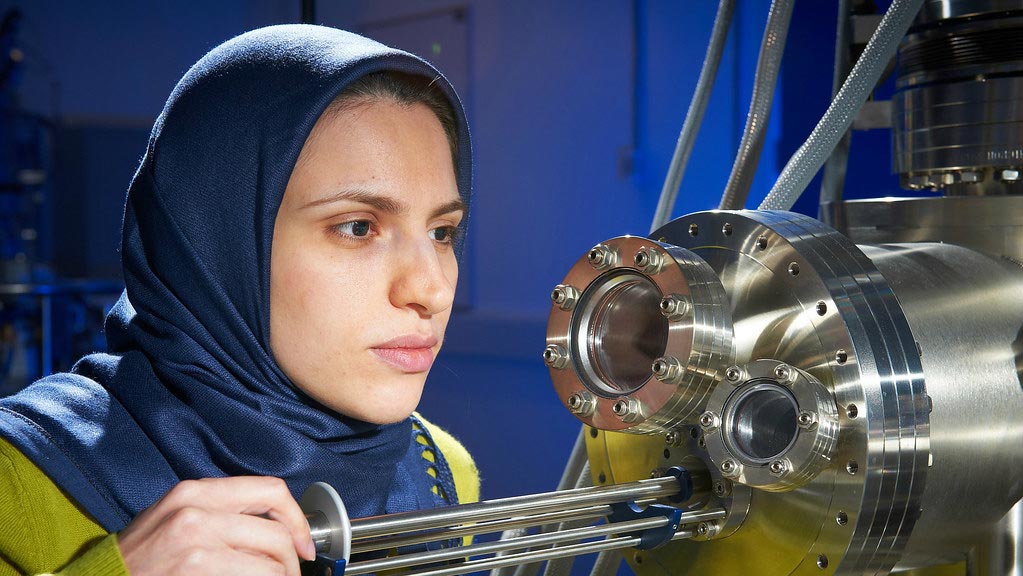
    Sieh Kazemi Operates Nano-Factory
    Sieh Kazemi operates the “nano-factory,” which will allow researchers to build new devices onto a single graphene layer.

    Graphene is an amazing material offering high strength, transparency, and flexibility with excellent electrical and thermal conductivity, all from a single layer of carbon atoms. To further understand and research all the possibilities of graphene, the Graphene Center Laboratory was opened at the University of Bath On May 1st.

    Forty times stronger than steel and conducting electricity ten times better than silicon, graphene is the wonder material that could one day replace silicon in microchips. Now the University is opening a new Graphene Center Laboratory that will study its amazing properties and develop its potential applications.

    Graphene could be used to develop faster electronic devices, for example, more advanced mobile phones and super-fast computers, flexible touch screens, and medical sensor devices.
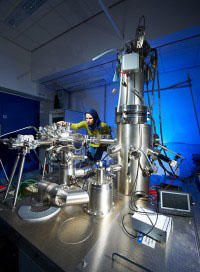
    Nano-factory to provide great things for graphene science
    Researchers will use the new Graphene Laboratory to investigate the extraordinary properties of graphene. Credit: University of Bath

    The new laboratory, officially opened by our Vice-Chancellor Professor Dame Glynis Breakwell on Tuesday, May 1, forms part of the Center for Graphene Science, which brings together expertise at the Universities of Bath and Exeter.

    Professor Simon Bending from the University’s Department of Physics said: “Graphene is a remarkable material made of a single layer of carbon atoms. Combining high strength, transparency, and flexibility with excellent electrical and thermal conductivity, it has many potential applications.”

    The new laboratory at Bath is home to a range of state-of-the-art equipment, including a specially adapted scanning probe microscope – nicknamed the “nano-factory” – that can build new materials and create rapid prototypes of novel devices that have never been made before.

    Dr. Adelina Ilie, Lecturer in Physics, on whose research the instrument is based, explained: “The nano-factory works like a tiny stencil, which can spray patterns of different materials onto a layer of graphene. This allows us to build new types of devices directly onto graphene, layer by layer, to directly probe and exploit its unique properties.”

    Dr. Peter Sloan, Lecturer in Physics added: “With the nano-factory, we can also build up bespoke atomic-scale structures one atom at a time to link with the stenciled devices, making our new microscope world-leading.

    “Not only will we make prototypes of unique graphene-based devices, but we can also really play around with some exciting fundamental physics.”

    Researchers will also use the new Graphene Center Laboratory to investigate the extraordinary properties of carbon nanotubes, rolled sheets of graphene some 50,000 times narrower than a human hair.

    Dr. Ilie has combined nanotubes with other elements to make hybrid carbon nanomaterials that are electronically patterned like striped candy canes; the stripes are so narrow that electrons are “guided” along them, suggesting they could be used as electronic connections in a quantum computer.

    Dr. Ilie said: “This new laboratory will enable us to investigate the huge potential applications of graphene and carbon nanotubes – the sky’s the limit!”

    The Center for Graphene Science has been funded by strategic investments by the Universities of Bath and Exeter into materials research, and by a £5 million award from the EPSRC/HEFCE Science and Innovation Awards Scheme 2008.

    Never miss a breakthrough: Join the SciTechDaily newsletter.
    Follow us on Google and Google News.

    Graphene Nanomaterials Nanotechnology Nanotubes University of Bath
    Share. Facebook Twitter Pinterest LinkedIn Email Reddit

    Related Articles

    “Patterned Regrowth” May Lead to Graphene-Based Circuits

    “Closed-Edge Graphene Nanoribbons”

    Graphene Hot Electron Bolometer May Outperform Existing Technologies

    Multi-Walled Carbon Nanotubes May Eventually Replace Expensive Platinum Catalysts

    Balancing Between Life and Research

    Exploring Graphene-Based THz Devices

    2-D Boron has Potential Advantages over Carbon Nanotubes

    Nanosponges May Help With Environmental Cleanup

    Analyzing the Environmental Costs and Impacts of Technology

    Leave A Reply Cancel Reply

    • Facebook
    • Twitter
    • Pinterest
    • YouTube

    Don't Miss a Discovery

    Subscribe for the Latest in Science & Tech!

    Trending News

    Don’t Miss: A Brilliant Venus and Glowing Harvest Moon Light Up the Sky

    New Twist on the Einstein Problem Reveals Unexpected Physics

    JWST Captures Stunning Evidence of How Supermassive Black Holes Feed

    Early Exercise May Permanently Change How Much Energy the Body Uses To Move

    New Molecule Wipes Out Aggressive Lymphoma Tumors in Mice in Just 11 Days

    The Human Family Tree May Need a Major Rewrite

    Scientists Find a Surprising Cancer-Fighting Effect in Dark Sweet Cherries

    New AI Detects Hidden Warning Signs of Solar Eruptions Hours Before They Emerge

    Follow SciTechDaily
    • Facebook
    • Twitter
    • YouTube
    • Pinterest
    • Newsletter
    • RSS
    SciTech News
    • Biology News
    • Chemistry News
    • Earth News
    • Health News
    • Physics News
    • Science News
    • Space News
    • Technology News
    Recent Posts
    • Could Alien Life Be Conscious in Ways We Can’t Imagine?
    • Scientists Develop a Fruit Wash That Removes Pesticide Residues and Keeps Produce Fresh Longer
    • Scientists May Have Finally Explained Why Astronauts Get Constipated in Space
    • Pomegranates Could Unlock a New Treatment for Heart Failure
    • Africa’s Giant Herbivores Were Disappearing Millions of Years Before Humans Could Hunt Them
    Copyright © 1998 - 2026 SciTechDaily. All Rights Reserved.
    • Science News
    • About
    • Contact
    • Editorial Board
    • Privacy Policy
    • Terms of Use

    Type above and press Enter to search. Press Esc to cancel.