
Close Menu
    Facebook X (Twitter) Instagram
    SciTechDaily
    • Biology
    • Chemistry
    • Earth
    • Health
    • Physics
    • Science
    • Space
    • Technology
    Facebook X (Twitter) Pinterest YouTube RSS
    SciTechDaily
    Home»Health»Scientists Identify Structural Protein for the Diagnosis and Treatment of Depression
    Health

    Scientists Identify Structural Protein for the Diagnosis and Treatment of Depression

    By Society for Neuroscience,April 13, 2020No Comments2 Mins Read
    Facebook Twitter Pinterest Telegram LinkedIn WhatsApp Email Reddit
    Share
    Facebook Twitter LinkedIn Pinterest Telegram Email Reddit
    Depressed Sad Woman
    Tubulin could provide a diagnostic marker of depression and a target for antidepressant treatment.

    Tubulin traps important signaling molecules, leads to reduced brain messaging.

    Scientists have zeroed in on a structural protein as a new target for the diagnosis and treatment of depression, according to research recently published in JNeurosci.

    The protein tubulin provides structure to cells and assists in many cellular processes, but it also plays a role in depression. A modified form of tubulin anchors the protein Gαs to lipid rafts, fatty structures floating in the cell membrane. In depressed people, Gαs gets stuck in lipid rafts and cannot trigger the production of cAMP, a molecule necessary for quick messaging in the brain. Imaging studies have shown that people with depression have less cAMP in their brains, which is remedied after successful treatment.
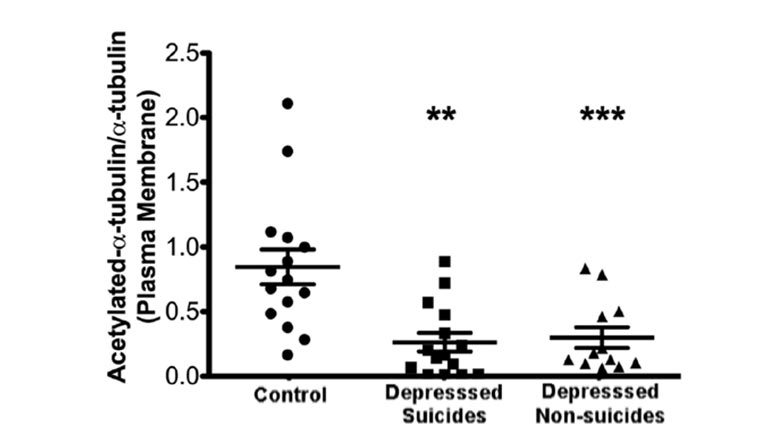
    Less Modified Tubulin Depressed Brain
    The brains of depressed people contain less modified tubulin in the plasma membrane. Credit: Singh et al., JNeurosci 2020

    Singh et al. examined the amount of modified tubulin in the brains from people who were not depressed as well as those from people with depression who died by suicide and by other causes. All the brains contained the same amount of modified tubulin, but the brains of people with depression had less modified tubulin in the lipid rafts. This could allow more tubulin to trap Gαs in the lipid rafts, preventing cAMP production. Tubulin could provide a diagnostic marker of depression and a target for antidepressant treatment.

    Reference: “Membrane-Associated α-Tubulin Is Less Acetylated in Postmortem Prefrontal Cortex From Depressed Subjects Relative to Controls: Cytoskeletal Dynamics, HDAC6 and Depression” by Harinder Singh, Justyna Chmura, Runa Bhaumik, Ghanshyam N. Pandey, Mark M. Rasenick and Jesse Brown, 13 April 2020, JNeurosci.
    DOI: 10.1523/JNEUROSCI.3033-19.2020

    Never miss a breakthrough: Join the SciTechDaily newsletter.
    Follow us on Google and Google News.

    Cell Biology Depression Mental Health Neuroscience Society for Neuroscience
    Share. Facebook Twitter Pinterest LinkedIn Email Reddit

    Related Articles

    Antidepressant Power of Lactate Revealed in New Research

    Suffering in Silence: Two-Thirds of Seniors Say They Won’t Treat Their Depression

    Single Brain Region Links Depression, Anxiety and Heart Disease

    Prenatal Depression Weakens Child’s Brain Connectivity – Associated With Increased Aggression and Hyperactivity

    Lithium in Public Drinking Water May Have an Anti-suicidal Effect – “Magic Ion” Has Potential to Improve Community Mental Health

    Neural Vulnerability in Huntington’s Disease Tied to Immune Response to Genetic Material

    Neuroscientists May Have Just Discovered Why Some People Are More Prone to Anxiety

    New Research Shows the Brain May Need Iron for Healthy Cognitive Development

    Ketamine Produces Rapid Antidepressant Responses

    Leave A Reply Cancel Reply

    • Facebook
    • Twitter
    • Pinterest
    • YouTube

    Don't Miss a Discovery

    Subscribe for the Latest in Science & Tech!

    Trending News

    Scientists Recreate a Nuclear Fireball and Uncover Fallout’s Hidden Chemistry

    These Tiny Gut Particles Could Be Accelerating Aging Throughout the Body

    Doctors Changed One Thing and Weight Gain Stopped

    Magnetic Fields May Solve a Longstanding Binary Star Mystery

    The Probiotic Breakthrough for Natural Anxiety Relief and Better Mental Health

    Animal vs. Plant Protein: Scientists Found a Surprising Nutritional Difference

    According to Scientists, This Simple Dietary Change Is Linked to Lower Depression Scores

    Researchers Discover a Hidden Vitamin D Problem That Persists Year-Round

    Follow SciTechDaily
    • Facebook
    • Twitter
    • YouTube
    • Pinterest
    • Newsletter
    • RSS
    SciTech News
    • Biology News
    • Chemistry News
    • Earth News
    • Health News
    • Physics News
    • Science News
    • Space News
    • Technology News
    Recent Posts
    • Mini Brain Organoids Expose Hidden Biological Differences in Alzheimer’s Disease
    • Scientists Recommend Doing This To Reduce Anxiety During Pregnancy
    • Scientists Reveal What Happened When 12 People Were Trapped Together in Antarctica for 10 Months
    • Buried for 1.7 Billion Years: These Ancient Fossils May Rewrite the Story of Complex Life
    • NASA Spots Giant Ocean Swell Signaling a Potential El Niño Comeback
    Copyright © 1998 - 2026 SciTechDaily. All Rights Reserved.
    • Science News
    • About
    • Contact
    • Editorial Board
    • Privacy Policy
    • Terms of Use

    Type above and press Enter to search. Press Esc to cancel.