
Close Menu
    Facebook X (Twitter) Instagram
    SciTechDaily
    • Biology
    • Chemistry
    • Earth
    • Health
    • Physics
    • Science
    • Space
    • Technology
    Facebook X (Twitter) Pinterest YouTube RSS
    SciTechDaily
    Home»Health»New Research Shows the Brain May Need Iron for Healthy Cognitive Development
    Health

    New Research Shows the Brain May Need Iron for Healthy Cognitive Development

    By Society for NeuroscienceJanuary 27, 2020No Comments2 Mins Read
    Facebook Twitter Pinterest Telegram LinkedIn WhatsApp Email Reddit
    Share
    Facebook Twitter LinkedIn Pinterest Telegram Email Reddit
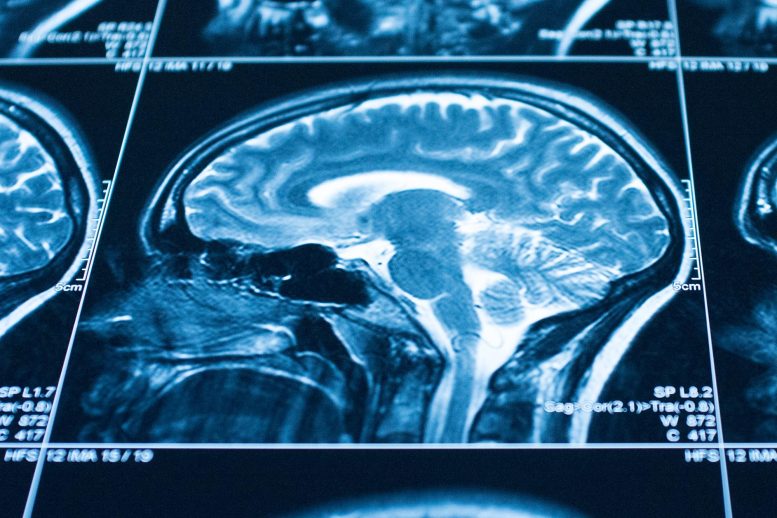
    Brain Scan MRI
    Research in children and young adults shows that iron levels in brain tissue rise during development and are correlated with cognitive abilities.

    Brain iron levels increase during development; may influence cognitive abilities.

    Iron levels in brain tissue rise during development and are correlated with cognitive abilities, according to research in children and young adults published today (January 27, 2020) in JNeurosci. Future work could lead to iron supplementation as an intervention for atypical cognitive development.

    Brain cells stay healthy in part by storing iron. It is most concentrated in the basal ganglia, a brain region that filters incoming information from moment to moment and suggests the best action to take. Low iron in the basal ganglia during early life is linked to cognitive impairment, yet we don’t know how iron levels change during typical development.
    Brain Iron Cognitive Development
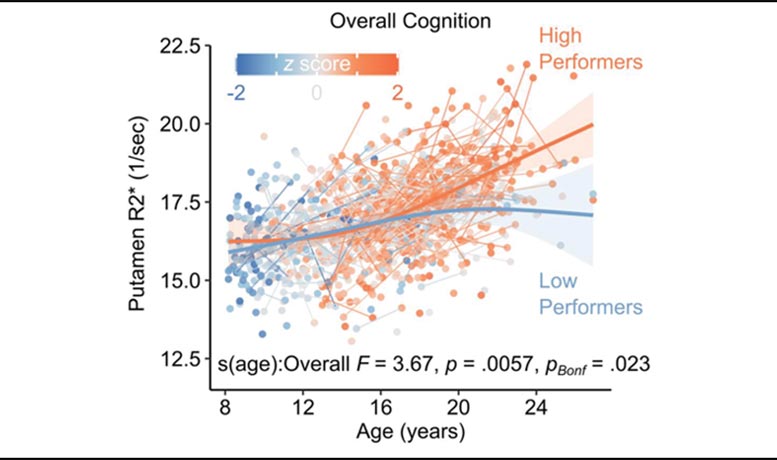
    Higher levels of brain iron in the putamen are correlated with greater cognitive abilities. Credit: Larsen et al., JNeurosci 2020

    Larsen et al. examined brain iron levels through magnetic resonance imaging brain scans from the Philadelphia Neurodevelopmental Cohort, a dataset of scans from over 1500 children and young adults ranging from age eight to twenty-four. The research team found that brain iron levels in the basal ganglia steadily increase throughout development and, in two subregions, continue to increase into adulthood. Decreased brain iron in one subregion, the putamen, was correlated with impaired performance on cognitive tasks involving reasoning and spatial processing, suggesting that brain iron is needed for healthy cognitive development.

    Reference: “Longitudinal Development of Brain Iron Is Linked to Cognition in Youth” by Bart Larsen, Josiane Bourque, Tyler M. Moore, Azeez Adebimpe, Monica E. Calkins, Mark A. Elliott, Ruben C. Gur, Raquel E. Gur, Paul J. Moberg, David R. Roalf, Kosha Ruparel, Bruce I. Turetsky, Simon N. Vandekar, Daniel H. Wolf, Russell T. Shinohara and Theodore D. Satterthwaite, 27 January 2020, JNeurosci.
    DOI: 10.1523/JNEUROSCI.2434-19.2020

    Never miss a breakthrough: Join the SciTechDaily newsletter.
    Follow us on Google and Google News.

    Brain Cell Biology Neuroscience Nutrition Society for Neuroscience
    Share. Facebook Twitter Pinterest LinkedIn Email Reddit

    Related Articles

    Antidepressant Power of Lactate Revealed in New Research

    Rapid Mental Rejuvenation: Experimental Drug Reverses Age-Related Cognitive Decline Within Days

    Can Drinking Cocoa Make You Smarter? Cocoa Flavanols Found to Boost Brain Oxygenation and Cognition

    Century-Old Scientific Debate Settled: Anesthesia’s Effect on Consciousness Solved

    Scientists Identify Structural Protein for the Diagnosis and Treatment of Depression

    Lactation Changes Electrical Signaling in Mom’s Brain – But It’s Reversible

    Chasing the Rush: Sugar Actually Changes the Chemistry of Your Brain

    Brain Waves of Sleeping Sheep Maaay Offer Clues to Human Brain Disease

    Common Nutrient Supplement May Prevent Alzheimer’s Disease

    Leave A Reply Cancel Reply

    • Facebook
    • Twitter
    • Pinterest
    • YouTube

    Don't Miss a Discovery

    Subscribe for the Latest in Science & Tech!

    Trending News

    Magnetic Bacterium Extends Lifespan by 43% in Surprising Anti-Aging Study

    Archaeologists Discover Evidence of “Brands” 3,200 Years Before Modern Capitalism

    The Rare Vision Side Effect of Ozempic and Wegovy You Should Know About

    Hidden Deep Beneath Mars, Scientists Find Evidence of a Vast Magmatic System

    Your Gut Microbiome May Be Contagious, Scientists Discover

    Scientists Find a Troubling Effect of Sitting That Exercise Couldn’t Prevent

    125-Million-Year-Old Crocodile Fossil Reveals Astonishing New Secrets

    Scientists Discover an “Impossible” Way Muscle Filaments Can Grow

    Follow SciTechDaily
    • Facebook
    • Twitter
    • YouTube
    • Pinterest
    • Newsletter
    • RSS
    SciTech News
    • Biology News
    • Chemistry News
    • Earth News
    • Health News
    • Physics News
    • Science News
    • Space News
    • Technology News
    Recent Posts
    • Scientists Discover an Unexpected Mental Health Benefit of Ozempic
    • Paleontologists Spent 20 Years Dating Thousands of Fossils – Here’s What They Found
    • Dead Sea Scrolls May Solve a Decades-Old Mystery About the Qumran Calendar
    • Study Challenges a Decades-Old Belief About Why Children Struggle To Read
    • Scientists Discover a “Loose Cannon” Virus Enzyme That Rewires Nearly Every Protein in a Bacterial Cell
    Copyright © 1998 - 2026 SciTechDaily. All Rights Reserved.
    • Science News
    • About
    • Contact
    • Editorial Board
    • Privacy Policy
    • Terms of Use

    Type above and press Enter to search. Press Esc to cancel.